
Quick Answer
To verify IPX8 waterproof claims for bone conduction headphones, buyers should request evidence tied to the exact product model and configuration, including the applicable test method, immersion conditions, test date, sample identification, and acceptance criteria. They should also confirm whether the tested sample matches the proposed production design and how water-resistance controls are maintained during assembly. An IPX8 claim alone does not establish a universal depth, duration, swimming suitability, or guaranteed performance across every production unit.
Detailed Explanation
1. Understand What an IPX8 Rating Establishes
IPX8 is part of the IP Code defined in IEC 60529, which classifies protection provided by enclosures against certain forms of ingress. The numeral 8 relates to immersion under conditions specified for the product. Those conditions must be understood before buyers decide whether a product is suitable for its intended use.
An IPX8 claim should not automatically be interpreted as a fixed water depth, a universal immersion duration, or proof that a headphone is suitable for every swimming environment. Nor does it establish resistance to every form of water exposure, such as high-pressure water jets, unless the applicable requirements have also been addressed.
For procurement purposes, ask the supplier to state exactly what the claim covers and which test conditions support it. This is more useful than relying on a product listing that simply says “waterproof.”
2. Verify the Exact Model and Configuration
A test result is meaningful only when the tested sample can be linked to the product being purchased. Confirm the model number, hardware revision, enclosure design, charging interface, buttons, seals, and other relevant construction details.
For bone conduction headphones, even a seemingly small design change can affect potential water-entry paths. Changes to an enclosure joint, cable entry, charging contacts, adhesive, or assembly process may mean that earlier test evidence no longer represents the revised configuration.
Ask the manufacturer to identify the tested sample and confirm whether the quoted production model is identical or has documented differences. If a change has been made, request an explanation of its impact and whether additional validation is needed.
3. Request the Test Method and Actual Conditions
Ask for the test procedure or applicable standard reference, together with the conditions used for the tested sample. The information should be specific enough for your technical team to compare the test with the intended product use.
For additional context on water-related environmental testing, buyers can also consult IEC 60068-2-18, while confirming which test requirements apply to the specific product and its IPX8 claim.
Request details such as:
- The test standard or documented internal procedure, including its revision where applicable.
- Immersion conditions, including the specified depth or pressure and duration.
- Sample quantity and sample identification.
- Any preconditioning or preparation required before testing.
- The acceptance criteria and the observations used to determine pass or fail.
- Any post-test functional checks or inspection requirements.
If a supplier mentions a “30 m deep water pressure testing chamber,” treat that as a capability to verify, not proof of product performance. Ask whether the equipment exists, whether it is suitable for the required test, and whether the specific model was tested under documented conditions. A chamber’s maximum capability alone does not establish that a product passed a particular test.
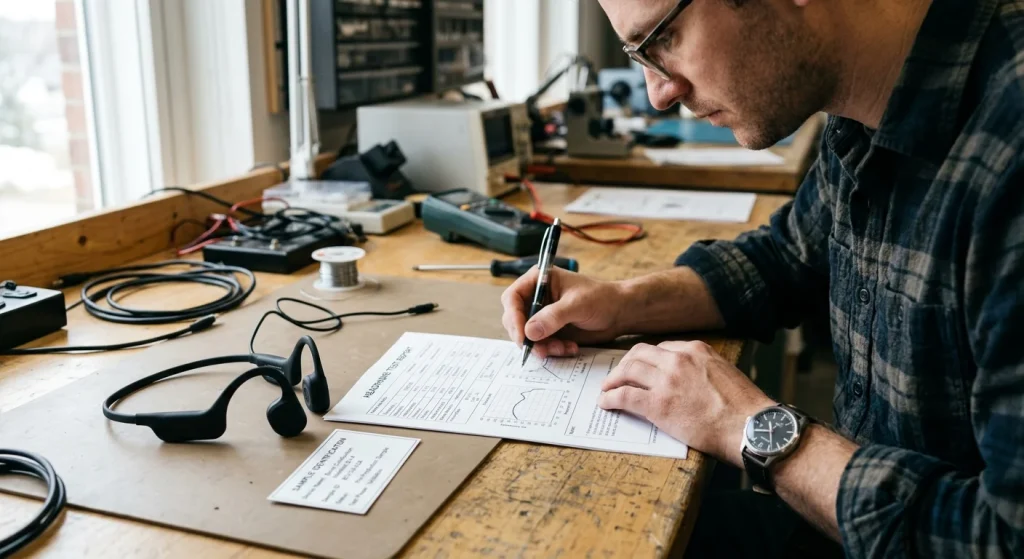
4. Review the Report, Sample Identity, and Test Date
Do not evaluate a report based only on a cover page, a photograph of a product in water, or a statement that testing was completed.
Check whether the report identifies the product model, sample configuration, test conditions, test date, results, and acceptance criteria. Where applicable, confirm the testing organization and whether its stated scope covers the work performed.
Also ask whether the tested sample was an engineering prototype, a pre-production sample, or a sample from routine production. These distinctions help establish how closely the evidence represents the product you will receive.
If a complete report cannot be shared for legitimate confidentiality reasons, ask whether a redacted report or controlled summary can be provided. The alternative should still identify the tested model, relevant conditions, result, and basis for the claim.
5. Separate Sample Validation from Mass-Production Consistency
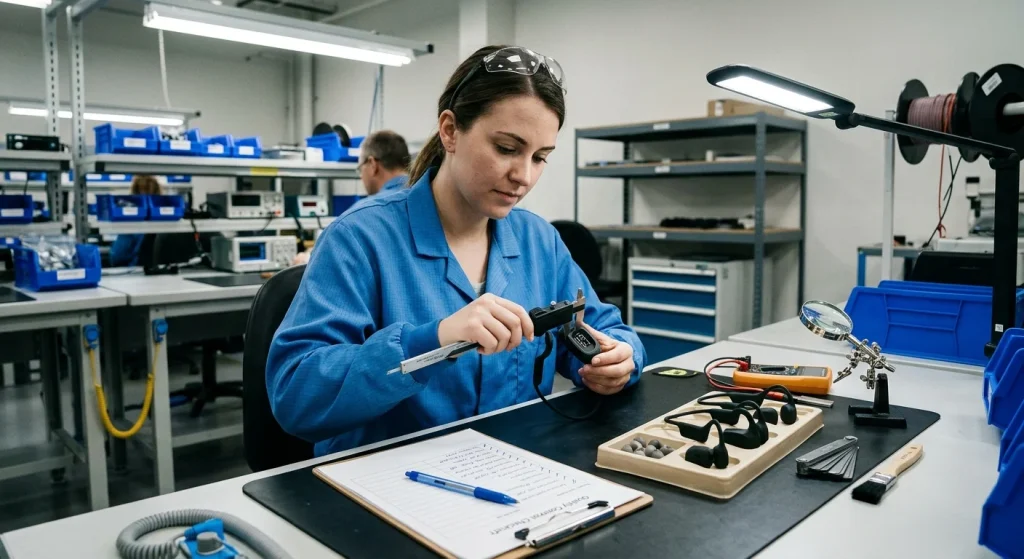
A passing test on one sample does not automatically demonstrate consistent water resistance across all production units. Sample validation and ongoing production control answer different questions: the first evaluates a defined sample under stated conditions; the second addresses whether units continue to meet the agreed requirements.
Ask how the manufacturer controls relevant assembly operations, including seal installation, adhesive application where applicable, enclosure closure, charging-interface protection, and inspection. Request the actual control plan or inspection records available for the proposed product rather than assuming a particular process or test is used.
Buyers should also agree on what happens when a unit fails inspection, a process changes, or a design revision is introduced. Retesting and corrective-action requirements should be defined according to the product risk and the agreed quality plan.
6. Review Design Changes and Water-Resistance Controls
Water resistance can depend on the combined performance of enclosure geometry, seals, material interfaces, charging arrangements, and assembly quality. A coating may be one element of a design, but the existence of a coating alone does not prove an IPX8 rating.
When evaluating a [custom headphones manufacturer], ask which features are critical to the approved water-resistance design and how changes are reviewed. If the supplier refers to nano waterproof coating, specialized assembly equipment, or pressure-testing facilities, request evidence relevant to the actual product and process.
Do not assume every model uses the same waterproofing method. Different product designs may require different engineering solutions and validation plans.
7. Define the Intended Underwater Use
Before approving a product, specify whether it is intended for swimming, surface-water activities, general outdoor use, or another application. If the headphone includes local MP3 playback, Bluetooth connectivity, or dual-mode operation, clarify which functions must operate before, during, and after the specified water exposure.
Bluetooth behavior underwater should be evaluated separately from enclosure water resistance. A product may maintain its physical integrity under a defined immersion test without providing continuous wireless connectivity in that environment.
Ask the supplier to distinguish verified performance from design intent and untested assumptions. Where swimming is the intended use, define the relevant conditions and required functional checks explicitly.
8. Agree on Acceptance Criteria Before Production
Before issuing production approval, document the exact model and revision, the evidence required, the test conditions, the pass/fail criteria, and the handling of design or process changes. Clarify whether water-resistance validation is required for engineering samples, pre-production units, routine production, or selected stages of the quality plan.
Also establish who approves deviations, how failed samples are investigated, and what documentation is delivered with the project. These decisions are more useful than a general promise that the product is waterproof.
For a broader overview of a [custom headphones OEM/ODM project], review how specifications, sample validation, testing, and bulk production fit together.
Comparison Table: Evidence Buyers Should Request
| Evidence item | What to verify | Why it matters |
|---|---|---|
| IPX8 claim | Applicable standard or documented test procedure | Clarifies the basis of the claim |
| Model identification | Model number, revision, and configuration | Connects evidence to the purchased product |
| Test conditions | Immersion conditions and duration | Defines the limits of the result |
| Test report | Date, sample ID, observations, and result | Supports traceability |
| Acceptance criteria | Defined pass/fail requirements | Reduces ambiguity during approval |
| Production controls | Relevant assembly and inspection records | Helps evaluate consistency beyond a single sample |
| Change management | Revalidation requirements after changes | Protects the approved product configuration |
Industry Insight
In OEM/ODM projects, waterproof performance is not just a product-page specification. It is a requirement that connects engineering design, sample validation, production control, and customer acceptance.
A supplier may have experience with waterproof audio products, but that experience should not be treated as evidence that every model has the same rating or has passed the same test. Buyers should evaluate the evidence for the selected configuration and agree on the conditions under which the claim is valid.
The same principle applies when comparing suppliers. One supplier may provide a detailed report and traceable sample identification, while another may provide only a rating statement. The quality and relevance of the evidence are more informative than the wording of the claim alone.
Buyer Tips
- Request model-specific evidence before approving an IPX8 claim.
- Record the test conditions and acceptance criteria in the product specification.
- Confirm whether the tested sample matches the proposed production revision.
- Ask how relevant assembly and inspection processes are controlled.
- Define retesting or review requirements for changes to seals, enclosure design, charging interfaces, or assembly methods.
Common Mistakes
- Treating IPX8 as a universal depth or duration. The actual test conditions must be confirmed for the product.
- Accepting a generic report. Evidence for a similar model may not apply to the selected configuration.
- Assuming a sample pass guarantees mass-production consistency. Ongoing process controls and agreed acceptance criteria remain necessary.
Key Takeaway
To verify IPX8 waterproof claims for bone conduction headphones, buyers need more than a rating printed on a specification sheet. They should review the exact model, test conditions, report traceability, acceptance criteria, and relevant production controls. The intended underwater use must also be defined clearly. When these requirements are agreed before production, buyers can make a better-informed approval decision and reduce uncertainty about whether the tested product matches the product they intend to purchase.
Related Questions
- What Specifications Should You Prepare Before Requesting a Custom Headphones Quote?
- How Should Buyers Evaluate Headphone Prototype Samples Before Mass Production?
- What Testing Should Be Completed Before Approving Custom Headphones for Production?
- How Can Buyers Assess a Headphone Manufacturer’s Quality Control Process?
- What Should Buyers Confirm Before Approving a Custom Headphones Production Run?
CTA
Planning a custom bone conduction headphone project? Prepare your intended use, target market, product configuration, and required water-resistance conditions before requesting a quotation. Ask potential manufacturing partners to identify the evidence available for the selected model and explain how design changes and production controls will be managed. A clear technical brief helps both sides assess feasibility and define the validation work required before production approval.