

Quick Answer
When preparing custom headphones specifications before requesting a quote, buyers should document the product category, intended use, target market, physical design, audio requirements, branding, packaging, estimated order quantity, and sample expectations. Available drawings, reference products, and acceptance criteria can help a manufacturer assess feasibility and identify missing information. If some requirements are not yet finalized, list them as open questions rather than making assumptions.
Detailed Explanation
1. Define the Product Category, Target Users, and Intended Use
Start by identifying the type of headphones you want to develop or customize. For example, the product may be open-ear sports headphones, bone-conduction headphones, swimming headphones, or another audio category.

Explain who will use the product and in what conditions. Running, cycling, fitness training, swimming, commuting, and general daily use can involve different requirements for wearing stability, controls, water resistance, and audio functionality.
Also clarify whether you need an existing model with modifications, a private-label product, or a more extensively customized design. The scope of customization affects which technical details the manufacturer needs to review before quoting.
2. Identify Target Markets and Compliance Requirements
Tell the manufacturer which countries or regions you intend to serve, such as the United States, Canada, the United Kingdom, or the European Union.
The destination market can affect applicable regulatory requirements, product labeling, packaging information, wireless compliance, battery documentation, and other import-related considerations. The exact requirements depend on the product configuration, radio functions, battery type, and intended market.
If you already have compliance requirements from your sales channels or distribution partners, include them in the brief. If you are uncertain, ask the manufacturer to identify which requirements need further verification. Do not assume that an existing model’s documentation automatically covers every customized configuration or destination market.
3. Describe the Physical Design and Wearing Style
Provide the physical characteristics that matter to your product concept. These may include the wearing style, housing shape, preferred materials, product color, control layout, cable arrangement, and accessories.
If you have a reference product, provide photographs or a sample and explain which characteristics you want to retain or change. A reference image communicates appearance, but it may not reveal internal construction, dimensions, or material specifications.
Separate essential requirements from preferences. For example, a particular wearing structure may be mandatory, while the exact shade of a housing color may remain open for sampling.
4. Specify Audio, Connectivity, Battery, and Waterproofing Requirements
List the functions that the product must support instead of simply requesting a feature-rich headphone.
| Specification area | Information to prepare |
|---|---|
| Audio | Intended listening use, sound preferences, microphone requirements, and any defined acoustic targets |
| Bluetooth | Required wireless functions, pairing behavior, and compatibility expectations |
| MP3 playback | Whether standalone playback is required, including relevant file and storage expectations |
| Battery | Desired usage expectations, charging method, and any established battery requirements |
| Microphone | Whether voice calls, voice recording, or other microphone functions are required |
| Waterproofing | Intended exposure, such as sweat, rain, or swimming, and any required protection level |
| Controls | Preferred physical buttons, control functions, and operating behavior |
Not every function is available on every model, and combining features may affect the design, component configuration, cost, and development scope. Ask the manufacturer to confirm feasibility for the selected product rather than assuming that all requested functions can be combined without changes.
For swimming products, clearly distinguish the intended underwater use from ordinary sweat resistance or rain protection. The appropriate specification depends on the intended application and must be confirmed for the selected model.
5. Clarify Branding, Packaging, and Labeling
For private-label projects, specify how your brand should appear on the product and its packaging.
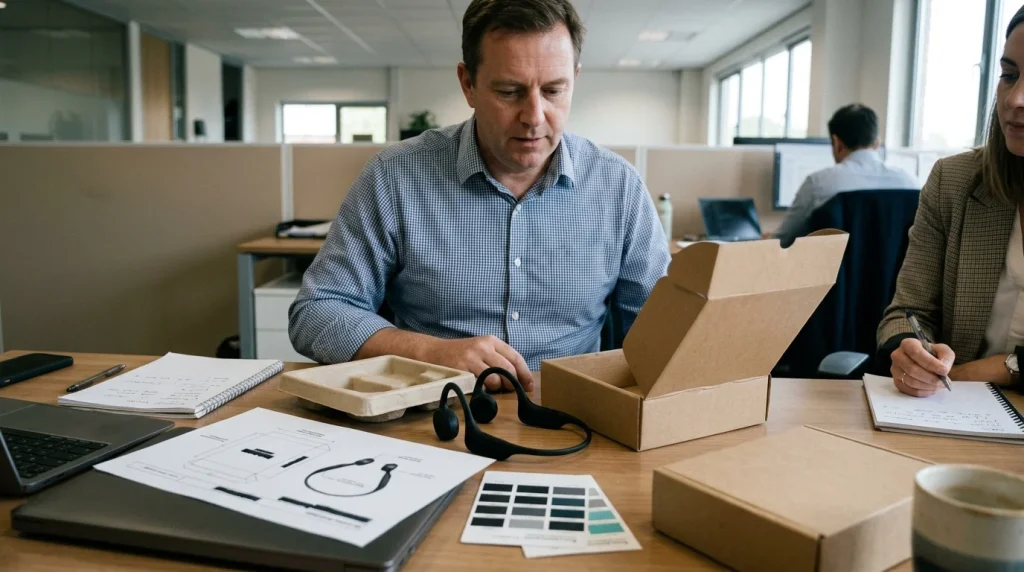
Possible requirements include a printed or laser-engraved logo, housing color customization, branded retail boxes, accessories, user manuals, and product labels. Provide logo artwork in an appropriate source format when available, together with any placement, size, or color restrictions.
Packaging requirements should distinguish retail presentation from shipping protection. If your distribution channel has specific labeling or packaging rules, provide them before the quotation is finalized.
The manufacturer should confirm which branding and packaging options are supported by the selected model and whether additional preparation, artwork approval, or other project-specific work is required.
6. State the Target Order Quantity and Sample Expectations
Provide your estimated initial order quantity and expected purchasing pattern. If you are evaluating a new product, distinguish the quantity for sample evaluation from the potential first production order and any later replenishment estimates.
Do not assume that a manufacturer’s standard MOQ automatically applies to every customization. A trial order involving an existing model may have different requirements from a project involving custom components, colors, packaging, or structural changes.
Also explain what you need from the sample. You may want to review appearance, wearing comfort, basic functions, branding, or a more developed product configuration. The sample scope should be clear enough for the supplier to determine what can be evaluated at that stage.
7. Prepare Drawings, Reference Products, and Acceptance Criteria
Useful supporting materials may include:
- Product photographs, reference models, and competitor examples used for design reference.
- Industrial design sketches, dimensioned drawings, or available CAD files.
- Logo artwork, color references, packaging dielines, and label requirements.
- A feature checklist separating mandatory functions from optional requests.
- Known technical requirements and relevant compliance documentation.
- Acceptance criteria for appearance, functionality, fit, and other important product characteristics.
You do not need to have every document completed before making an initial inquiry. Instead, identify what is available, what is still under discussion, and which details require the manufacturer’s input.
8. Make Quotations Comparable
When contacting multiple manufacturers, send the same core brief to each supplier. Ask them to identify the proposed model or configuration, included customization, exclusions, assumptions, sample scope, MOQ, and any additional development or tooling requirements relevant to the project.
This is particularly important when comparing a standard product with a more customized proposal. Two quotations may appear similar while covering different materials, branding methods, packaging specifications, or functional requirements.
A clear brief does not guarantee identical quotations, but it makes differences easier to identify and helps you evaluate whether each supplier is pricing the same product scope.
Comparison Table
| Information status | What to provide | Quotation impact |
|---|---|---|
| Confirmed | Required product category, essential functions, target market, and branding direction | Gives the supplier a defined basis for evaluation |
| Estimated | Initial order quantity, preferred materials, and sample objectives | Helps the supplier identify assumptions requiring confirmation |
| Open for discussion | Unfinalized design details, optional features, and packaging alternatives | Allows the supplier to identify possible options and trade-offs |
| Not yet available | Missing drawings, technical targets, or compliance information | May limit the precision of the initial quotation until clarified |
Comparison Table note: The purpose of this table is to distinguish confirmed requirements from unresolved decisions, not to compare individual manufacturers.
Industry Insight
In custom headphone sourcing, the main quotation challenge is often not the number of specifications but the difference between what the buyer assumes and what the supplier has actually included.
For example, a request for a waterproof sports headphone with a custom logo may refer to an existing model with a supported branding option, or it may imply changes to the housing, materials, sealing structure, or other components. Those are materially different project scopes.
Buyers can reduce ambiguity by recording each requirement as mandatory, preferred, or undecided. They should also ask suppliers to state the assumptions behind their quotations and flag requirements that need technical review. This approach helps procurement teams compare proposals based on equivalent product configurations rather than headline prices alone.
Buyer Tips
- Prepare a one-page product brief first. Identify the product category, intended users, target market, essential features, branding direction, and estimated initial quantity.
- Separate required features from optional requests. This helps manufacturers distinguish essential specifications from features that may be adjusted to meet technical or commercial constraints.
- Send reference materials with explanations. Mark which aspects of a reference product matter, such as its wearing structure, color, controls, or packaging, rather than expecting the supplier to infer your intentions.
- Request clarification of quotation assumptions. Ask suppliers to identify the model, included customization, exclusions, and unresolved technical questions.
- Define what sample approval means. Specify the appearance, functions, or other characteristics you intend to evaluate, and distinguish preliminary review from final product acceptance.
Common Mistakes
Mistake 1: Requesting a Quote with Only a Product Name
Risk: Different manufacturers may interpret the request as different product categories, configurations, or levels of customization.
How to avoid it: Provide a brief covering intended use, essential functions, branding, target market, and estimated quantity.
Mistake 2: Listing Every Possible Feature Without Prioritizing Them
Risk: The proposed configuration may be technically unsuitable, unnecessarily complex, or more expensive than the intended product requires.
How to avoid it: Separate mandatory functions from optional features and ask the supplier to confirm which combinations are feasible for the selected model.
Mistake 3: Comparing Quotations with Different Inclusions
Risk: A lower quotation may exclude packaging customization, sample work, or other requirements included in another proposal.
How to avoid it: Use the same brief for each supplier and compare the specified configuration, customization scope, exclusions, and assumptions.
Key Takeaway
A useful custom headphone quotation begins with a clear product brief, not a long list of unprioritized features. Prepare the information you already know, label estimates and unresolved decisions, and provide reference materials wherever possible. Then ask each manufacturer to confirm feasibility and state exactly what its quotation covers. This makes supplier responses easier to evaluate and gives the project a more reliable starting point for sample planning and further technical discussions.
Related Questions
The other five FAQ titles from the current weekly cluster were not included in the supplied configuration. The following are proposed related questions based on the topics identified as belonging to other Supporting FAQs; replace them with the approved cluster titles if they differ.
- What Should You Check When Evaluating Custom Headphone Samples?
- What Testing Requirements Should You Confirm Before Ordering Custom Headphones?
- How Do Audio Chip and Feature Requirements Affect Custom Headphone Development?
- When Does a Custom Headphones Project Require CNC Prototyping or Injection Molding?
- What Shipping and Logistics Details Should You Confirm for a Custom Headphones Order?
CTA
Preparing a custom headphone project for quotation? Share your intended product category, target market, essential functions, branding requirements, estimated order quantity, and any available reference materials. The YONG YUNG team can discuss the proposed requirements and help identify which details need further confirmation before a quotation can be prepared. Final feasibility, MOQ, cost, and development requirements depend on the selected model and customization scope.