
Quick Answer
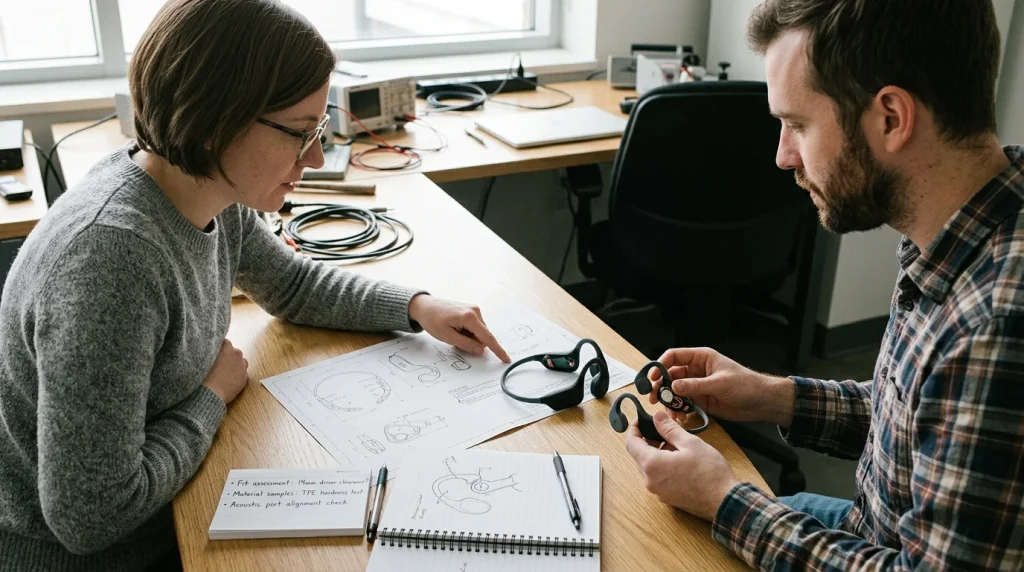
A headphone ODM turnkey product development workflow is a structured process that coordinates product requirements, industrial design, engineering, prototyping, design for manufacturing (DFM), tooling, validation, and production preparation. The ODM supplier manages or coordinates the agreed development activities, while the buyer approves key specifications, design decisions, budgets, and acceptance criteria. Before starting, both parties should define the project scope, responsibilities, deliverables, and approval milestones to reduce avoidable redesigns and production risks.
Detailed Explanation
What Does a Turnkey Headphone ODM Workflow Include?
A turnkey workflow connects the main development activities into a coordinated process rather than treating design, engineering, and manufacturing as separate tasks. Depending on the supplier’s capabilities and the agreed project scope, the process may cover the following stages.
Stage 1: Define Product Requirements and Project Scope
The process begins with a product brief. The buyer should explain the intended market, target users, product category, essential functions, industrial design direction, commercial constraints, and expected sales channels.
For sports audio, the brief may also specify wearing comfort, fit stability, sweat resistance, water exposure, battery expectations, Bluetooth behavior, microphone requirements, and physical control preferences. These are project requirements, not assumptions that every ODM supplier can automatically satisfy.
The buyer and supplier should distinguish mandatory requirements from optional features. They should also document which decisions require buyer approval and which activities the supplier is responsible for coordinating.
Stage 2: Review the Industrial Design and Establish Engineering Feasibility
An initial sketch or industrial design concept communicates the intended appearance, but it does not necessarily establish that the product can be manufactured reliably.
The supplier and relevant engineering personnel need to review the available design information, component space, assembly constraints, material choices, acoustic considerations, and mechanical structure. For open-ear or bone-conduction headphones, the review may also consider contact points, wearing stability, transducer placement, and the relationship between the housing and the intended acoustic performance.
The output should be an agreed engineering direction, with unresolved technical questions recorded for further investigation. The scope of this review depends on the information supplied and the engineering services included in the project.
Stage 3: Develop the Prototype and Review Design Feasibility
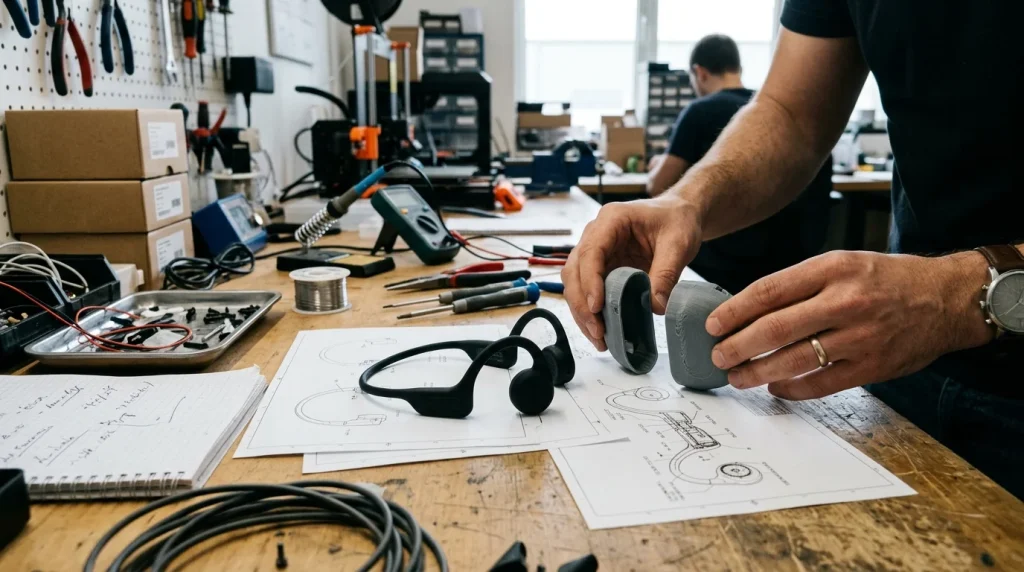
A prototype allows the project team to assess physical dimensions, appearance, wearing comfort, basic functional behavior, and identified technical risks before committing to production tooling.
Different prototypes serve different purposes. A visual mock-up may help evaluate shape and proportions, while an engineering prototype may be needed to investigate mechanical fit, electronics integration, or acoustic performance.
Buyers should confirm what each prototype is intended to demonstrate and what it cannot yet prove. A prototype that looks correct does not automatically establish production readiness, long-term reliability, or waterproof performance.
Stage 4: Conduct Design for Manufacturing (DFM)
Design for manufacturing evaluates whether the proposed product can be assembled and produced within the intended manufacturing process and quality requirements.
The review may examine part geometry, component availability, assembly sequence, fastening methods, material selection, tolerances, cable routing, sealing structures, and inspection accessibility. For waterproof sports headphones, the design team may also need to consider sealing interfaces and how the relevant assembly steps will be controlled and verified.
A DFM review should identify design concerns, proposed changes, and decisions requiring buyer approval. Changes that affect appearance, functionality, cost, or product performance should be documented rather than introduced without agreement.
For a broader view of supplier evaluation and development responsibilities, buyers can also review our guide, How to Choose a Headphone ODM Supplier: From Product Development to Mass Production.
Stage 5: Confirm Tooling and Prepare for Production
Once the design reaches the agreed level of maturity, the project may proceed to tooling and production-oriented samples, where applicable. The team should confirm the approved drawings, material specifications, component requirements, and revision status before authorizing irreversible manufacturing commitments.
Tooling readiness does not mean that every production risk has been resolved. Trial parts or samples may reveal fit, assembly, appearance, or functional issues that require corrective action.
Before moving forward, the buyer should understand which deliverables will be supplied, how design changes will be handled, and what evidence is required for approval.
Stage 6: Validate the Product and Establish Production Readiness
The final development stage checks the product against agreed requirements. Depending on the product and project scope, validation may include functional checks, acoustic evaluation, mechanical assessments, battery-related checks, environmental testing, or water-ingress testing where applicable.
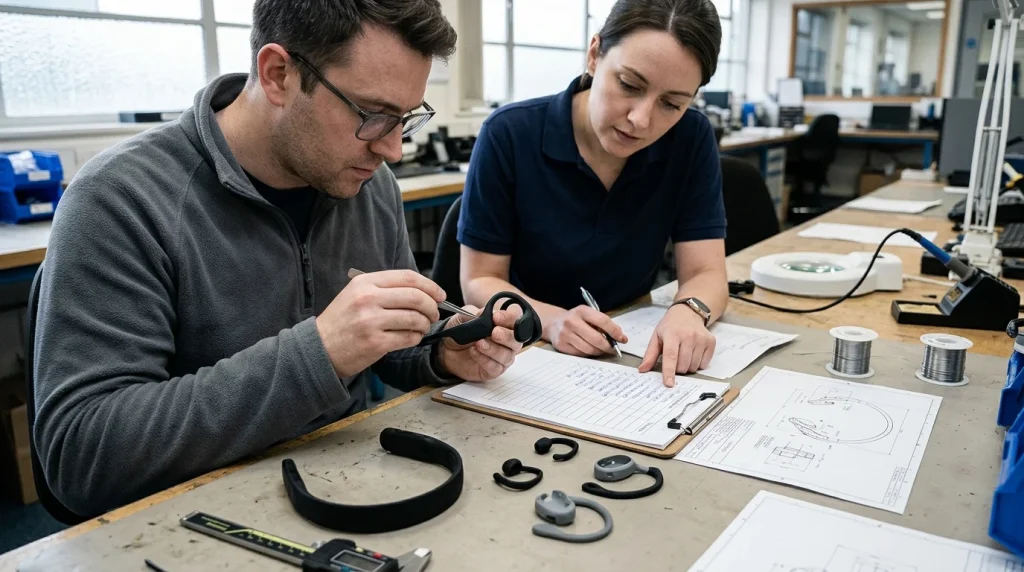
Testing must use appropriate methods and defined acceptance criteria. A supplier’s general statement that a product has been tested is not a substitute for reviewing the relevant test scope, conditions, results, and limitations.
The project team should resolve significant deviations, approve the applicable product specifications, and establish the inspection and quality-control requirements for production. Only then should the parties make a controlled transition to mass-production preparation.
How Should Buyers Define the ODM Workflow?
A turnkey arrangement does not necessarily mean that every development activity is performed in-house by one supplier. Some projects involve external engineering specialists, component vendors, tooling partners, or independent testing laboratories.
The buyer should therefore establish a responsibility matrix that identifies who performs each activity, who reviews the results, and who has final approval authority.
A practical workflow also needs clear stage gates. Each gate should identify the required deliverables, open issues, decision-maker, and conditions for proceeding. This gives both parties a common reference when design changes, technical constraints, or commercial decisions affect the development schedule.
Comparison Table
| Development stage | Main purpose | What buyers should verify | Potential risk |
|---|---|---|---|
| Requirements definition | Establish product objectives and constraints | Written brief, priorities, acceptance criteria | Unclear scope and repeated revisions |
| Engineering feasibility | Assess whether the concept can be implemented | Design assumptions, unresolved technical issues | Appearance-led decisions that overlook engineering constraints |
| Prototyping | Evaluate the concept and investigate risks | Prototype purpose, revision, review criteria | Treating a visual sample as a validated product |
| DFM review | Identify manufacturing and assembly concerns | Documented findings and approved changes | Late design changes and avoidable production problems |
| Tooling preparation | Translate the approved design into production-oriented parts | Drawing revision, tooling scope, approval responsibilities | Committing before key decisions are settled |
| Validation and production preparation | Check compliance with agreed product requirements | Test evidence, deviations, specifications, inspection criteria | Entering production with unresolved issues |
Industry Insight
In headphone development, the most important distinction is between coordinating a workflow and accepting responsibility for every technical outcome. An ODM supplier may manage several stages while relying on external partners for specialized engineering, tooling, or testing. Buyers should evaluate the actual scope of responsibility rather than relying on the term “turnkey” alone.
The quality of handoffs is equally important. An industrial design must be translated into engineering requirements; prototype findings must be reflected in approved revisions; and validation results must connect to production specifications. When these links are missing, teams can end up approving different versions of the same product.
A documented workflow helps buyers see where decisions are pending, who owns them, and what evidence supports each approval. It does not eliminate technical uncertainty, but it makes that uncertainty easier to identify and manage.
Buyer Tips
- Request a stage-by-stage development plan. Ask for the proposed activities, deliverables, decision gates, and dependencies rather than accepting a general promise of turnkey service.
- Clarify who performs each activity. Identify which work is completed by the ODM supplier and which may involve external engineers, tooling vendors, or testing laboratories.
- Define prototype acceptance criteria. State whether each sample is intended for appearance review, engineering evaluation, functional verification, or another specific purpose.
- Control design revisions. Establish a process for recording changes, reviewing their impact, and approving updated drawings or specifications before work proceeds.
- Agree on production-readiness evidence. Specify which test records, approved specifications, outstanding-issue reviews, and quality-control documents are required before the project advances.
Common Mistakes
Mistake 1: Assuming Turnkey Means Everything Is Included
Risk: The buyer may expect industrial design, acoustic engineering, tooling, certification testing, and production support to be included when the supplier’s actual scope covers only selected activities.
How to avoid it: Request a written scope of work that identifies included services, exclusions, external dependencies, deliverables, and additional approval requirements.
Mistake 2: Approving Tooling Before the Design Is Sufficiently Defined
Risk: Unresolved dimensions, component choices, or assembly constraints may lead to modifications, extra work, or delays.
How to avoid it: Establish a design-freeze or tooling-approval gate. Confirm the relevant drawings, critical interfaces, and outstanding issues before authorizing tooling.
Mistake 3: Treating a Successful Prototype as Proof of Mass-Production Readiness
Risk: A limited sample may not demonstrate repeatable assembly, reliability, or compliance with all intended product requirements.
How to avoid it: Separate prototype approval from validation and production-readiness approval. Define the required evidence for each stage and document any remaining limitations.
Key Takeaway
A headphone ODM turnkey workflow should provide more than a sequence of development activities. It should establish clear ownership, documented deliverables, controlled design revisions, and approval criteria from the initial product brief through production preparation. Buyers should evaluate whether the proposed process matches their product’s technical requirements and whether each stage produces sufficient evidence for the next decision. A clearly defined scope helps both parties manage uncertainty before manufacturing commitments become difficult to reverse.
Related Questions
- What Is Included in a Headphone ODM NRE Cost?
- How Does a Headphone ODM Supplier Turn an Industrial Design into a Production-Ready Product?
- What Engineering Capabilities Should a Headphone ODM Supplier Provide?
- How Do Headphone ODM Suppliers Test Products Before Mass Production?
- How Does IP Co-Development Work with a Headphone ODM Supplier?
CTA
Planning a new open-ear, bone-conduction, or other sports headphone product? Before development begins, prepare a brief covering the intended product form, essential functions, industrial design direction, target market, and validation requirements. The YONG YUNG team can discuss your project requirements and clarify which development activities, samples, and manufacturing deliverables would need to be confirmed for your proposed OEM/ODM arrangement.