
Private-label headphone customization allows brands to develop a product presentation that aligns with their visual identity, target customers, and sales channels. Depending on the headphone model and the supplier’s available processes, customization may include logo application, product colors, surface finishes, retail packaging, accessories, manuals, and product labels.
However, not every option is available for every model. Some changes use existing production processes, while others may require additional setup, material confirmation, artwork review, or custom development. Before approving a design, buyers should confirm which options are technically suitable, what they involve, and how the final requirements will be verified.
This guide explains the main customization areas and provides a practical checklist for reviewing branding and packaging before mass production.
Quick Answer
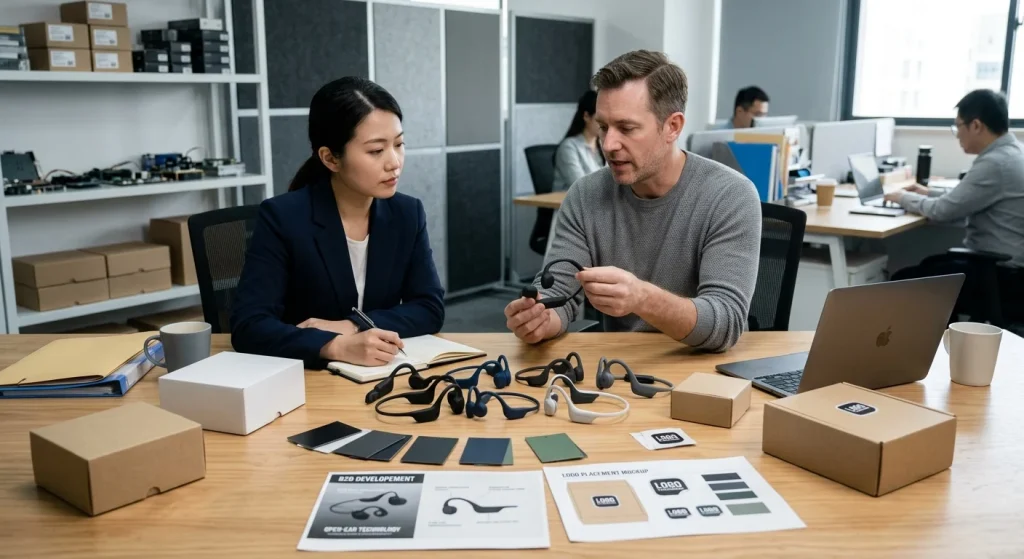
Private-label headphones can often be customized through logo application, selected colors and finishes, printed packaging, inserts, manuals, labels, and barcodes. The available options depend on the specific model, materials, production process, and target market. Buyers should confirm the permitted customization methods, prepare production-ready artwork, review physical samples where necessary, and document all approved details before authorizing bulk production.
Detailed Explanation
1. Logo Application Options and Suitability
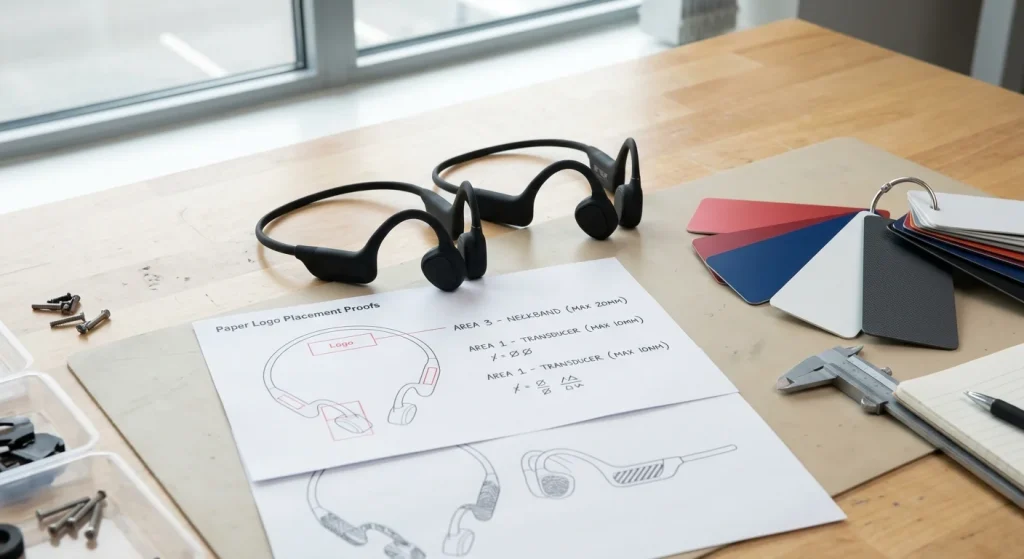
A logo is one of the most visible elements of a private-label headphone product. The appropriate application method depends on the product’s surface material, available space, design complexity, expected durability, and appearance requirements.
Common methods that buyers may ask suppliers about include:
- Laser engraving: May be suitable for certain materials and surface designs. Buyers should confirm whether the selected material produces a clear, consistent result and whether the method affects the surface finish.
- Printing: Can accommodate many logo designs, but suitability depends on the material, surface shape, ink system, and required durability.
- Molded or embossed marks: May be possible when the product structure and tooling support them. This option should not be assumed to be available on an existing model.
- Printed labels: May be appropriate for packaging, cartons, or certain product surfaces where direct application is unsuitable.
These are examples of methods to evaluate, not a guarantee that every method is available from every supplier.
Before selecting a method, provide the supplier with your logo artwork and ask for confirmation of the recommended process, usable placement area, minimum line or text requirements, color limitations, and any additional setup or tooling implications.
For a custom headphones manufacturer, a useful approval process should establish not only how the logo is applied, but also its position, size, orientation, color, and acceptable visual result.
2. Product Colors and Surface Finishes
Color customization can help a product match a brand’s visual identity or distinguish different models within a product range. Depending on the model, buyers may be able to choose from existing colors or request a custom color.
Surface finishes may also affect the final appearance. For example, a matte finish and a glossy finish can make the same color look different under the same lighting conditions.
Before confirming a color, buyers should ask:
- Which colors are currently available for this exact model?
- Is the requested color an existing option or a new development requirement?
- Does the color apply to the entire product or only selected components?
- Are there limitations caused by the material, coating, or manufacturing process?
- Will a physical sample be available for color approval?
- Could the request affect setup requirements, order quantities, cost, or lead time?
Do not rely on a screen image alone when color accuracy is important. Display settings, lighting, photography, and printed references can all influence perceived color.
If your brand uses defined color references, provide them to the supplier and agree on the method that will be used to evaluate the final sample. Record any approved color reference and the corresponding product components in the project documentation.
3. Retail Packaging, Printed Artwork, and Inserts
Packaging affects more than product appearance. It also influences product protection, storage, shipping, shelf presentation, and the unboxing experience.
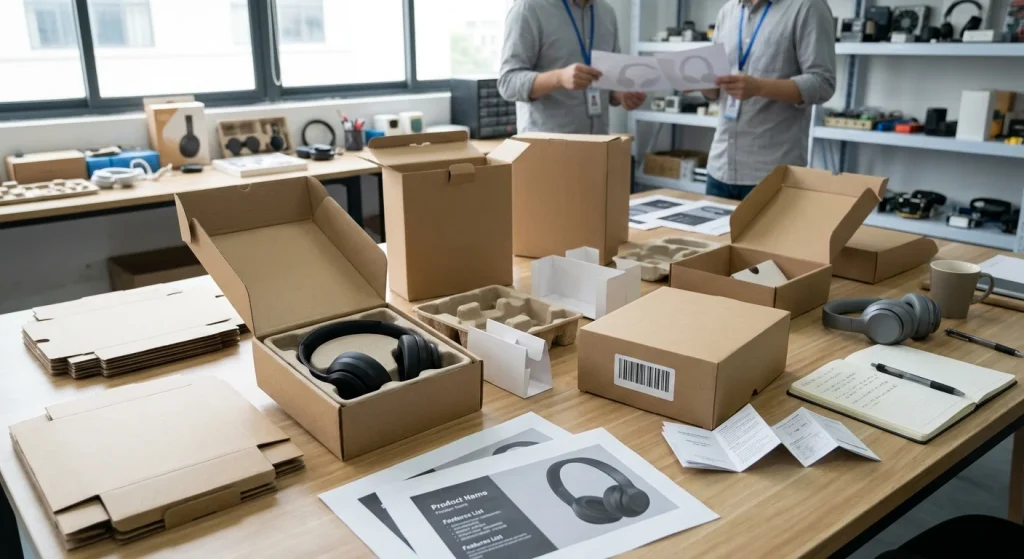
Depending on the selected packaging structure and supplier capabilities, customization may cover:
- Retail box structure and dimensions
- Printed graphics, colors, and brand marks
- Internal trays, supports, or protective inserts
- Product presentation and accessory arrangement
- Outer carton markings
- Packaging artwork and print finishes
A custom printed retail gift box packaging request should begin with the actual product dimensions, accessory list, protection requirements, and intended sales channel. A visually attractive box is not sufficient if it cannot protect the product or accommodate the included accessories.
Buyers should confirm the packaging structure before finalizing the artwork. If dimensions, inserts, or product contents change after approval, the artwork may need to be revised.
It is also important to distinguish standard packaging options from custom packaging development. An existing box design may require fewer changes than a new structure, but availability and cost depend on the supplier’s arrangements and the order requirements.
Before production, confirm the box dimensions, material, print specifications, insert layout, quantity per package, and any shipping-carton requirements. Request a physical packaging sample when fit, protection, or print quality is critical.
4. Manuals, Labels, Barcodes, and Market-Specific Information
Branding requirements often extend beyond the headphone itself and the retail box. Manuals, product labels, carton labels, and barcodes may all need to match the buyer’s product information and distribution plan.
Items to review include:
- Brand and product name
- Model number or SKU
- Instructions and safety information
- Language versions
- Barcode type and placement
- Importer or responsible-party information, where applicable
- Required warnings and market-specific information
- Shipping and warehouse labels
The exact requirements depend on the destination market, product category, sales channel, and applicable rules. Buyers should confirm these requirements with their compliance team or a qualified adviser rather than assuming that one label or manual is suitable worldwide.
For barcode planning, buyers can consult the official GS1 standards and identification resources to understand product identification requirements. The buyer should still confirm which barcode format and data are required by the intended retailer, distributor, or fulfillment channel.
If the product will be sold in multiple countries, prepare a market-by-market content checklist. Do not approve packaging artwork until the required languages, identifiers, warnings, and other applicable information have been reviewed.
5. Preparing Brand Assets and Approving Artwork
Incomplete or low-quality artwork can create avoidable revisions. Before requesting a final proof, buyers should prepare a consistent set of brand assets and product information.
A practical preparation list includes:
- Logo files: Supply suitable vector artwork where available, along with the approved color version and any permitted monochrome version.
- Brand colors: Provide the relevant color references and explain which components or packaging elements use each color.
- Product information: Confirm the product name, model number, SKU, included accessories, and any wording that must appear on the packaging.
- Packaging content: Supply the approved text, images, icons, barcodes, and required market information.
- Artwork instructions: Identify the intended placement, dimensions, orientation, and any areas where printing or marking must be avoided.
- Approval responsibility: Name the person or team authorized to approve the final artwork and sample.
Review the supplier’s proof carefully. Check spelling, logo proportions, color references, barcode placement, image resolution, alignment, and the relationship between the artwork and the actual package structure.
A digital proof is useful for checking layout, but it may not reveal every issue with physical color, surface texture, print finish, or fit. When these factors matter, request a representative sample before approving bulk production.
6. Review Samples Before Bulk Production
A sample review should verify that the approved branding instructions have been implemented as intended. Buyers should assess both the product and its packaging, rather than focusing only on the logo.
Use the following checklist during sample review:
- Is the logo in the approved position, size, orientation, and color?
- Is the logo legible and visually consistent with the approved reference?
- Does the product color and finish match the agreed requirement?
- Are there visible defects, smudges, scratches, or uneven application?
- Does the retail box match the approved dimensions and artwork?
- Are the inserts suitable for the product and included accessories?
- Are manuals, labels, barcodes, and market-specific information correct?
- Are the product model, packaging version, and approved artwork clearly identified?
If the sample does not meet the requirements, document the difference and request a correction before sign-off. Avoid relying on verbal confirmation for details that affect the final product.
The approval record should identify the sample version, artwork revision, date, and person responsible for approval. Where practical, retain approved reference files and sample photographs for comparison during production inspection.
7. How Customization Affects Tooling, MOQ, Cost, and Lead Time
Customization depth can influence project requirements, but the effect varies by model and production process. Buyers should request an itemized explanation rather than assuming that every change carries the same cost or order quantity.
| Customization level | Typical examples | What to confirm |
|---|---|---|
| Existing standard option | Selecting an available color or packaging option | Availability, selection limits, and applicable order requirements |
| Branding or artwork change | Applying a logo or updating printed packaging | Application method, artwork setup, sample approval, and any related charges |
| Model-dependent modification | Changing a component’s color, finish, or packaging fit | Technical feasibility, material compatibility, and validation needs |
| Custom development | A new structural feature or packaging design | Tooling or development requirements, ownership, cost, schedule, and approval milestones |
A request for a low MOQ trial order for global sports brands should be treated as a commercial requirement to verify, not a standard promise. Ask the supplier whether the requested model and customization combination can be supported at the proposed quantity.
Likewise, a new logo placement may be relatively straightforward in one case but impractical on another product surface. A new packaging structure may require additional development even if the headphone itself remains unchanged.
Ask the supplier to separate product costs, packaging costs, setup charges, and any tooling or development charges where applicable. Confirm whether sample costs are separate from bulk production costs, which changes would require a new sample, and how revisions could affect the schedule.
No MOQ, cost, or lead-time figure should be assumed until the supplier has evaluated the specific product, artwork, packaging requirements, and order quantity.
8. What Buyers Should Document Before Artwork Sign-Off
Artwork approval should establish one clear version of the branding and packaging requirements. Without a documented approval record, the buyer and supplier may interpret colors, placement, wording, or package contents differently.
Before signing off, record the following:
- Product model and version
- Logo application method and exact placement
- Approved product colors and finishes
- Packaging structure, material, dimensions, and insert layout
- Final artwork file names and revision numbers
- Approved manual, label, barcode, and carton information
- Included accessories and package contents
- Sample review results and unresolved issues
- Any agreed inspection criteria for branding and packaging
- Approval date and authorized approver
- Any remaining commercial or technical conditions
Make sure the approved files are the same versions referenced in the supplier’s production instructions. If a change is made after approval, record the revision and confirm whether a new proof or sample is needed.
This documentation creates a practical reference for both parties and reduces the risk of producing a batch that follows an outdated artwork file or an unclear instruction.
Customization Options at a Glance
| Element | Common options to discuss | Key buyer check |
|---|---|---|
| Logo | Printing, laser marking, molded marks, or labels where suitable | Material compatibility, position, appearance, and durability |
| Product color | Existing colors or model-dependent custom colors | Physical reference, component coverage, and availability |
| Finish | Matte, glossy, or other supported finishes | Appearance, surface compatibility, and consistency |
| Retail packaging | Box structure, graphics, inserts, and print finishes | Product fit, protection, artwork, and sales channel |
| Manuals and labels | Language, model details, warnings, and product information | Market requirements and approved content |
| Barcodes | Retail or fulfillment identification | Correct data, format, placement, and channel requirements |
| Sample approval | Product sample, packaging sample, and artwork proof | Version control and written sign-off |
Industry Insight
Private-label customization is most effective when branding decisions are treated as controlled product requirements rather than last-minute visual changes. A logo, color, or packaging update can affect more than appearance: it may influence material selection, production setup, sample review, package fit, and the information required for a particular market.
For buyers, the key is to distinguish between what is already supported by the selected model and what requires additional development. Clear artwork, documented approval criteria, and an agreed sample-review process make supplier quotations easier to compare and reduce ambiguity before bulk production.
The goal is not to customize every available element. It is to select the changes that support the brand’s positioning and sales channel while keeping technical, commercial, and compliance requirements clear.
Buyer Tips
- Start with the exact model. Ask which logo, color, and packaging options are supported for that model instead of assuming all products offer the same choices.
- Submit complete artwork. Provide clear files, color references, final wording, barcode data, and packaging dimensions where available.
- Separate standard options from development work. Ask the supplier to identify any new tooling, setup, or technical validation requirements.
- Review a physical sample when needed. Use it to check color, logo appearance, package fit, and print quality.
- Confirm market requirements early. Have manuals, labels, warnings, and barcode requirements reviewed before final artwork approval.
- Keep a version-controlled approval record. Link the approved files and sample to the exact model and production order.
Common Mistakes
Mistake 1: Assuming every logo method works on every model
Risk: The requested method may be unsuitable for the material, surface geometry, or available application area.
How to avoid it: Provide the logo artwork and ask the supplier to confirm a suitable method and sample-review criteria.
Mistake 2: Approving color from a screen image alone
Risk: The physical product or printed packaging may look different from the digital preview.
How to avoid it: Agree on color references and review a physical sample when color accuracy is important.
Mistake 3: Finalizing packaging before confirming product dimensions
Risk: The box or insert may not fit the product and accessories correctly.
How to avoid it: Confirm the product version, dimensions, accessories, and packaging structure before approving final artwork.
Mistake 4: Treating a digital proof as final production approval
Risk: The proof may not show physical print quality, fit, finish, or actual logo application.
How to avoid it: Decide in advance which elements require a physical sample and document the approval decision.
Mistake 5: Changing artwork after sign-off without recording the revision
Risk: The supplier may use an outdated file or interpret the change inconsistently.
How to avoid it: Issue a clearly identified revised file, withdraw the superseded version, and confirm whether another proof or sample is required.
Key Takeaway
Private-label headphone customization can cover logos, product colors, finishes, retail packaging, manuals, labels, and barcodes, but the available options depend on the specific model and production process. Buyers should confirm feasibility, prepare complete brand assets, review the artwork and samples, and document every approved detail before bulk production. A clear customization checklist helps align brand expectations with technical feasibility, commercial requirements, and market-specific packaging needs.
Related Questions
- What Specifications Should You Prepare Before Requesting a Custom Headphones Quote?
- How Should Buyers Verify IPX8 Waterproof Claims for Bone Conduction Headphones?
- Which Audio Features Can Be Customized in Sports Headphones?
- When Does a Custom Headphones Project Need CNC Prototypes or New Injection Molds?
- How Do MOQ, FOB Pricing and Amazon FBA Requirements Affect a Custom Headphones Order?
CTA
Planning a private-label headphone project? Start by identifying the model, branding elements, target market, and packaging requirements you need to confirm. Share your proposed logo, color references, artwork, and expected order quantity with your supplier so the available options and any additional requirements can be reviewed before sample approval. Clear specifications and documented decisions make it easier to move from a branding concept to a production-ready order.