
Quick Answer
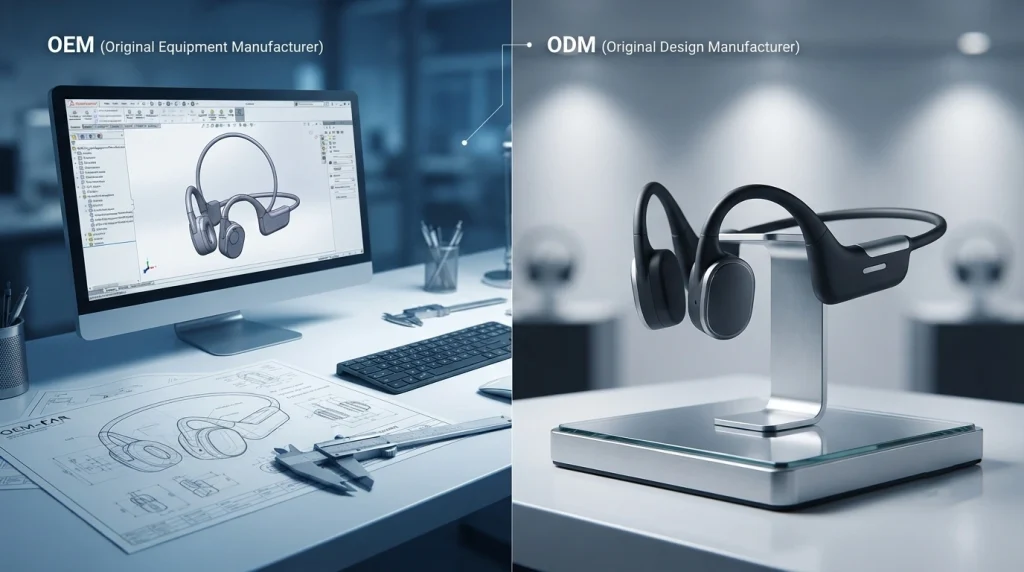
The fundamental difference between OEM (Original Equipment Manufacturer) and ODM (Original Design Manufacturer) lies in the product’s design origin and intellectual property. In an OEM arrangement, a brand provides the full technical specifications, blueprints, and designs, and the factory acts strictly as the producer. Conversely, an ODM arrangement involves the manufacturer using their existing product designs or molds, which the brand then selects, modifies, and rebrands for their own distribution.
Detailed Answer
For procurement managers and Amazon sellers, selecting the right manufacturing path is crucial for long-term brand success. Understanding the distinction between OEM and ODM is the first step in aligning your production strategy with your business goals.
OEM (Original Equipment Manufacturer)
In an OEM model, the brand holds the intellectual property. You engage a bone conduction headphones manufacturer to produce a product that you have engineered from scratch. This includes the mechanical housing design, circuit board layout, and acoustic tuning. The advantage here is total product differentiation; your product will be unique in the marketplace, allowing for specific feature sets that competitors do not possess. However, this route requires a higher initial investment in research and development (R&D), tooling, and longer lead times for prototyping. It is the preferred path for established brands looking to launch innovative, proprietary private label bone conduction headphones.
ODM (Original Design Manufacturer)
The ODM model relies on the factory’s pre-existing research and development. A reputable swimming headphones manufacturer will already have a catalog of tested, high-performance acoustic designs. Brands select an existing base model and then apply minor modifications, such as color changes, logo application, or packaging adjustments. This is often referred to as “white-labeling” or “private-labeling.” The primary benefit of an ODM model is speed-to-market. By leveraging existing molds, brands can avoid expensive tooling costs and significant R&D delays. This is highly effective for Amazon sellers or distributors looking to quickly build a catalog of ODM bone conduction headphones.
Strategic Selection
The choice between OEM and ODM should depend on your brand’s maturity and capital resources, but understanding the nuances of OEM vs ODM headphone manufacturing is essential for long-term success. As your brand grows and you accumulate market data, transitioning to an OEM project allows for the creation of truly distinct, high-value audio hardware. Whether you are sourcing OEM bone conduction headphones or selecting a reliable ODM partner, the goal remains the same: ensuring consistent quality, regulatory compliance, and a supply chain that can scale with your sales volume.
Comparison Table
| Feature | OEM (Original Equipment Mfg) | ODM (Original Design Mfg) |
| Design Ownership | Brand (Customer) | Factory |
| Customization | Full control (Hardware/Software) | Limited (Logo, Color, Packaging) |
| Development Cost | High (R&D & Tooling) | Low (No new tooling) |
| Time to Market | Longer (Prototyping needed) | Fast (Ready for production) |
| Typical MOQ | 1000+ units | 500+ units |
Industry Insight
In the current global electronics landscape, the line between OEM and ODM has become increasingly fluid. Top-tier factories often act as “ODM-plus” partners. For instance, a professional swimming headphones manufacturer might offer a standard catalog of ODM designs, but also allow brands to request specific housing adjustments or specialized acoustic driver upgrades. This flexibility is essential for brands that want the speed of an ODM launch without sacrificing the performance advantages of OEM.
The most successful brands often treat ODM as a testing ground. They launch private label bone conduction headphones via an ODM model to validate market demand in specific regions. Once specific features—such as increased battery life or specific neckband ergonomics—are proven popular, they reinvest those profits into an OEM project to secure exclusive design rights and build deeper brand moats.
Buyer Tips
- Assess Technical Capability: Always request a tour of the factory’s R&D department. A true bone conduction headphones manufacturer should demonstrate competence in both hardware design and software integration.
- Confirm IP Rights: If pursuing an OEM project, ensure the contract explicitly states that all molds, schematics, and firmware are the exclusive property of your brand.
- Start with Samples: Never move to mass production without testing multiple samples of an ODM model to ensure the acoustic quality meets your brand standards.
- Check Regulatory Compliance: Ensure your partner has the necessary certifications (FCC, CE, RoHS) for the specific ODM bone conduction headphones you intend to sell.
Common Mistakes
- Underestimating Tooling Costs: Many buyers opt for OEM without realizing that the cost of injection molds for headbands and internal components can be significant, potentially straining the launch budget.
- Ignoring Communication Transparency: Failing to establish clear communication channels regarding design changes often leads to discrepancies between the prototype and the final mass-produced units.
- Skipping Quality Control (QC): Assuming that a factory’s standard QC is sufficient without implementing your own third-party inspections can result in high return rates, especially with complex private label bone conduction headphones.
Recommended Internal Links
Related Questions
- How do I protect my intellectual property when working with a Chinese manufacturer?
- What is the typical lead time for a new ODM audio product development?
- Can I convert an ODM product into an OEM product later in the partnership?
- How do I evaluate the quality of a bone conduction transducer during the sampling phase?
Summary
Understanding the distinction between OEM and ODM is vital for any audio business strategy. While ODM bone conduction headphones offer speed and cost efficiency, OEM bone conduction headphones provide the design exclusivity required for long-term brand building. Whether you are collaborating with a swimming headphones manufacturer to create a niche aquatic product or expanding your line of private label bone conduction headphones, the success of your project depends on selecting the right manufacturing model. By mastering OEM vs ODM headphone manufacturing strategies, you can ensure your product launch aligns with your specific quality standards and budget, ultimately driving long-term brand success.