
Quick Answer
When deciding whether to choose OEM vs ODM headphones, new audio brands typically find greater initial success starting with ODM due to lower startup costs and faster speed-to-market. ODM allows brands to test market demand with proven designs and manageable financial risk. As the brand gains traction and consumer demand solidifies, transitioning to OEM provides the necessary control for exclusive design, unique acoustic tuning, and deeper brand defensibility. Ultimately, the decision depends on your capital resources, long-term product vision, and desired speed of market entry.
Detailed Answer
For a new audio brand, the manufacturing model is not just a logistical decision; it is a strategic one. Choosing between Original Equipment Manufacturer (OEM) and Original Design Manufacturer (ODM) defines your product’s uniqueness, your profit margins, and your ability to scale.
The ODM Approach: Evaluating OEM vs ODM headphones for Speed
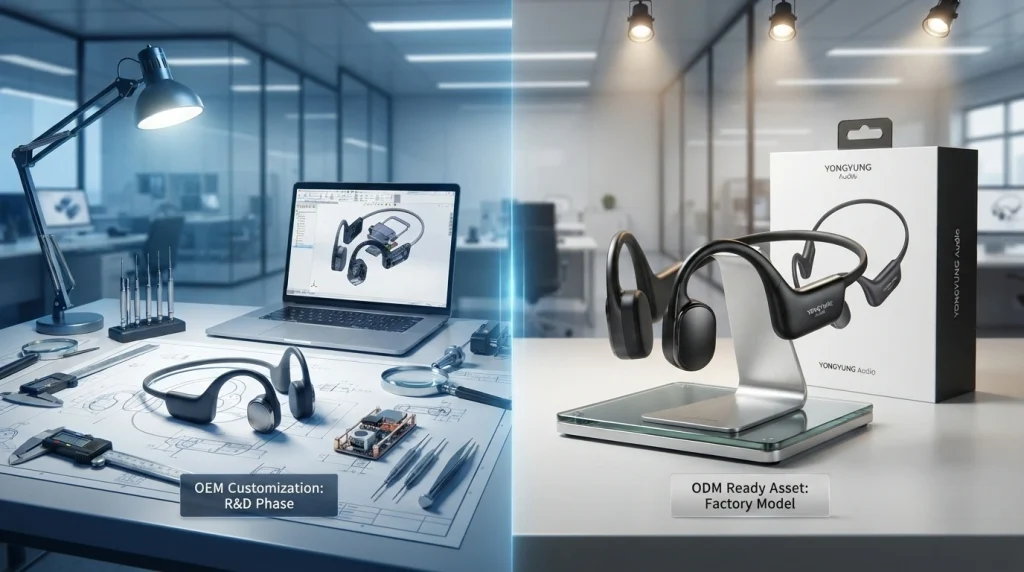
Most new entrants in the audio space leverage an ODM model. In this setup, a bone conduction headphones manufacturer provides a pre-developed, functional product. Your brand customizes the external features—such as color, branding, and packaging—to suit your aesthetic. The primary benefit is speed. By skipping the lengthy R&D phase, you can launch a product in weeks rather than months. For a startup, this means lower R&D overhead and a quicker entry into competitive e-commerce markets. It is an ideal way to build a private label bone conduction headphones catalog without the prohibitive costs of custom mold development.
The OEM Approach: Control and Exclusivity
OEM represents a higher level of commitment. In this model, you provide the specifications, mechanical design, and acoustic requirements, and the manufacturer executes your vision. This is the path for brands that have identified a specific market gap, such as a need for a specialized swimming headphones manufacturer to produce a unique waterproof unit that standard catalog items cannot match. While the investment in tooling and testing is significantly higher, the reward is total control over your intellectual property. You own the design, which creates a competitive moat that prevents copycats from easily replicating your unique product functionality.
Strategic Considerations
New brands must consider their market entry strategy. If your goal is to validate a brand name and test consumer interest, ODM bone conduction headphones offer the lowest barrier to entry. You can focus your capital on marketing and customer acquisition rather than design engineering. If, however, your business model relies on disruptive technology or unique ergonomic designs that differentiate your products from the mass market, investing in OEM bone conduction headphones early on may be necessary to secure your brand’s future position. Many successful brands start with ODM to generate cash flow, then reinvest those profits into OEM projects to develop their flagship, exclusive audio hardware. Before committing to a manufacturer, every new business should carefully weigh the risks and benefits of OEM vs ODM headphones to ensure their supply chain strategy is scalable.
Comparison Table
| Customization Level | Typical MOQ |
| Logo Only (ODM) | 300–500 units |
| Custom Packaging (ODM) | 500–1000 units |
| Full OEM/ODM Design | 1000+ units |
Industry Insight
In the current consumer electronics sector, the “hybrid” approach is gaining significant traction. Many new brands start by auditing the catalog of a professional swimming headphones manufacturer to see which existing platforms perform well. Instead of jumping straight into a fully custom OEM project, they perform “light customization.” This could involve adjusting the neckband tension or improving the battery capacity on an existing ODM model. This middle-ground strategy reduces the high R&D costs of full-scale OEM bone conduction headphones while still offering consumers a slightly better, more curated product than standard off-the-shelf options. It is a prudent way to manage inventory risk while establishing a reputation for quality before scaling to fully bespoke product lines.
Buyer Tips
- Validate the Manufacturer: Ensure your chosen bone conduction headphones manufacturer has transparent factory certifications and a history of working with brands in your target market.
- Request Prototyping: Even in an ODM arrangement, request a customized sample of the ODM bone conduction headphones to test the audio quality and build robustness personally.
- Start Small: Do not overcommit on inventory. Begin with an ODM model to gather customer feedback, then refine your strategy once you understand what your users actually value.
- Focus on Documentation: Regardless of the model, ensure all intellectual property, quality agreements, and compliance certifications are clearly documented before transferring any funds.
Common Mistakes
- Over-customizing early on: Many brands try to change too many internal components of an ODM product, leading to increased costs and longer testing times that defeat the purpose of the ODM model.
- Neglecting Market Research: Launching a product simply because a factory offers it is dangerous. Ensure the model aligns with actual consumer needs, especially in niche categories like sports audio.
- Ignoring Compliance: Assuming that all private label bone conduction headphones meet regional standards (like FCC or CE) without verifying certificates can lead to massive losses if imports are seized.
Recommended Internal Links
Related Questions
- What are the hidden costs associated with OEM product development?
- How do I transition from an ODM product to an OEM model as my brand grows?
- What is the standard process for verifying factory quality control?
- How long does the customization process take for private label audio products?
Summary
Choosing between OEM and ODM is a foundational step for any new audio business. For brands just starting, ODM bone conduction headphones provide the efficiency needed to test the market without massive R&D spending. Conversely, moving toward OEM bone conduction headphones is essential for established brands seeking design exclusivity and higher profit margins. By working with a reliable bone conduction headphones manufacturer or a specialized swimming headphones manufacturer, you can effectively launch your private label bone conduction headphones. Always remember to align your MOQ requirements with your initial sales forecasts to ensure a healthy cash flow, regardless of which manufacturing path your manufacturer recommends for your growth stage. Whether you decide on OEM vs ODM headphones, ensuring your manufacturing partner aligns with your long-term brand strategy is the key to success.