
Quick Answer
A useful custom headphones manufacturer comparison should evaluate more than the quoted unit price. Buyers should compare product feasibility, development scope, sample and tooling responsibilities, production specifications, compliance evidence, packaging, delivery arrangements, payment conditions, and subcontractor control. Each supplier should be assessed against the same product requirements and commercial assumptions. This makes differences in project scope, responsibilities, and potential risks easier to identify before an order is placed.
Detailed Explanation
1. Start With the Same Product Requirements
A supplier comparison is only meaningful when every manufacturer is quoting against the same product brief. Differences in product configuration can make two apparently similar quotations difficult to compare.Before comparing quotations, buyers should understand the broader requirements for selecting a custom Bluetooth headphones manufacturer and defining a suitable product specification.Consistent headphone product specifications give each supplier the same technical basis for preparing a quotation.
Before requesting quotations, prepare a shared specification covering:
- Product type, intended users, and application
- Required acoustic and functional characteristics
- Bluetooth, playback, microphone, and control requirements, where applicable
- Materials, colors, dimensions, and structural requirements
- Water-resistance or other environmental requirements, if relevant
- Accessories and package contents
- Target sales markets and applicable compliance requirements
Ask each supplier to identify which requirements are feasible, which need further technical review, and which are outside the proposed scope.

A manufacturer should not be treated as a better fit simply because its quotation includes more features. The relevant question is whether it can address the actual product requirements and explain the assumptions behind its proposal.
2. Compare What Development Work Is Included
Custom projects can involve different levels of engineering and coordination. One quotation may cover only modifications to an existing model, while another may include additional design, engineering review, prototypes, or sample revisions.The scope of custom headphone development should be documented so that buyers can distinguish included engineering work from separately quoted activities.
Ask each supplier to separate included work from excluded work. Clarify whether the quotation covers:
- Review of the product brief and technical requirements
- Existing-model customization or new-product development
- Design or engineering adjustments
- Prototype or sample preparation
- Firmware or functional changes, where applicable
- Sample revisions and approval stages
- Documentation required before production
Do not assume that a phrase such as “custom development included” means the same thing across suppliers. Record the actual deliverables, revision limits if specified, and any work that requires separate confirmation or quotation.
3. Separate Sample Costs From Sample Approval Responsibilities
Sample quotations should explain what is being supplied and what the buyer is expected to evaluate.
Compare the sample configuration, included accessories, customization level, and any stated development charges. Also establish who is responsible for reviewing technical requirements, recording feedback, and confirming approval.
Before sampling begins, agree on:
- The exact sample configuration
- The functions and specifications to be evaluated
- The test conditions and acceptance criteria
- The person authorized to approve the sample
- How changes after approval will be documented
A lower sample charge may reflect a simpler sample scope rather than a more economical development process. Buyers should compare the deliverables and responsibilities, not just the sample amount.
4. Clarify Tooling Ownership and Additional Costs
Some customization projects may require changes to product housings, structural components, or other parts. Others may use existing components and require no new tooling.
For each supplier, record whether tooling is expected, who is responsible for arranging it, and what the quotation says about ownership and access. Where applicable, ask about design files, maintenance, storage, modification, and transfer arrangements.
Also distinguish tooling charges from other possible project expenses, such as prototype work, engineering changes, special components, or additional testing. These items should not be assumed to be included unless the supplier confirms them in writing.
The objective is not to assume that every custom project requires a new mold. It is to understand which costs may arise from the specific design and who is responsible for them.
5. Compare Production Specifications and Quality Documentation
A supplier’s quality statements are difficult to evaluate unless they are connected to defined product requirements and records.
Ask each manufacturer what production specifications and quality documents are relevant to the proposed project. Depending on the product and agreed scope, these may include approved specifications, inspection criteria, test records, material information, and documented procedures for handling nonconforming products.
Record the documents that will be provided, when they will be available, and which party is responsible for reviewing or approving them.
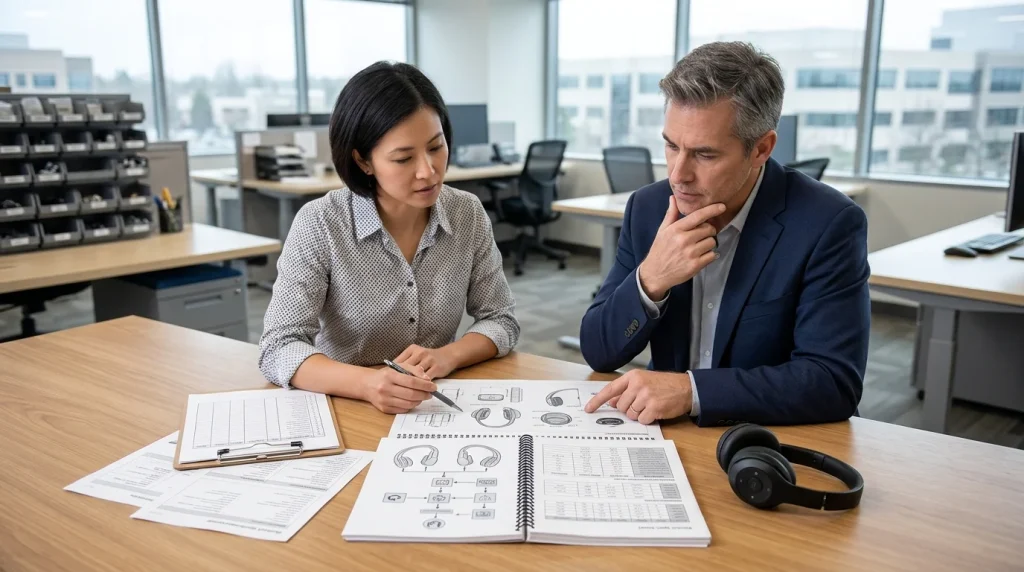
Avoid treating a general quality certificate or a factory photograph as proof that a particular headphone model meets every requirement. Evidence should be relevant to the product, process, and order being evaluated.
6. Check Compliance Evidence for the Target Market
Compliance requirements depend on the product design, functions, components, and destination market. A supplier’s general statement that a product is compliant is not a substitute for identifying the applicable requirements and reviewing relevant evidence.For products containing wireless communication functions, buyers should review the applicable EU Radio Equipment Directive requirements when assessing whether a product is suitable for the European market.
Ask each supplier to clarify:
- Which market-specific requirements have been considered
- Which tests or assessments are relevant to the product
- Whether existing reports apply to the proposed model and configuration
- Whether changes to components or design could affect the evidence
- Which party is responsible for arranging and maintaining required documentation
- Buyers should also understand the manufacturer responsibilities for CE marking, including applicable conformity assessment procedures and technical documentation obligations for products placed on the EU market.
For example, Bluetooth-related requirements and radio-equipment obligations may involve different processes. Buyers should identify the applicable obligations for the finished product rather than assume that one certificate or test report covers every market and requirement.For the legal framework, buyers can refer to the original text of the Radio Equipment Directive 2014/53/EU to review the applicable requirements for radio equipment placed on the European Union market.
7. Compare Packaging and Product Configuration
Packaging differences can affect the quoted price and the buyer’s preparation work.
Compare the contents of each proposed package, including the product, charging accessories, cables, manuals, labels, inserts, and retail packaging, where applicable.
Ask suppliers to distinguish standard packaging from customized packaging. Record whether artwork preparation, packaging samples, translation, labeling, or special inserts are included or quoted separately.
The same principle applies to product configuration. Two suppliers may quote the same model name but include different accessories, firmware settings, colors, or functional options. These differences should be resolved before comparing prices.
8. Establish Production, Delivery, and Commercial Responsibilities
A quotation should make clear which responsibilities belong to the supplier and which remain with the buyer or another appointed service provider.
Compare the stated production assumptions, order milestones, delivery arrangements, and responsibilities for required documents. Do not treat an estimated production schedule as a guaranteed delivery commitment unless the supplier has explicitly agreed to the relevant terms.
Payment conditions also need to be reviewed in context. Record the stated deposit, balance arrangements, payment milestones, currency, quotation validity, and any assumptions that could change the final amount.
Rather than comparing payment terms as isolated numbers, assess how clearly each supplier defines the commercial conditions and what happens if the project scope changes.
9. Evaluate Subcontractor Transparency and Change Control
A manufacturer may perform some processes internally and use external partners for others. Outsourcing is not automatically a negative factor. The important questions are whether the arrangement is transparent and whether responsibilities are clearly assigned.Organizations should establish appropriate controls and monitoring for externally provided processes, products, and services.When evaluating outsourced processes, buyers can refer to ISO 9001 guidance on external providers to understand why externally provided processes, products, and services need appropriate controls and monitoring.
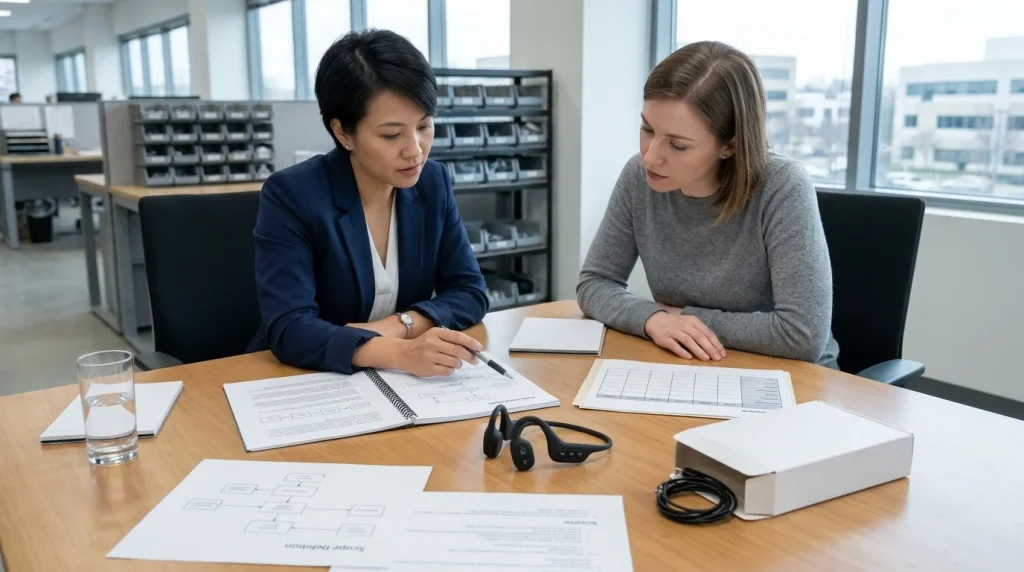
Ask each supplier to identify relevant outsourced processes, explain how external providers are selected or managed, and clarify who is accountable for product conformity and corrective action.
Also ask how changes to materials, components, production locations, or subcontractors are communicated and approved.
A supplier comparison should record not only what a manufacturer says it can do, but also how it manages changes that could affect the approved product or production arrangement.
10. Assess Communication and Project Risk Management
Clear communication is part of project execution. During quotation and sample discussions, observe whether each supplier answers technical questions directly, identifies unresolved issues, and documents decisions.
Compare suppliers on their ability to:
- Explain technical limitations and open questions
- Provide consistent written specifications
- Record revisions and approval decisions
- Identify responsibilities and project dependencies
- Communicate proposed changes before implementation
- Escalate issues that may affect cost, quality, or schedule
A polished presentation does not establish manufacturing suitability. However, incomplete answers, inconsistent documents, or unclear ownership of decisions can make a project harder to control.
Comparison Table
Use one worksheet for all shortlisted suppliers. Enter the supplier’s actual answer, supporting evidence, and any unresolved point rather than relying on a general impression.
| Comparison Factor | Questions to Ask Each Supplier | Evidence or Terms to Record |
|---|---|---|
| Product fit and feasibility | Can you meet the required design, functions, and intended application? Which points need technical review? | Written feasibility response; exceptions; open technical questions |
| Development scope | Which engineering, customization, firmware, and revision activities are included? | Itemized scope; deliverables; exclusions; revision assumptions |
| Samples and approval | What sample configuration is included? Who evaluates and approves it? | Sample specification; sample charges; acceptance criteria; approval record |
| Tooling | Is new tooling expected? Who arranges and owns it? | Tooling scope; ownership terms; access and transfer conditions; additional charges |
| Production specifications | Which specifications and quality records will govern production? | Approved specification; inspection criteria; relevant test and production records |
| Compliance | Which requirements apply to the target market, and what evidence is available for this model? | Applicable requirements; relevant reports; declarations; responsible party |
| Packaging and configuration | What accessories, labels, manuals, and packaging are included? | Bill of materials or configuration list; packaging scope; exclusions |
| Production and delivery | Which milestones and delivery responsibilities are included in the proposal? | Schedule assumptions; agreed milestones; delivery terms; document responsibilities |
| Payment and quotation | What are the payment conditions, quotation validity, and pricing assumptions? | Written quotation; currency; payment milestones; validity; change conditions |
| Subcontracting | Which processes are outsourced, and who controls and approves changes? | Outsourced-process list; responsible parties; change-notification and approval process |
| Communication and risk | How are decisions, technical issues, and project changes recorded? | Named contacts; meeting records; issue log; revision history; escalation process |
How to Make the Comparison Fair
Do not compare quotations until the major differences have been identified. If one supplier includes customized packaging and another quotes a standard package, record that difference before drawing a price conclusion. Apply the same approach to sample scope, tooling, testing, accessories, production assumptions, and delivery responsibilities.
A simple scoring system can help organize the review, but it should not replace evidence. For example, buyers can classify each item as confirmed, partially confirmed, not included, or requires clarification. This makes missing information visible and prevents an attractive unit price from hiding unresolved project responsibilities.
Industry Insight
A low unit price does not automatically produce a lower total project cost. If important development work, tooling, testing, packaging, or documentation is excluded, the buyer may need to arrange or pay for those items separately. Conversely, a higher quotation does not automatically indicate better engineering, stronger quality control, or lower risk. It may simply include a different scope or commercial assumption.
The most useful comparison is therefore based on equivalent product specifications, quantities, deliverables, responsibilities, and evidence. Buyers should distinguish confirmed commitments from estimates and verbal explanations. This is particularly important when external providers are involved: ISO 9001 Auditing Practices Group guidance discusses the need to define and monitor controls over externally provided processes, products, and services. ISO+1
Buyer Tips
- Issue one common product brief. Give every shortlisted supplier the same requirements and ask them to identify exceptions.
- Request itemized quotations. Separate product pricing from development work, samples, tooling, packaging, and other applicable charges.
- Keep a clarification log. Record unanswered questions, the supplier’s response, the date, and whether the answer is documented.
- Compare evidence, not presentation quality. A clear, relevant document is more useful than a broad capability statement.
- Confirm responsibilities in writing. Identify who approves specifications, samples, changes, compliance documents, and production release.
- Revisit the comparison after sampling. Update the assessment using the actual sample configuration and documented evaluation results.
Common Mistakes
- Choosing from unit price alone. This ignores differences in scope, configuration, and excluded work.
- Comparing non-equivalent quotations. Different accessories, packaging, sample levels, or specifications make the prices incomparable.
- Assuming all development work is included. Broad wording such as “customization included” needs a written definition.
- Treating certificates as universal proof. Compliance evidence must relate to the applicable requirements and the actual product configuration.
- Ignoring subcontracted processes. Buyers should understand which activities are outsourced and who remains responsible for their control.
- Accepting verbal changes without records. Unrecorded changes can create disagreement about the approved design, materials, or commercial scope.
- Treating a higher price as proof of higher quality. Quality and suitability require relevant specifications, records, and sample evaluation.
Key Takeaway
A reliable custom headphones manufacturer comparison is based on equivalent requirements and documented responsibilities—not the lowest or highest quotation. Compare product feasibility, development scope, samples, tooling, quality and compliance evidence, packaging, commercial conditions, and subcontractor controls side by side. Where information is missing, record it as an open question rather than assuming it is included. This gives buyers a clearer basis for selecting a supplier and managing project risk.
Related Questions
The following articles are the other five supporting FAQs in this weekly cluster:
- What Should Buyers Define Before Choosing a Custom Bluetooth Headphones Manufacturer?
- How Should Buyers Compare Bluetooth and MP3 Modes in Swimming Headphones?
- Which Changes to Custom Bluetooth Headphones May Require New Tooling?
- How Can Buyers Verify a Headphones Manufacturer’s In-House Production Capabilities?
- How Should Buyers Evaluate Optional Features in Custom Bluetooth Headphones?
These are navigation suggestions, not hyperlinks. Add links only after confirming the published URLs.
CTA
Planning a custom headphone project? YONG YUNG welcomes inquiries from brands, importers, distributors, retailers, and product-development teams. Share your intended application, target market, product configuration, and key technical requirements. This provides a practical starting point for discussing product fit, development scope, and the information needed to evaluate a potential project. Any proposed scope and responsibilities can then be clarified during the discussion.