
For buyers researching OEM audio manufacturer China suppliers, choosing a manufacturing partner involves more than finding a supplier with an attractive quotation. For international brands, importers, distributors, and product-development teams, a successful manufacturing partnership depends on product requirements, technical coordination, sample approval, quality expectations, and production management.
Before starting an OEM project, buyers need to understand what the manufacturer is responsible for, which development services may be available, and how decisions made during the early stages can affect the final product.
This guide explains how to evaluate and work with an OEM audio manufacturer in China, from initial project planning to sample development, production preparation, and mass manufacturing.
1. What Does an OEM Audio Manufacturer in China Do?
An OEM audio manufacturer produces audio products according to a buyer’s product requirements, specifications, or approved designs. Depending on the manufacturer’s actual capabilities and project arrangements, its responsibilities may cover different stages of product manufacturing.
Typical areas of responsibility can include:
- Product customization: Modifying an existing product with requested colors, logos, packaging, accessories, or selected functional configurations.
- Technical coordination: Reviewing product requirements and coordinating relevant acoustic, electronic, mechanical, and structural considerations.
- Sample development: Preparing product samples for evaluation, testing, and approval.
- Production preparation: Coordinating components, materials, assembly requirements, and production documentation.
- Manufacturing and assembly: Producing products according to confirmed specifications and agreed production arrangements.
- Quality requirements: Applying agreed inspection criteria and handling identified product issues within the defined manufacturing process.
Not every OEM manufacturer provides all these services internally. Some manufacturers have in-house engineering and production teams, while others work with external development partners or specialized suppliers.
Buyers should therefore distinguish between a manufacturer’s actual in-house capabilities and the services it coordinates through external partners.When reviewing a potential manufacturing partner, buyers can also learn more about YONG YUNG’s company and manufacturing background.When evaluating outsourced manufacturing activities, buyers can refer to ISO 9001 guidance on external providers to understand the importance of evaluating and monitoring externally provided processes, products, and services.
A supplier’s ability to coordinate a project does not automatically mean every development or manufacturing activity is performed in its own facility.
2. Understanding OEM, ODM, and Private Label Audio Manufacturing
Before contacting potential suppliers, buyers should understand the differences between OEM, ODM, and private-label cooperation. These models can involve different levels of product ownership, customization, and development responsibility.
OEM Manufacturing
In an OEM project, the buyer provides product requirements, specifications, or an existing design, and the manufacturer produces the product according to the agreed requirements.
Depending on the project, the buyer may define the product’s appearance, functions, technical specifications, packaging, and other requirements.
The manufacturer is responsible for the manufacturing activities included in the agreement. Engineering support, tooling, and product modifications should be discussed separately when their scope is not already defined.
ODM Manufacturing
ODM cooperation generally involves a manufacturer providing an existing product design or development solution that the buyer can customize for its market.
The buyer may select an existing model and request changes to branding, colors, packaging, accessories, or selected product features.
For projects requiring substantial modifications, both parties should clarify which changes are technically feasible and whether additional development or tooling is necessary.
Private Label Manufacturing
Private-label cooperation usually focuses on selling an existing product under the buyer’s own brand.
Typical customization options may include:
- Brand logo and product identification
- Product color and finish
- Retail packaging
- Accessories and included components
- Selected configuration options
Private labeling does not necessarily involve developing a new product from the beginning.
Before proceeding, buyers should clarify product design ownership, tooling ownership, customization boundaries, and responsibility for future modifications.Buyers can review the different responsibilities involved in OEM and ODM manufacturing services before deciding which cooperation model best fits their project.
3. Define Your Audio Project Before Contacting Manufacturers
A clear project brief helps manufacturers evaluate requirements more accurately and reduces misunderstandings during quotation and development.
Rather than sending only a product reference image or a general request for pricing, buyers should organize the main project information.
Product Category and Application
Start by identifying the product category and intended use.
For example, an audio project may involve:
- Bone conduction headphones
- Open-ear sports headphones
- Swimming headphones
- Bluetooth headphones
- Other specialized audio products
The intended application also matters. Products designed for sports, swimming, everyday listening, or professional use may have different structural, acoustic, and functional requirements.For projects focused on bone conduction technology, buyers can review our bone conduction headphones manufacturing solutions.Buyers sourcing products for sports and outdoor applications can also review our wholesale sports headphones supply options.
Target Users and Markets
Identify the intended customer group and sales markets.
Relevant considerations may include:
- Age group and user profile
- Sports or everyday usage scenarios
- Expected wearing comfort
- Environmental conditions
- Applicable market regulations
- Packaging and language requirements
Market requirements should be reviewed early because they may influence product configuration, documentation, labeling, and validation.For products containing wireless communication functions and intended for the European market, buyers should review the applicable EU Radio Equipment Directive (RED) requirements during project planning.For aquatic audio projects, explore our swimming headphones manufacturing solutions to understand the product category and its customization considerations.
Functional and Customization Requirements
List the functions and modifications that are important to the project.
Depending on the product, these may include Bluetooth connectivity, MP3 playback, microphone functions, physical controls, charging methods, waterproofing requirements, or other features.
Separate essential requirements from optional preferences. This makes it easier to evaluate technical feasibility and prioritize development work.
Commercial Expectations
Buyers should also prepare an initial commercial framework, including target price expectations, estimated order quantities, packaging requirements, and expected purchasing timelines.
These figures do not need to be final at the first discussion stage. However, clearly identifying expectations helps manufacturers assess whether the project is commercially and technically practical.
4. Clarify Technical and Manufacturing Responsibilities
Audio product development may involve several technical disciplines. Buyers should understand which activities are handled by the manufacturer and which require external support.
Depending on the product and project scope, technical work may involve:
- Acoustic design and sound performance
- Speaker and transducer selection
- Electronic components and circuit design
- Bluetooth connectivity and firmware
- Mechanical structure and product housing
- Battery and charging configuration
- Waterproofing and structural protection
- Tooling and mold development
For an existing product customization project, some of these elements may already be established. For a new product development project, additional engineering work may be necessary.

Confirm In-House and Outsourced Activities
One important question is whether the manufacturer performs each activity internally or coordinates it through external partners.
Buyers can request a clear explanation of responsibility for:
- Product design and engineering
- Acoustic and electronic development
- Tooling and mold production
- Component sourcing
- Product assembly
- Quality inspection
- Packaging and shipment preparation
This does not mean outsourcing is automatically a disadvantage. Specialized partners may be appropriate for certain technical activities.
The important point is that responsibilities, communication channels, and quality expectations should be clear.
Establish Engineering Change Control
Product requirements may change during development. A change to a component, structure, firmware version, or product configuration can affect cost, performance, tooling, and production arrangements.For Bluetooth-enabled products, buyers should also understand the Bluetooth SIG product qualification process and confirm the applicable qualification responsibilities before commercialization.
Buyers should establish how engineering changes are proposed, reviewed, approved, and documented.
Changes made after sample approval should not be introduced into production without the appropriate confirmation from both parties.
5. Evaluate Samples Before Approving Production
Sample evaluation is an important stage between product development and mass production.
A sample allows buyers to assess whether the proposed product meets the agreed requirements before committing to a larger order.
However, receiving a sample does not automatically mean the product is ready for mass production.
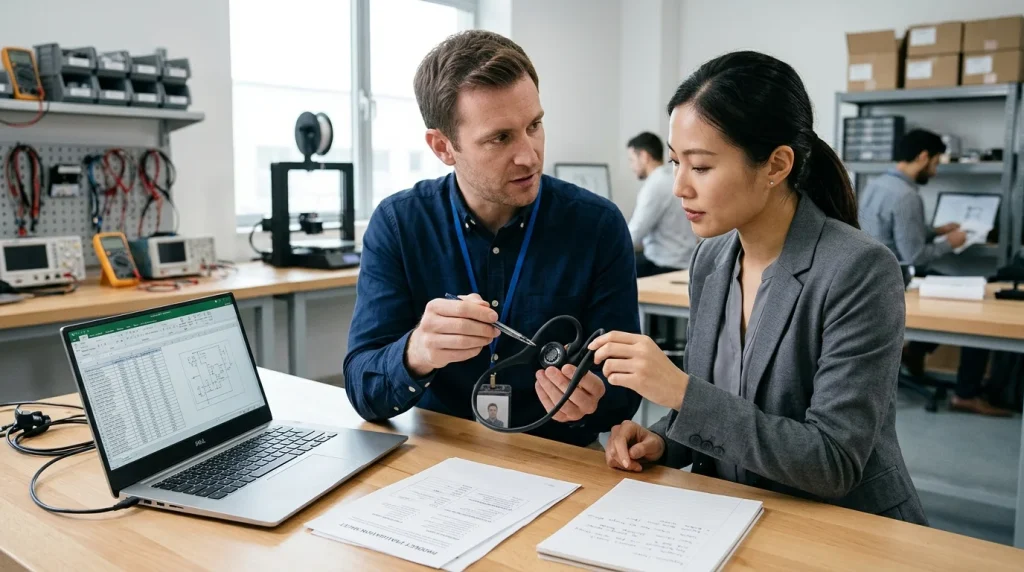
Review the Sample Against Defined Requirements
The evaluation should cover the product characteristics that matter to the intended application.
Depending on the project, buyers may review:
- Appearance, dimensions, and materials
- Wearing comfort and fit
- Acoustic performance
- Bluetooth connection and functional operation
- Button or touch-control behavior
- Charging performance
- Battery operation
- Waterproofing requirements, where applicable
- Packaging and included accessories
The evaluation criteria should be established before testing. Otherwise, different stakeholders may judge the same sample using different expectations.
Record Feedback and Revisions
When a sample does not meet expectations, feedback should be specific and documented.
Instead of saying that the sound quality or fit is not satisfactory, buyers should describe the observed issue and the expected result as clearly as possible.
For example, feedback may identify a particular fit problem, an unwanted sound characteristic, an inconvenient control position, or a difference between the sample and the agreed appearance.
The manufacturer can then review the requested change and determine its feasibility.
Approve a Clearly Identified Sample Version
Before mass production, both parties should identify the approved sample version.
Relevant information may include the sample date, product model, hardware configuration, firmware version, appearance, and agreed specifications.
This helps reduce the risk of confusion when multiple sample revisions have been produced.
The approved sample should serve as a reference for subsequent production, together with the written product specifications and agreed acceptance criteria.
6. Establish Quality Requirements Before Mass Production
Quality expectations should be discussed before production begins, rather than only after products have been manufactured.
A buyer should understand what will be inspected, how acceptance will be determined, and what records may be available.
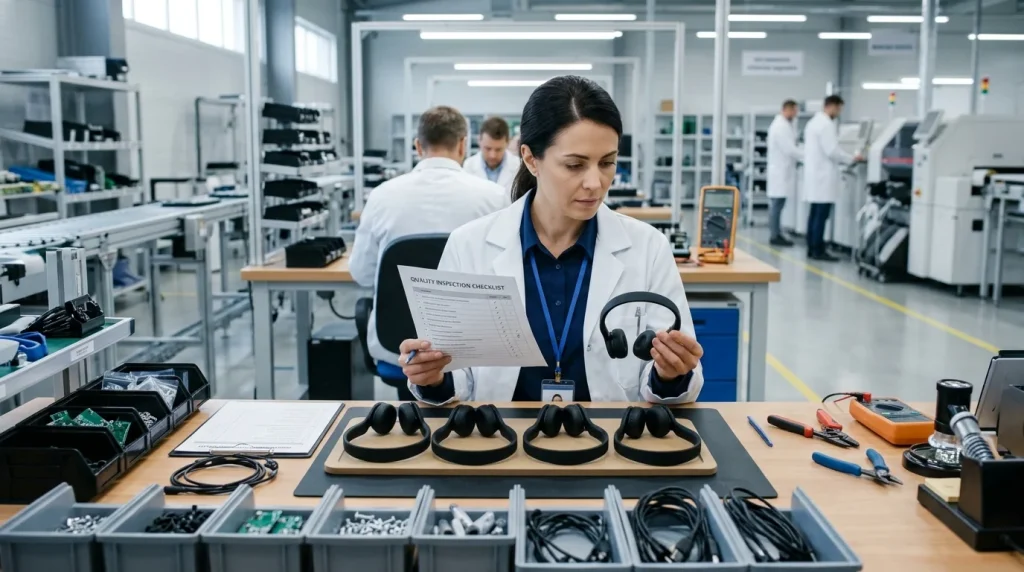
Understand the Main Inspection Stages
Three commonly used quality-control terms are IQC, IPQC, and FQC.
- IQC (Incoming Quality Control): Inspection or verification of incoming materials and components before they enter the production process.
- IPQC (In-Process Quality Control): Inspection or monitoring during manufacturing and assembly.
- FQC (Final Quality Control): Inspection of finished products before they proceed to the next stage, such as packing or shipment.
The specific inspection activities and records depend on the manufacturer’s actual quality system and the requirements agreed for the project.
Buyers should not assume that every manufacturer uses identical inspection procedures.
Define Product Acceptance Criteria
The product specification should identify the characteristics that determine whether a finished product is acceptable.
These may include:
- Appearance and cosmetic requirements
- Functional performance
- Acoustic characteristics
- Charging and battery operation
- Connectivity
- Accessory completeness
- Packaging requirements
- Applicable safety or regulatory requirements
Where possible, buyers should request relevant inspection records or test documentation to understand how the agreed requirements are verified.
Discuss Defect Handling and Corrective Actions
Both parties should also agree on how product issues will be reported and handled.
Important questions include:
- How are defects identified and recorded?
- Who reviews the reported issue?
- How are corrective actions agreed?
- How are affected products or components handled?
- How are changes documented and approved?
A clear process helps prevent misunderstandings when quality issues arise during production or after delivery.
7. Understand Pricing, MOQ, and Order Responsibilities
A manufacturer’s quotation should be evaluated based on its assumptions and included scope, not only the final unit price.
Two quotations may appear similar while covering different product configurations, components, packaging, or manufacturing responsibilities.
Review the Main Cost Factors
Depending on the project, audio product manufacturing costs may be influenced by:
- Product model and technical configuration
- Component selection
- Customization requirements
- Tooling or mold development
- Engineering and sample development
- Packaging and accessories
- Order quantity
- Testing and documentation requirements
- Shipping terms and delivery arrangements
Not every project requires new tooling or additional development fees. These costs should be identified only when applicable to the actual project.
Clarify MOQ and Quotation Assumptions
Buyers should ask whether the quoted MOQ applies to a specific model, color, configuration, or packaging arrangement.
Other questions may include:
- Is the quotation based on the approved product configuration?
- Are accessories and packaging included?
- Are tooling or development costs listed separately?
- What payment terms apply?
- Which shipping terms are assumed?
- How long is the quotation valid?
- What conditions could change the quoted price?
A written quotation with clearly defined assumptions makes supplier comparisons more meaningful.
Confirm Shipping and Documentation Responsibilities
Before placing an order, buyers should confirm the responsibilities of both parties for shipment preparation.
This may include packaging specifications, carton information, shipping marks, commercial invoices, packing lists, and other documents required for the transaction.
The agreed Incoterms and shipping arrangements should also be clearly stated in the order documentation.
8. Prepare for Pilot Production and Mass Manufacturing
After sample approval and commercial confirmation, the project moves toward production preparation.
This stage requires more than confirming an order quantity. The manufacturer and buyer should verify that the necessary product, material, documentation, and quality requirements are ready.
Confirm Production Readiness
Before production begins, relevant items may include:
- Approved product specifications
- Confirmed sample reference
- Final product configuration
- Approved artwork and packaging
- Component and material arrangements
- Agreed inspection requirements
- Production quantity and schedule
- Responsibilities for changes and approvals
A pilot production run may be appropriate for projects that require additional verification before larger-scale manufacturing.
Whether a pilot run is necessary depends on the product, project complexity, and the agreement between both parties.
Maintain Communication During Production
Clear communication is important throughout manufacturing.
Buyers should know who is responsible for project updates, how production issues will be communicated, and how decisions affecting the product will be approved.
If a component becomes unavailable or a manufacturing issue requires a change, the proposed solution should be reviewed before implementation.
After production is completed, the parties should also confirm the agreed final inspection, packaging, and shipment arrangements.When comparing OEM audio manufacturer China options, buyers should evaluate production readiness, quality requirements, and shipment responsibilities as part of the overall manufacturing arrangement.
9. Questions to Ask Before Choosing an OEM Audio Manufacturer
Before selecting a manufacturing partner, buyers can use the following questions to evaluate project suitability.
Product and development
- Does the manufacturer support the product category required for this project?
- Can it customize an existing model?
- Does the project require new product development?
- Which engineering activities are handled internally?
- Which activities involve external partners?
Samples and technical requirements
- What information is required before sample development?
- How are sample revisions documented?
- How is the approved sample identified?
- Which product specifications will be used for production?
Manufacturing and quality
- Which manufacturing and assembly activities are performed in-house?
- What inspection stages are used?
- Which quality records can be provided?
- How are defects and corrective actions handled?
- How are engineering changes controlled?
Commercial and order arrangements
- What is included in the quotation?
- Does the MOQ vary by model, color, or configuration?
- Are tooling and development costs applicable?
- What packaging and accessories are included?
- Which party is responsible for shipment documentation?
- What are the agreed payment and delivery terms?
The answers should be evaluated together. A suitable manufacturer is not simply the supplier offering the lowest initial price, but one whose technical capabilities, responsibilities, communication, and manufacturing arrangements match the project’s requirements.For additional information about manufacturing cooperation, customization, and wholesale arrangements, visit our OEM/ODM and wholesale FAQ.
10. Frequently Asked Questions
What should buyers prepare before contacting an OEM audio manufacturer in China?
Buyers should prepare the product category, intended application, target users, sales markets, essential functions, customization requirements, expected order quantity, and target price range. Product images, reference samples, or preliminary specifications can also help the manufacturer understand the project.
What is the difference between an OEM and ODM audio manufacturer?
An OEM manufacturer generally produces products according to the buyer’s specifications or design requirements. An ODM manufacturer generally provides an existing product design or development solution that the buyer can select and customize. The exact responsibilities and ownership arrangements should be confirmed in the project agreement.
How can buyers evaluate an OEM audio manufacturer’s production capabilities?
Buyers should ask which activities are performed in-house, which are outsourced, and who is responsible for each stage. Relevant evidence may include facility information, manufacturing and assembly records, inspection documentation, and explanations of the production workflow. Claims about manufacturing capabilities should be supported by verifiable information.
Why is sample approval important before mass production?
Sample approval confirms that the product version has been reviewed against the agreed requirements. It provides a reference for appearance, configuration, and performance during subsequent production. Buyers should identify the approved sample version and document any specifications or changes that form part of the approval.
Should buyers choose an OEM audio manufacturer based only on unit price?
No. Unit price is only one part of the purchasing decision. Buyers should also evaluate product suitability, technical support, development responsibilities, sample quality, tooling arrangements, inspection requirements, production coordination, and shipment responsibilities. Comparing the complete project scope provides a more useful basis for supplier selection.
Conclusion
Working with an OEM audio manufacturer in China requires clear planning and coordination throughout the project. Buyers should understand the differences between OEM, ODM, and private-label arrangements, define product requirements, confirm technical responsibilities, evaluate samples, and establish quality and commercial expectations before mass production.
A structured approach helps both parties identify potential risks earlier, reduce misunderstandings, and establish a clearer basis for manufacturing cooperation.
For brands, importers, distributors, and product-development teams evaluating an audio project, YONG YUNG welcomes inquiries about product categories, intended applications, customization expectations, and technical requirements. Sharing this information provides a practical starting point for discussing potential OEM or ODM cooperation.