
Choosing a custom Bluetooth headphones manufacturer is a project decision, not simply a supplier price comparison. The manufacturer must be able to understand the intended product, clarify technical requirements, explain the scope of customization, and provide evidence that supports its proposed development and production process.
For brand owners, importers, distributors, and product development teams, supplier evaluation should begin before committing to development work or approving a production order. A supplier’s website or sales presentation can help identify potential candidates, but it does not independently establish technical feasibility, manufacturing capability, product compliance, or readiness for a specific project.
A structured custom Bluetooth headphones manufacturer evaluation helps buyers separate confirmed capabilities from assumptions, identify unresolved risks, and establish clear responsibilities before moving forward.
1. Define the Product, Application, and Target Market
Start by determining whether the manufacturer has relevant experience with the type of headphone you intend to develop. Bluetooth headphones can differ significantly in acoustic design, wearing structure, control methods, waterproofing requirements, battery configuration, and intended use.
For example, a product designed for running may prioritize secure positioning, sweat resistance, and awareness of surrounding sounds. A swimming headphone project may require a different product architecture, local audio storage for underwater playback, and specific waterproof performance evidence. A general-purpose open-ear product may have a different set of priorities.
Before comparing suppliers, establish the following:
- Intended product category and wearing structure.
- Main use cases and operating environment.
- Target customer and sales market.
- Required connectivity, controls, and audio functions.
- Relevant environmental, safety, and regulatory considerations.
- Expected degree of customization and product differentiation.
The purpose is not to finalize every specification at the first meeting. It is to determine whether the supplier understands the application and can identify the information needed to assess feasibility.
Buyers should also distinguish between a supplier that offers an existing model for customization and one that can support a new product development project. These are different scopes of work, and they may involve different engineering responsibilities, costs, risks, and approval stages.
For a broader framework covering supplier selection and order readiness, see How to Evaluate a Private Label Bluetooth Headphones Supplier: Product Fit, Quality Evidence and Order Readiness
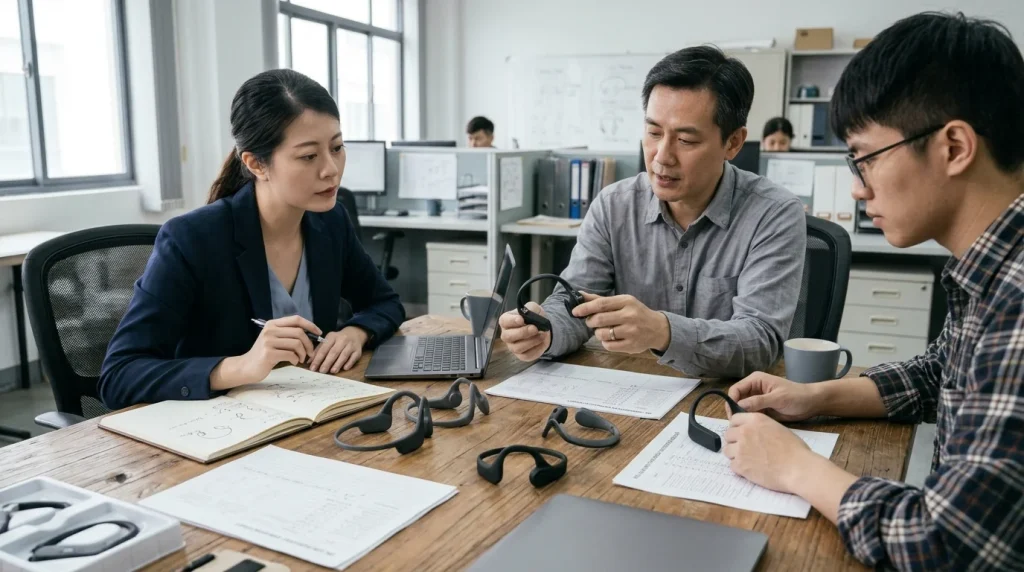
2. Evaluate Technical Fit and Development Scope
A manufacturer’s ability to supply a product that looks similar to the requested design does not automatically mean it can deliver every required feature. Buyers should ask how the proposed product architecture relates to the intended use and which requirements need further engineering review.
Review the supplier’s proposed approach to:
- Acoustic performance and the intended listening experience.
- Bluetooth connectivity and device compatibility.
- Battery, charging, and power-management requirements.
- Mechanical design, fit, and material selection.
- Controls, microphones, and other requested functions.
- Environmental protection and relevant performance testing.
- Firmware, hardware, or structural changes, where applicable.
The level of technical evidence should match the complexity of the project. An existing model with limited cosmetic changes may require a different evaluation process from a product involving new electronics, structural modifications, or substantial acoustic development.
Ask the supplier to separate confirmed existing features from proposed modifications and items that still require validation. If a feature depends on a third-party component, external engineering partner, or additional development work, clarify that dependency before treating the feature as committed.
A useful next step is to request a feasibility review identifying the proposed solution, technical assumptions, unresolved questions, validation method, and party responsible for each decision.
3. Verify Manufacturing Process Transparency
Manufacturing capability should be evaluated through evidence relevant to the product and the proposed scope, rather than through general statements about factory size or production capacity.
Ask the supplier to explain how the product would move from component sourcing and assembly through inspection, packing, and shipment preparation. The exact process will vary by product design and the work performed by the supplier or its partners.
Useful areas to investigate include:
- Which production and inspection steps are performed internally.
- Which activities are outsourced or handled by external partners.
- How incoming components and materials are checked.
- How assembly issues and nonconforming products are recorded.
- How product revisions are communicated to production.
- How finished goods are inspected against agreed acceptance criteria.
Where appropriate, request process descriptions, sample inspection records, relevant photographs, or a walkthrough of the proposed workflow. If an audit is important to the project, agree on its scope and the evidence to be reviewed.
Do not treat a factory photograph, equipment list, or general capacity figure as proof that every required process is available for your specific order. The key question is whether the supplier can explain who performs each relevant task and how the outcome will be verified.
For a deeper review of manufacturing evidence, buyers can also consult the relevant supplier assessment material on the YONG YUNG website. The information should be assessed against the requirements and evidence for the actual project.
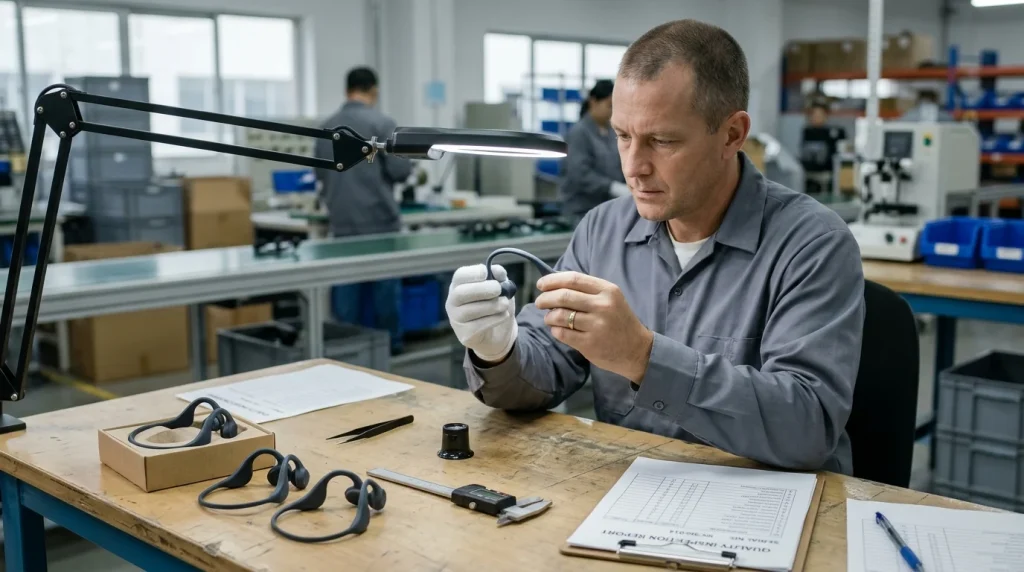
4. Review Quality Evidence and Product Testing
Quality claims are more useful when they are connected to defined inspection methods, acceptance criteria, and records. Before starting a project, determine how the supplier intends to verify the product characteristics that matter most to your business.
Depending on the design, the evaluation may cover acoustic performance, Bluetooth operation, charging, battery behavior, physical construction, controls, and environmental resistance. Not every project requires every test, and the relevant method should be selected according to the product requirements and identified risks.
Ask for clarification on:
- Which product characteristics will be inspected or tested.
- At which stage each check takes place.
- Whether the method is an internal inspection, a documented test, or an independent assessment.
- What acceptance criteria will be used.
- How failures, deviations, and corrective actions are recorded.
- Which reports or records can be provided for the specific model or project.
A test statement without a defined method or identifiable product reference may be insufficient for a procurement decision. Buyers should check that any report they receive relates to the relevant model, configuration, and test scope.
It is also important to distinguish between a test performed on a development sample and a process used to monitor production. Sample testing can provide useful evidence about a particular unit, while production inspection addresses whether the agreed requirements are being followed during manufacturing.
For waterproof products, verify the specific rating, applicable test method, sample configuration, and supporting evidence instead of assuming that a general waterproof claim covers every use condition.
5. Check Compliance and Market Documentation
Regulatory and market-access requirements should be identified early because they may influence component selection, product design, labeling, documentation, and project timing.
The applicable obligations depend on the product, the destination market, how the product is marketed, and the responsibilities assigned to the manufacturer, importer, brand owner, or other economic operator.
Before committing to a project, clarify:
- Which requirements may apply in each intended market.
- Which party is responsible for identifying applicable obligations.
- What technical documentation, declarations, reports, or product records are available.
- Whether the evidence relates to the exact product model and configuration.
- Whether changes to hardware, components, or product claims could affect the evidence.
- Which documents must be completed before the product is placed on the market.
Do not rely on a logo or a generic statement that a supplier is “certified” as a substitute for reviewing relevant documentation. Check the issuing organization, model identification, document scope, validity where applicable, and any limitations.
Bluetooth qualification is a separate issue from general product safety or radio-frequency compliance. The Bluetooth SIG explains that Bluetooth products must complete the applicable qualification process before being brought to market, and that a supplier cannot complete that process on behalf of another company’s product under the buyer’s own membership account. Buyers should review the official Bluetooth Qualification Process and clarify the responsibilities applicable to their product and brand.
6. Compare Commercial Terms and Project Responsibilities
Commercial comparison should consider the full project scope rather than only the quoted unit price. Two supplier quotations may appear similar while covering different engineering tasks, sample stages, tooling responsibilities, testing, documentation, packaging, or production acceptance arrangements.
Before approving a proposal, clarify:
- What the quotation includes and excludes.
- Which product configuration and revision the price refers to.
- Whether development, samples, tooling, or external testing involve separate charges.
- Which costs may change if the requirements are revised.
- The assumptions behind the proposed schedule and project milestones.
- Who owns or controls project files, tooling, and custom-developed materials, where relevant.
- How payment, acceptance, delivery, and unresolved issues are handled under the agreement.
Do not assume that every project needs new tooling, or that an existing model can meet all requirements without engineering changes. The appropriate scope depends on the design and the agreed division of responsibilities.
Ask suppliers to identify assumptions and exclusions in writing. If a proposal depends on a particular component, supplier, test method, or approval date, record that dependency so it can be reviewed before the project advances.
The objective is to make proposals comparable and reduce the likelihood of disagreements about what was included in the original scope.
7. Establish Sample Approval and Change Control
A sample is an important decision point, but sample approval should be connected to a defined product configuration and a documented acceptance process.
Before approving development or production, establish what the sample is intended to demonstrate, which requirements will be checked, and who has authority to approve it. Record the relevant model, hardware and software configuration where applicable, physical characteristics, accessories, and other agreed product details.
The project should also define how changes are handled after approval. A component substitution, firmware revision, structural modification, or change in a critical supplier may affect product performance or the validity of earlier evidence.
For each proposed change, clarify:
- What is changing and why.
- Which specifications or test results may be affected.
- Whether additional review or testing is needed.
- Who must approve the change.
- How the revised configuration will be identified and recorded.
These controls do not require every minor change to trigger a full redevelopment process. They ensure that the decision is proportionate to the change and its potential impact.
Before mass production, buyers should confirm that the approved reference and the production requirements are clearly identified. For detailed guidance on comparing production units with an approved sample, see the relevant sample-consistency guide on the YONG YUNG website, after confirming its published URL.
8. Use a Practical Supplier Evaluation Checklist
Use the checklist below to compare potential suppliers before requesting samples, approving development work, or placing a production order.

| Evaluation Area | What Buyers Should Check | Evidence to Request | Warning Signs |
|---|---|---|---|
| Product fit | Relevant experience with the product type and intended application | Existing model information, product specifications, relevant examples | Supplier cannot explain important application requirements |
| Technical feasibility | Whether the requested features are already available or need development | Feasibility review, technical assumptions, validation plan | Proposed features are treated as confirmed without review |
| Development scope | Clear distinction between existing-model customization and new development | Scope document, responsibilities, milestones, exclusions | Unclear ownership of engineering tasks or external dependencies |
| Manufacturing process | Who performs the relevant production and inspection steps | Process description, relevant records, audit evidence where appropriate | Broad claims without project-relevant supporting evidence |
| Quality verification | Defined inspection methods and acceptance criteria | Test methods, applicable reports, inspection records | Test claims lack model identification or measurable criteria |
| Compliance | Applicable market requirements and responsibilities | Relevant declarations, reports, technical documentation | Generic certification claims with no verifiable supporting documents |
| Commercial terms | Scope, exclusions, additional costs, and payment conditions | Detailed quotation and written project terms | Important costs or responsibilities remain undefined |
| Sample approval | Clear sample configuration and acceptance procedure | Sample record, approved specifications, review results | Verbal approval with no identifiable reference |
| Change control | How revisions and substitutions are assessed and approved | Change procedure, revision records, approval history | Unapproved changes or unclear responsibility |
| Communication | Clear owners for technical, commercial, and quality decisions | Meeting notes, action list, responsibility assignments | Repeatedly unresolved questions or contradictory commitments |
A supplier does not need to have the same operating model as every competitor. The important issue is whether its verified capabilities, project responsibilities, and proposed evidence are suitable for your product and business requirements.
For an early-stage project, unresolved questions can be recorded as conditions to address before the next milestone. For a production-ready product, buyers may require stronger evidence of process control, documentation, and acceptance arrangements before placing an order.
Conclusion: Make the Evaluation Evidence-Based
Evaluating a custom Bluetooth headphones manufacturer means checking the fit between the product requirements, the supplier’s actual capabilities, the proposed development scope, and the evidence available to support the project.
Before moving forward, buyers should be able to explain what the supplier will deliver, which requirements remain unverified, who is responsible for each task, and how sample approval, compliance, quality, and changes will be controlled.
If you are assessing a custom Bluetooth headphones project, contact YONG YUNG to discuss your product category, intended market, customization scope, and key technical requirements. Sharing the information available at the evaluation stage can help establish which questions and project details need to be clarified next.