
Quick Answer
What Certifications Should a Headphone Factory Have? To choose a reliable supplier, verifying headphone factory certifications is essential for quality control.. A professional manufacturer must hold core international standards to ensure product safety and market access.
Detailed Answer
Navigating the regulatory landscape is a non-negotiable step when selecting a manufacturing partner. Whether you are launching OEM bone conduction headphones or developing complex ODM bone conduction headphones, the factory’s ability to prove compliance determines your product’s legitimacy in the US and European markets.
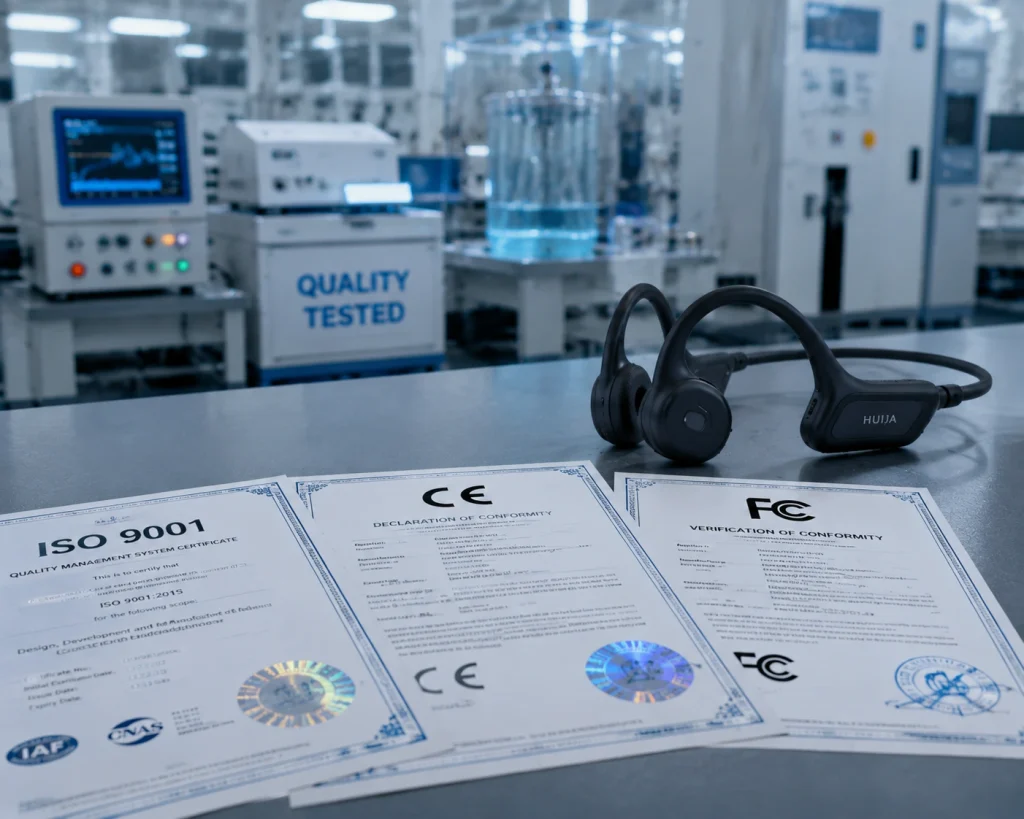
First and foremost, ISO 9001 certification is the gold standard for quality management systems. It indicates that the factory has standardized processes for production, testing, and continuous improvement. Without this, consistency across large-scale manufacturing runs is difficult to guarantee.
For electronic devices, CE (Conformity European) and FCC (Federal Communications Commission) certifications are essential. CE mark confirms that the products meet health, safety, and environmental protection standards for the EEA, while FCC compliance is strictly required for wireless devices exported to the United States. Furthermore, RoHS compliance ensures that the components do not contain hazardous materials, which is a mandatory requirement for environmental health and safety in most developed economies.
When dealing specifically with a swimming headphones manufacturer, the technical requirements shift. You must look for IP68-rated test reports. IP68 signifies that the device is dust-tight and capable of continuous immersion in water under specific conditions. Because high-quality swimming headphones rely on precise acoustic seal integrity, an independently verified IP68 report is the only way to confirm a factory’s capability to prevent internal water damage.
Additionally, if the factory handles lithium-ion batteries, ensure they provide UN38.3 reports. This is a critical safety certification for the transportation of batteries, without which your inventory may be held or rejected by shipping carriers and customs authorities. Always request original copies of these certificates and verify them against the issuing body’s official database to ensure they are current and not expired.
Comparison Table
| Certification Type | Purpose | Necessity |
| ISO 9001 | Quality Management System | Essential |
| CE / FCC | Safety & Radio Frequency Compliance | Mandatory |
| RoHS | Hazardous Substance Restriction | Mandatory |
| IP68 | Waterproofing Standard | Mandatory for Swimming Gear |
| UN38.3 | Lithium Battery Safety | Mandatory for Air Freight |
Industry Insight
The competitive landscape for private label bone conduction headphones has forced manufacturers to invest more heavily in third-party testing. Modern factories that manage OEM bone conduction headphones production now typically operate their own internal reliability labs to perform pre-compliance testing. This internal validation allows manufacturers to catch potential failures in acoustic response or seal leakage before the final certification process, saving significant time and cost. As global regulations like the EU’s Radio Equipment Directive become stricter, a manufacturer’s documentation proficiency—their ability to compile technical files for regulators—is just as important as their actual production output.
Buyer Tips
- Verify Authenticity: Always ask for the certificate’s registration number and cross-reference it with the issuer’s website to ensure it hasn’t been revoked.
- Request Fresh Tests: Ensure that waterproof (IP68) or battery (UN38.3) reports are for the specific model you are sourcing, not just a general factory certification.
- Consider Regional Needs: If you are targeting specific markets, ask if the factory has experience with local requirements like the UKCA mark for the UK or PSE for Japan.
- Demand Transparency: A professional manufacturer will provide these documents readily; hesitation or inability to provide valid test reports is a major red flag.
Common Mistakes
- Accepting “Self-Declarations”: Mistaking a factory’s internal test report for a formal, third-party accredited certification.
- Ignoring Expiry Dates: Failing to check if the certifications provided are still valid or have expired years ago.
- Overlooking Battery Safety: Neglecting UN38.3 reports, which leads to massive delays or complete shipment rejection by air cargo services.
Recommended Internal Links
Related Questions
- How can I verify if an IP68 certification is legitimate?
- What is the difference between CE and FCC compliance?
- Do all headphone manufacturers need ISO 9001 certification?
- Why is UN38.3 certification important for international shipping?
Summary
Securing the correct certifications is the final step in validating a professional bone conduction headphones manufacturer. Whether you are interested in private label bone conduction headphones or developing custom ODM bone conduction headphones, verifying documents like ISO 9001, CE, FCC, and IP68 ensures your products meet international standards. Be mindful that MOQ requirements may vary, but quality and compliance should never be compromised. Proper due diligence regarding these certifications will streamline your supply chain and prevent costly regulatory hurdles. If you need assistance verifying manufacturer qualifications, please visit our Contact Page to discuss your needs.