
Quick Answer
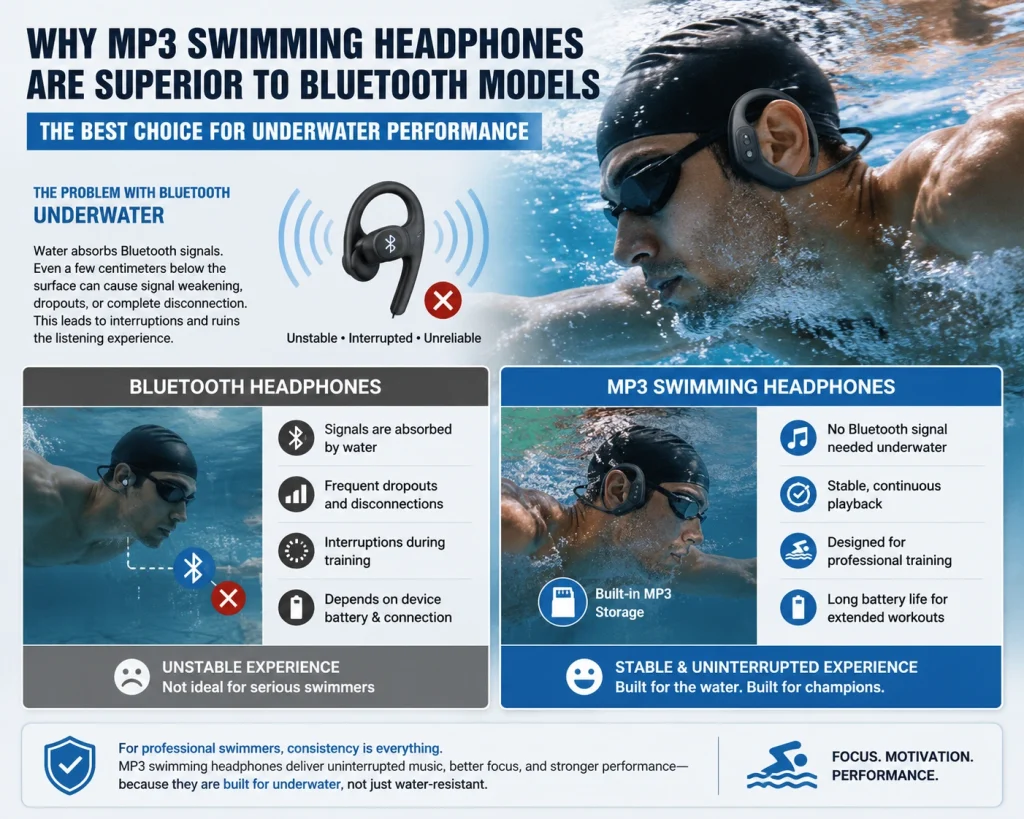
MP3 swimming headphones are superior for aquatic environments primarily because Bluetooth signals cannot effectively propagate through water. Water absorbs high-frequency radio waves, causing constant connectivity loss and audio dropouts during swimming. Integrated MP3 players allow for localized onboard storage, ensuring uninterrupted, high-fidelity audio playback regardless of submersion depth or stroke style. For swimmers, this independence from a paired device is essential for a reliable training experience, making MP3-capable units the preferred choice for a professional swimming headphones manufacturer.
Detailed Answer
The fundamental limitation of Bluetooth technology in water is physics. Bluetooth operates on the 2.4 GHz frequency band, which is heavily attenuated by water molecules. When a user is swimming, even a few centimeters of submersion cause the radio signal to fail, resulting in total loss of connection between the headphones and the smartphone or smartwatch.
In contrast, MP3 swimming headphones function as standalone devices. By integrating internal memory chips—typically ranging from 8GB to 32GB—these devices store audio files directly on the unit. This eliminates the need for an external transmitter, rendering the medium (water) irrelevant to audio playback quality. For any bone conduction headphones manufacturer, developing MP3-integrated models represents a strategic response to the physical constraints of aquatic environments.
Furthermore, relying on Bluetooth for swimming requires the swimmer to wear a compatible device—like a smartwatch—within extremely close proximity to the headphones, often on the same side of the body. This significantly limits movement and training flexibility. MP3-capable hardware provides the swimmer with total freedom of motion, a critical selling point for B2B partners sourcing products for active, performance-focused demographics.
From a technical manufacturing perspective, integrating an MP3 module requires additional circuit board design to handle file decoding and storage management. However, this investment yields a much more stable and satisfying user experience. As the market for private label bone conduction headphones continues to mature, procurement managers are increasingly prioritizing models that offer dual-mode capability—Bluetooth for land-based training and MP3 for dedicated swimming sessions. This versatility is what makes MP3-integrated hardware the gold standard in modern aquatic audio development.
Comparison Table
| Feature | Bluetooth Headphones | MP3 Swimming Headphones |
| Underwater Connectivity | Poor/Non-existent | Perfect/Uninterrupted |
| Signal Range | Very Limited (In-air) | N/A (Internal) |
| Device Dependency | Requires Paired Device | Standalone |
| Best Usage Environment | Land/Gym/Casual | Swimming/Diving/Performance |
Industry Insight
The transition from simple Bluetooth-only units to dual-mode MP3/Bluetooth devices has been a major trend in the OEM bone conduction headphones sector. Factories that successfully implement high-speed data transfer interfaces (typically USB-C or proprietary magnetic pins) are currently seeing the highest demand from Amazon sellers and specialized sports brands. The challenge for a high-quality swimming headphones manufacturer lies in maintaining IP68 integrity while allowing for the charging port and data transfer pins. As competition in the ODM bone conduction headphones space intensifies, products that offer seamless file management combined with reliable battery life are the ones gaining the most significant market traction.
Buyer Tips
- Prioritize Dual-Mode: Source models that offer both Bluetooth for daily use and MP3 mode for swimming to maximize product appeal.
- Verify Memory Standards: Ensure the factory uses high-speed, reliable flash memory chips to prevent file corruption during data transfer.
- Test Waterproofing: Always request independent IP68 certification reports to ensure the internal storage and circuitry are protected during prolonged submersion.
- Check Interface Quality: Evaluate the magnetic charging/data cable design; a robust connection is essential for long-term product durability.
Common Mistakes
- Assuming Bluetooth Works Underwater: Relying on Bluetooth-only models for swimming pools, which inevitably leads to high return rates and customer dissatisfaction.
- Ignoring Data Transfer Speed: Overlooking how long it takes to upload music to the internal storage, which impacts the overall user experience.
- Neglecting File Format Support: Failing to ensure the internal decoder supports popular audio formats like MP3, WAV, and FLAC.
Recommended Internal Links
Related Questions
- What is the maximum storage capacity supported for MP3 swimming headphones?
- How does bone conduction technology perform in water?
- Can I customize the firmware for my private label bone conduction headphones?
- What are the quality control standards for waterproof audio products?
Summary
Choosing between Bluetooth and MP3 functionality is critical when sourcing your next batch of OEM bone conduction headphones. While Bluetooth is ideal for land-based activities, MP3 integration is mandatory for any swimming headphones manufacturer aiming to provide a functional aquatic experience. By understanding these technical requirements, you can better manage your MOQ and select a partner capable of delivering high-quality, reliable ODM bone conduction headphones. Whether you are launching a private label bone conduction headphones line or expanding your sports accessory catalog, prioritizing MP3 capability will significantly enhance product performance and reduce consumer returns in this highly competitive industry.