
When reviewing waterproof headphones supplier test evidence, buyers should verify the product model, test conditions, reported results, and production controls before accepting a waterproof-performance claim. A report may document a particular sample under defined conditions, but it does not automatically establish that every production unit will perform identically or that the product is suitable for every underwater application.
For private-label brands, importers, and distributors, the key question is not simply whether a supplier can provide a test report. It is whether the available evidence applies to the exact product being purchased and supports the intended use.
This guide explains how to assess the relevance and limitations of waterproof test evidence, identify documentation gaps, and make a more informed supplier-acceptance decision.
For a broader supplier evaluation framework, see our guide to evaluating a private label Bluetooth headphones supplier.
1. Confirm the Exact Product Model and Configuration
Before reviewing a waterproof test report, identify the product it covers. Similar-looking headphones may have different internal components, enclosure designs, charging interfaces, buttons, acoustic structures, or sealing arrangements.
Ask the supplier to identify the tested product by its model number and, where applicable, hardware revision, configuration, and sample identifier.
Check whether the report and product documentation refer to the same version. If a report covers an earlier revision, the supplier should explain whether the current product has changed and provide evidence that supports the current configuration.
Important details to compare include:
- Product model and hardware revision
- Physical enclosure and sealing design
- Charging port, connector, or charging-contact arrangement
- Buttons, microphone openings, and other potential water-entry points
- Battery, acoustic, and other relevant component configurations
- Sample identification and the relationship between the tested sample and the proposed commercial product
A matching product name alone is not enough. Buyers should look for traceable evidence connecting the report to the actual product configuration.
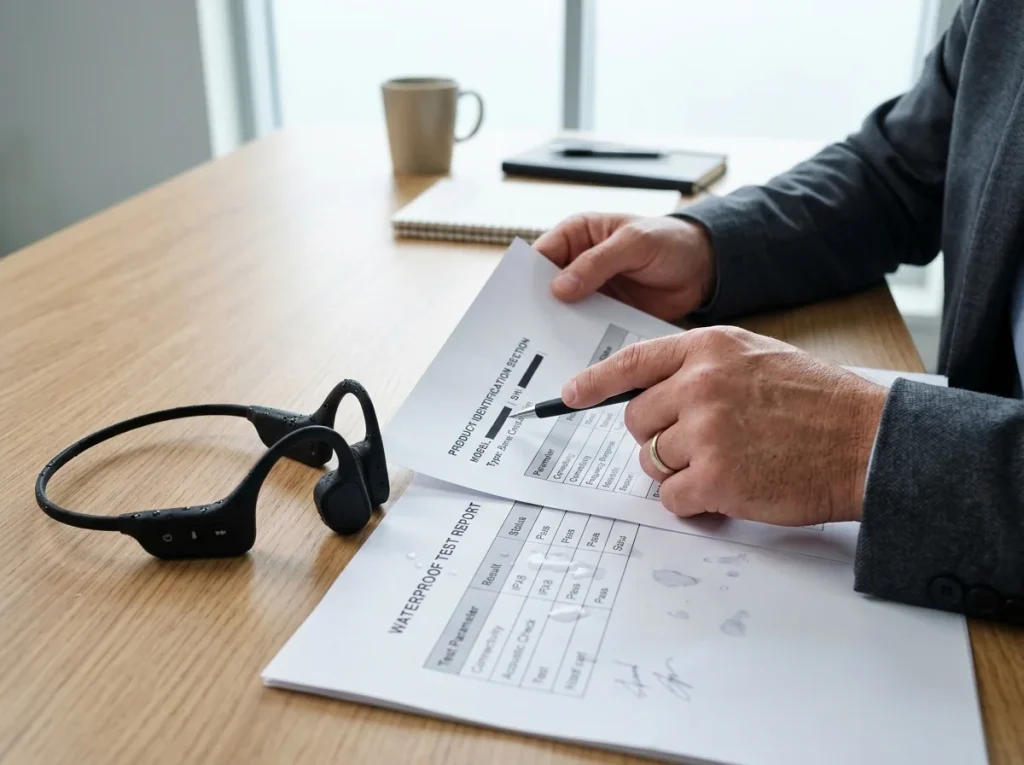
2. Review the Test Method, Conditions, and Results
A useful report should provide enough information for the buyer to understand what was tested and under which conditions.
Review the test method, applicable standard or procedure, test date, sample identification, exposure conditions, acceptance criteria, and recorded result. Where relevant, check the stated water-exposure duration, pressure or depth conditions, sample preparation, and whether the product was inspected or tested for function after exposure.
The level of detail required depends on the claim being evaluated. If a supplier makes a specific underwater-use claim, a brief statement such as “waterproof tested” may not provide enough evidence to assess it.
Questions to ask include:
- What test method or standard was used?
- Which product model and revision were tested?
- What were the exposure conditions and duration?
- What criteria defined a pass or failure?
- Was the product inspected or functionally checked after exposure?
- Does the report identify the sample and the party that performed the test?
If key details are missing, request clarification or additional records. Do not assume that an unexplained result establishes performance under conditions that were never documented.
3. Distinguish an IP Rating from an Underwater-Use Claim
An ingress protection (IP) rating describes protection against specified forms of ingress under the applicable test conditions. It should not be interpreted as an unrestricted promise of waterproof performance.
For example, an IPX8 claim relates to water immersion under conditions defined by the applicable requirements and testing arrangement. The designation alone does not tell a buyer that a product can be used at any depth, for any duration, or in every aquatic environment.
This distinction matters when evaluating swimming headphones, bone conduction headphones intended for aquatic activities, and waterproof MP3/Bluetooth dual-mode products. Their intended functions and operating conditions may differ.
Before accepting an underwater-use claim, establish:
- The exact rating or performance claim being made
- The applicable test standard or procedure
- The immersion conditions covered by the evidence
- The intended activity and operating conditions
- Any stated restrictions, exclusions, or operating instructions
If a supplier claims suitability for deeper-water use or other conditions beyond the documented test, ask for evidence that specifically addresses those conditions. Do not infer deep-water pressure resistance from an IP rating alone.
4. Determine Whether the Evidence Applies to the Commercial Product
A test report can be technically valid for the sample tested but still be insufficient for a purchasing decision if the commercial product differs from that sample.
Compare the report against the latest specification sheet, approved sample, product drawings or relevant configuration records, and any declared changes. Confirm that the tested version corresponds to the version proposed for quotation, sampling, or mass production.
Pay particular attention to differences in:
- Housing geometry and enclosure assembly
- Gaskets, adhesives, seals, and other sealing-related components
- Charging structures and external openings
- Component suppliers or materials that may affect sealing
- Assembly methods or other processes relevant to waterproof performance
Not every product change invalidates a previous test. However, a supplier should assess whether the change could affect the tested performance and explain what verification is appropriate.
If the report covers a different configuration, ask the supplier to document the difference and its impact assessment. Where the effect cannot be established from existing evidence, additional evaluation may be necessary before acceptance.
5. Check How Product Changes Are Controlled
Waterproof performance can depend on the interaction between product design, materials, components, and assembly. A sample that passes a test does not, by itself, establish that a later modified version will perform in the same way.
Buyers should therefore ask how the supplier identifies and reviews changes that may affect sealing or water resistance.
Relevant change-control questions include:
- Are changes to sealing-related components recorded?
- Can the supplier identify which model revision was tested?
- Are changes to housing, adhesives, gaskets, or assembly methods reviewed for potential impact?
- Who decides whether additional verification is required?
- Are revised samples or reports linked to the applicable product revision?
- How are approved specifications communicated to production?
The objective is to establish a traceable relationship between the approved configuration, the supporting evidence, and the product supplied. Buyers should not assume that a previous report remains applicable after every design or process change.
6. Ask How Waterproof-Related Quality Checks Are Controlled in Production
Laboratory testing and production quality control answer different questions.
A laboratory report may provide evidence about a defined sample under specified conditions. Production records help buyers understand whether relevant controls are applied during manufacturing and whether inspection results are documented for the products or batches concerned.
Ask the supplier which sealing-related checks are relevant to the product, at what production stage they are performed, and how results are recorded. Depending on the design and established process, relevant controls may include inspection of sealing components, checks of assembly conditions, visual inspection, or a defined leak or water-resistance test.
Do not assume that every supplier uses the same process or that every product requires the same checks. The appropriate controls depend on the design, risk, and agreed product requirements.
Useful evidence may include:
- The applicable inspection procedure or control plan
- Defined acceptance criteria
- Completed inspection or test records, where available
- Identification of the product model, batch, or sample covered
- Records of nonconformities and corrective actions, where relevant
- An explanation of how changes to the process are reviewed
A generic quality statement is not equivalent to a completed record. Buyers should establish what is actually controlled, what evidence is available, and which questions remain unresolved.

7. Understand the Different Types of Evidence
Not all evidence has the same purpose or level of independence. Buyers should assess each item according to what it can establish rather than treating every document as equivalent proof.
| Evidence item | What it establishes | What it does not establish | Follow-up questions |
|---|---|---|---|
| Product test report | Recorded results for the identified sample under the stated test conditions | Performance of every production unit or suitability beyond the tested conditions | Does the report identify the exact model, sample, method, conditions, and result? |
| Third-party test report | Test findings issued by an external testing organization, within the report’s stated scope | Automatic applicability to a different model or configuration | Who issued the report, and which product version and tests does it cover? |
| Internal test record | Results documented by the supplier’s own testing or inspection process | Independent third-party verification | What procedure and acceptance criteria were used, and how is the record traceable? |
| Production inspection record | Documented checks for the identified production stage, sample, or batch | Universal waterproof performance unless the check specifically supports that conclusion | Which model or batch was checked, and what were the results? |
| Product specification or declaration | The supplier’s stated product configuration or performance claim | Independent confirmation that the claim has been demonstrated | Which test evidence supports the claim, and does it cover the current version? |
| Marketing material or product listing | How the product is described or promoted | Technical proof of waterproof performance | Can the supplier provide the underlying report or relevant test records? |
| Change-control record | Documented review of a product or process change | Proof of performance unless supported by suitable verification | What changed, what impact was assessed, and was further testing required? |
A third-party report may add useful independent evidence, but buyers still need to verify its authenticity, scope, and relevance. An internal record may also be useful when its method, criteria, traceability, and results are sufficiently documented.
8. Document Gaps Before Accepting a Supplier’s Claim
When the available evidence is incomplete, record the gap rather than treating the claim as confirmed or rejecting it without further review.
A practical evidence review should identify the missing information, the person responsible for providing it, and the decision that depends on it. This creates a clear record for supplier discussions, sample approval, and purchasing decisions.
Common gaps include:
- The report does not identify the exact model or revision.
- The test conditions are missing or do not match the intended use.
- The supplier provides a rating claim without the supporting report.
- A report covers a sample that differs from the proposed commercial product.
- A design or process change has not been assessed for its possible effect on sealing.
- Production checks are described, but relevant records or acceptance criteria have not been provided.
- The supplier cannot explain whether additional verification is needed.
Before accepting the claim, decide whether each gap is resolved, requires additional evidence, or must remain an explicit limitation on the purchasing decision.
A supplier’s willingness to explain the scope and limitations of its evidence is useful during evaluation, but communication alone is not a substitute for the required technical records.
9. Use a Waterproof Test-Evidence Review Checklist
Use the following checklist to compare suppliers consistently and document the basis of your decision.
| Review item | Acceptance question | Status to record |
|---|---|---|
| Model and revision | Does the evidence identify the product configuration being purchased? | Verified / Missing / Clarification required |
| Test method | Is the method or applicable standard identified? | Verified / Missing / Clarification required |
| Test conditions | Are the relevant exposure conditions and duration documented? | Verified / Missing / Clarification required |
| Test result | Are the outcome and acceptance criteria clear? | Verified / Missing / Clarification required |
| Intended use | Does the evidence support the stated application and operating conditions? | Verified / Missing / Clarification required |
| Report source | Is the issuing party identified, and can the report be checked where necessary? | Verified / Missing / Clarification required |
| Product changes | Have relevant design or process changes been reviewed? | Verified / Missing / Clarification required |
| Production controls | Are relevant quality checks and available records explained? | Verified / Missing / Clarification required |
| Open issues | Are unresolved gaps assigned for follow-up before the relevant approval stage? | Closed / Open / Conditional |
Use “Verified” only when the available evidence supports the specific point being assessed. “Missing” means the necessary evidence has not been provided, while “Clarification required” means the material is available but does not yet establish the point clearly enough.
The final decision should reflect the intended use, the evidence required for that application, the product configuration, and any unresolved risks. If a material gap remains, request additional documentation or appropriate verification before approving the waterproof claim for the intended purpose.
Conclusion
Evaluating waterproof headphones requires more than checking whether a supplier advertises an IP rating or provides a test report. Buyers need to establish what was tested, under which conditions, which product configuration the evidence covers, and how relevant performance is controlled when the product enters production.
For private-label projects, maintaining consistency between the tested sample, approved specification, and commercial product is particularly important. By reviewing report scope, documenting product changes, examining production controls, and recording unresolved evidence gaps, buyers can make more transparent and defensible supplier-acceptance decisions.
A waterproof claim should be accepted only to the extent supported by relevant evidence—not beyond the documented conditions or intended application.