
Before approving a private label Bluetooth headphones supplier, buyers should request documents that identify the exact product, explain its technical configuration, support relevant quality and performance claims, and establish which compliance requirements apply. A supplier’s website or general certificate list is not enough to verify that the documents cover the model being purchased.
The right document package depends on the headphone design, destination market, customization scope, and stage of the sourcing process. Buyers do not need every possible report for every product, but they should know which documents are essential, which may be available on request, and which gaps must be resolved before approval.
This guide explains what to request from a private label Bluetooth headphones supplier, how to check document applicability, and how to follow up when evidence is incomplete.
For a broader supplier assessment framework, see [How to Evaluate a Private Label Bluetooth Headphones Supplier: Product Fit, Quality Evidence and Order Readiness].
1. Request Product Specifications and Model Identification
Start with a current product specification sheet. It should identify the proposed model and describe the configuration being quoted, rather than presenting a generic catalogue covering several products.
Depending on the model, the specification may include the product type, dimensions, weight, Bluetooth version, battery details, charging method, microphone functions, controls, supported features, accessories, and stated operating conditions.
Check that the model name and number are consistent across the specification sheet, quotation, sample label, packaging information, and any available test reports. If the supplier uses internal model codes that differ from the public product name, request a written mapping between them.
Also ask for a document revision date or version number. Without version control, buyers may not be able to determine whether the specification describes the sample they evaluated or an earlier product configuration.
2. Ask for Relevant Component Information
A complete bill of materials (BOM) may not be available to every buyer, particularly where it contains confidential supplier or design information. However, the supplier should be able to clarify the components or configuration details that materially affect product performance, compatibility, compliance, or change control.
Depending on the project, relevant information may include the Bluetooth chipset or platform, battery specification, charging components, microphone configuration, acoustic components, and other critical parts. Request the level of detail needed to evaluate the product, while recognizing that a supplier may reasonably protect proprietary design information.
The purpose is not necessarily to obtain every internal part number. It is to establish whether the quoted product has a defined configuration and whether important component substitutions will be communicated.
If the supplier cannot provide a full BOM, ask whether it can provide a controlled component summary or identify critical components by function and specification. Record any limitations and agree on how future substitutions will be reviewed.
3. Request Quality-Control Procedures and Inspection Records
Ask the supplier which quality-control documents are available for the proposed product or manufacturing process. Useful examples may include incoming quality control (IQC) records, in-process quality control (IPQC) records, final quality control (FQC) inspection criteria, sample inspection results, and nonconformance or corrective-action records.
Not every document needs to be supplied at the initial enquiry stage. A process overview and representative record may be sufficient for preliminary screening, while order-specific inspection records may be created later.
When reviewing a record, check the date, product or model identifier, inspection stage, criteria used, result, and responsible party. Determine whether it is a completed record for a specific sample or batch, a blank form, or simply a general procedure.
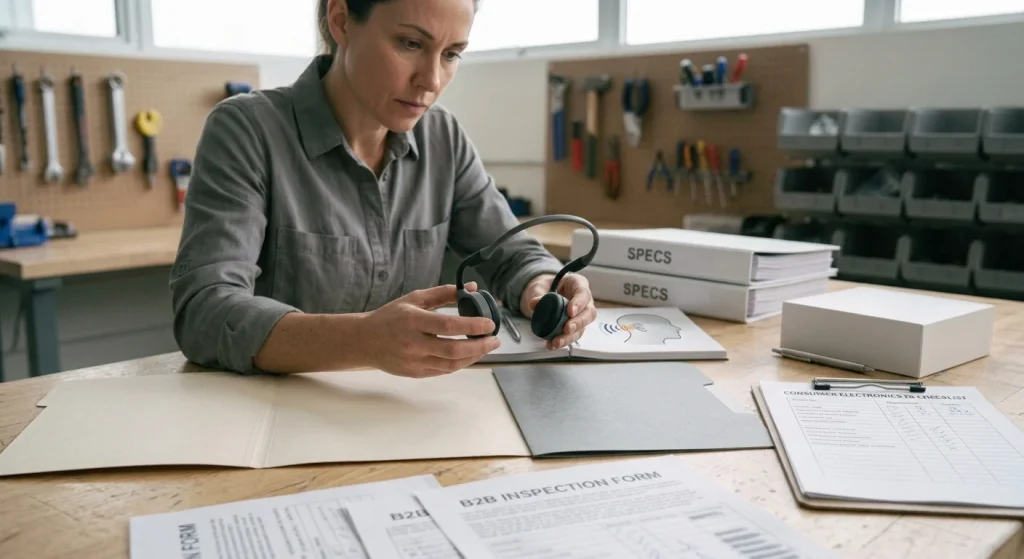
A procedure shows what should happen; a completed record shows what was documented on a particular occasion. Neither should be treated as proof of every aspect of product quality. If a supplier provides only blank templates, ask when and how completed records will be made available for the order.
4. Check Product Test Reports and Their Scope
Product test reports should support the particular performance or safety claims relevant to the intended use and destination market. Depending on the product, buyers may need to review reports relating to electrical safety, radio-frequency performance, battery-related requirements, waterproof performance, or other applicable characteristics.
For each report, verify:
- The issuing laboratory or organization
- Report number and issue date
- Product name, model number, and tested configuration
- Test method or standard referenced
- Conditions and limitations of the test
- Results and any stated exceptions
Check whether the report covers the complete headphone product, a component, or a different model. A report for a similar-looking product is not automatically evidence for the product being purchased.
If the supplier says several models are covered by one report, request the model list or supporting explanation showing how the tested configuration relates to each model. If the product has been modified since testing, ask whether the change affects the report’s applicability and whether additional assessment is necessary.
A test report, a test plan, and a supplier’s statement that testing has been completed are different forms of evidence. Record which one has been provided and what remains outstanding.
5. Verify Regulatory and Certification Documents
CE, FCC, RoHS, BQB, and ISO 9001 refer to different types of regulatory, product-compliance, qualification, or quality-management considerations. They are not interchangeable, and a buyer should not assume that every headphone product requires the same documents or that one certificate covers every model.
First identify the destination market and the applicable requirements for the product configuration. Then ask the supplier to provide the relevant declarations, certificates, registration or qualification details, and supporting reports that are applicable to that product and market.
For each document, check the issuer, document number, issue or expiry date where applicable, scope, model identifiers, and any limitations. Where an official database or issuer verification service is available, use it to confirm the information rather than relying solely on a screenshot.
For Bluetooth products, buyers should review the official Bluetooth SIG product qualification guidance. The Bluetooth SIG explains that applicable Bluetooth products must complete the qualification process before being marketed or distributed, and that product names and model numbers must match the information used for marketing and sale. Buyers should establish which company is responsible for the applicable qualification steps and verify the relevant product information.
For an ISO 9001 certificate, check the certified organization’s legal name, the sites and activities in scope, the issuing certification body, and the certificate’s validity. A quality-management-system certificate is not a product test report and does not independently prove that a particular headphone model meets every product requirement.
The same principle applies to CE, FCC, and RoHS documentation: the exact evidence and obligations depend on the applicable rules, product configuration, market, and responsible economic operator. Ask for documents that match the intended product instead of treating a general certificate list as blanket coverage.
6. Request Factory and Quality-Management Evidence
To understand how the supplier manages product quality, request evidence appropriate to the stage of evaluation. This may include a process overview, relevant production-area photographs, inspection procedures, representative completed quality records, or a quality-management certificate if one is claimed and relevant.
Check whether the evidence identifies the actual organization and location involved in the work. If manufacturing, assembly, or testing is outsourced, ask which organization performs each activity and who controls the associated records.
When a supplier claims to hold ISO 9001 certification, request the certificate and check its scope and validity. Do not infer certification from a factory photograph, a quality-control checklist, or a statement that the company follows quality procedures.
The objective is to understand what is documented and who is accountable, not to turn this document request into a full factory audit. If the evidence raises a significant concern, record it as a separate follow-up item before proceeding.
7. Confirm Packaging, Labeling, and Market Documentation
Private-label orders may require more than product specifications and test reports. Buyers should also establish which packaging and market-specific documents are relevant to the intended destination and sales channel.
Depending on the order, request or confirm the approved packaging artwork, product and model identification, user manual, required warnings, product labels, barcode information, and any applicable declarations or shipment documents. Not every item applies to every product or destination.
Review whether the brand name, model number, product description, and relevant ratings are consistent across the product, packaging, manual, and compliance documentation. If a label or manual is still being developed, record who is responsible for approving it and when the final version must be available.
Do not assume that a supplier’s existing packaging or standard manual is suitable for every market. The buyer and supplier should identify the applicable requirements and approve the correct version before production or shipment.
8. Control Document Versions and Follow Up on Missing Evidence
A document package is useful only if buyers can tell which version is current and what it actually covers. Keep a simple record of each document’s filename, model, revision or issue date, source, review status, and unresolved questions.
When a document is missing, avoid recording it as verified simply because the supplier says it exists. Instead, mark it as requested, pending, not applicable, or unavailable, and state the reason for that status.
For each outstanding item, record the responsible person, the evidence required, and the deadline or approval stage by which it must be resolved. If a supplier provides a replacement document, check whether the new version supersedes the previous one and whether it changes the model scope or stated result.
Before sample approval, production release, or shipment, review the outstanding items against the requirements agreed for that stage. Some documents may be appropriate to request during initial screening; others may only be available after a sample is tested or an order-specific inspection is completed.
9. Use a Supplier Document Request Checklist
Use the checklist below to compare supplier responses consistently. It distinguishes the evidence requested from what the document can actually establish.
| Document or evidence | What it helps verify | What to check | Common gaps |
|---|---|---|---|
| Product specification sheet | Model configuration and stated features | Model number, revision, technical details, date | Generic or outdated specification |
| Relevant component summary or BOM | Critical component configuration | Scope, version, key component details | Full BOM unavailable; substitutions not addressed |
| Quality procedures | Planned inspection and quality controls | Process scope, inspection stage, responsibility | General statements without defined criteria |
| Completed inspection records | Documented inspection results | Model, date, criteria, result, traceability | Blank templates or records for another model |
| Product test reports | Results for stated tests | Issuer, report number, model, test method, result | Different model, incomplete scope, unclear conditions |
| Regulatory declarations or certificates | Applicable compliance status | Market, issuer, scope, model, validity | Expired, unverifiable, or mismatched documents |
| Bluetooth qualification details | Applicable Bluetooth qualification status | Product name, model number, official listing | Qualification status assumed from chipset information |
| ISO 9001 certificate, if claimed | Quality-management-system certification | Legal entity, site, scope, issuer, validity | Scope does not match the relevant organization or site |
| Factory or process evidence | Relevant manufacturing and quality arrangements | Location, activity, responsible organization | Undated or unrelated photographs |
| Packaging artwork and manual | Approved product presentation and labeling | Model, brand, language, warnings, revision | Unapproved artwork or inconsistent model details |
| Shipment and destination documents, where applicable | Readiness for the intended delivery arrangement | Required fields, destination, responsibilities | Requirements checked too late or incomplete documents |
The checklist is a starting point, not a universal list of mandatory documents. Mark each item as Verified, Pending, Not Applicable, or Unavailable, and record why. If a document is not applicable, retain the reason rather than leaving the field ambiguous.
Conclusion
A reliable supplier-document review connects each document to a specific question: Which product is being supplied? What configuration was evaluated? Which quality or performance claims are supported? Which compliance requirements apply? And what remains unresolved before the next approval stage?
For a private label Bluetooth headphones supplier, the key is not the number of files received but their relevance, traceability, scope, and consistency. A documented request-and-follow-up process helps buyers identify gaps early and make sourcing decisions on verifiable information rather than assumptions.