
Feature descriptions alone do not tell buyers whether a headphone will deliver the sound and call quality they expect. Terms such as “custom EQ,” “clear calls,” and “dual-microphone ENC” describe intended functions, but they do not establish measurable performance. When evaluating OEM headphones audio tuning and ENC, buyers should define the listening experience, microphone requirements, test conditions, and sample-approval criteria before moving into production.
A reliable evaluation combines objective measurements with listening and voice tests. It also requires the manufacturer and buyer to use consistent product versions and repeatable test conditions.
What Does Custom EQ Sound Tuning Involve?
Custom EQ tuning adjusts the product’s frequency response to shape its sound. The main areas buyers usually discuss are bass, midrange, and treble.
- Bass: Influences perceived weight, impact, and low-frequency presence.
- Midrange: Carries much of the information in vocals, speech, and many musical instruments.
- Treble: Influences detail, brightness, and the perception of high-frequency sounds.
The desired balance depends on the product’s intended audience and listening scenarios. A headphone positioned for everyday calls and general listening may require a different sound profile from one designed primarily for exercise or music playback.
Tuning also depends on the acoustic structure. Driver characteristics, housing design, acoustic openings, seals, wearing position, and the way sound reaches the ear can all affect the result. Therefore, EQ adjustments should be evaluated on the actual product structure rather than treated as a software setting that works independently of hardware.
Buyer preference is important, but it should be translated into clear listening goals. Instead of requesting simply “stronger bass” or “more clarity,” buyers can identify reference tracks, describe the desired tonal balance, and compare listening results with measured frequency-response data.For projects involving bone conduction products, learn more about bone conduction headphones manufacturing.
How Should Buyers Evaluate Acoustic Performance?
Frequency-response measurement helps show how a headphone reproduces different frequencies under defined test conditions. It can help identify tonal balance, left-right differences, and changes between samples.For a recognized reference on headphone characteristics and measurement methods, buyers can consult IEC 60268-7:2025 for headphones and earphones.
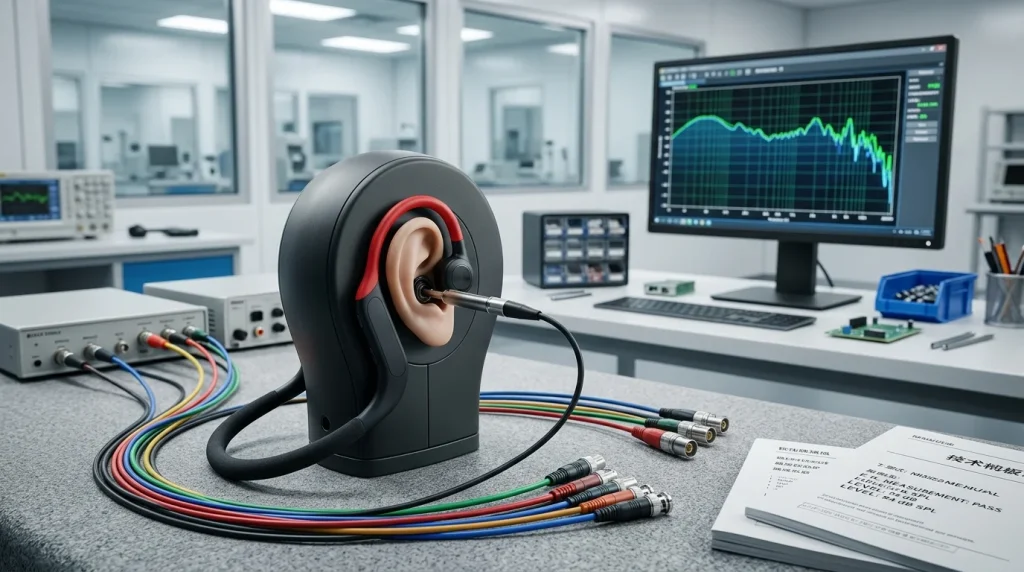
However, a frequency-response graph is meaningful only when the measurement method is understood. Buyers should ask the manufacturer to identify:
- The test fixture, ear simulator, coupler, or head-and-torso simulator used.
- The measurement position and wearing or mounting procedure.
- The input signal, volume or reference level, and relevant device settings.
- Whether compensation or smoothing has been applied to the displayed response.
- How many remounts or repeated measurements were made.
An acoustic test chamber may be used as part of a controlled measurement environment, but it is not the only possible setup and should not be treated as a universal requirement. The important point is to document the method and use it consistently.
Repeatability matters as much as the first measurement. Small changes in positioning, contact, leakage, or fixture setup can affect results. Buyers should therefore compare repeated measurements and, where practical, evaluate more than one sample. Listening tests should complement measurements: use the same source material, playback level, fit, and listening conditions when comparing samples.For a practical discussion of headphone test repeatability, see Klippel’s application note on QC headphone testing.
What Does Dual-Microphone ENC Do?
ENC, commonly used to describe environmental noise cancellation or reduction in calling applications, refers to processing intended to reduce unwanted background sound in the microphone signal while preserving the speaker’s voice.
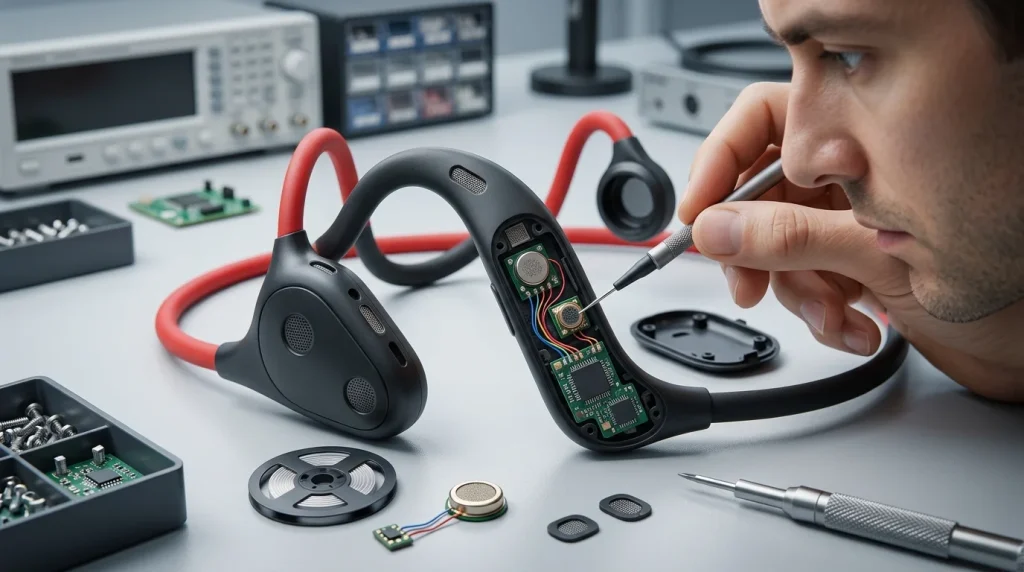
In a dual-microphone design, two microphone signals may be used together to help distinguish the user’s voice from surrounding noise. The actual result depends on microphone characteristics, physical placement, acoustic design, signal processing, and the operating environment.
The number of microphones alone does not establish call quality. Two products with the same microphone count can behave differently because their microphone positions, sensitivity, directionality, enclosure design, and processing implementations may differ.
ENC should also be distinguished from ANC. ENC is generally associated with improving the transmitted voice signal during calls. ANC (active noise cancellation) is intended to reduce noise heard by the headphone wearer. They address different signal paths and should have separate requirements and test procedures.
ENC is not expected to remove every sound in every environment. Wind, sudden impacts, competing speech, microphone obstruction, and high or changing background noise can all affect performance. Buyers should evaluate intelligibility and naturalness, not just whether background noise becomes quieter.Microphone characteristics such as sensitivity, directional response, and dynamic range are addressed in IEC 60268-4:2018 for microphones.
How Can Buyers Test ENC Performance?
An ENC evaluation should use repeatable conditions rather than relying on a single informal phone call. A practical test plan can include:
- Define the test environment. Record the background-noise type, approximate level, source position, and distance from the headset.
- Use consistent speech material. Use the same speaker, spoken phrases, language, speaking distance, and voice level for comparisons.For speech-based testing, ITU-T Recommendation P.501 provides test signals for telephony and other speech-based applications.
- Test different noise scenarios. Include steady background noise, traffic-like noise, competing speech, and other environments relevant to the product’s intended use.
- Check voice intelligibility. Listen for missing words, distortion, unnatural voice changes, pumping, or excessive suppression.
- Compare microphone placement. Confirm that the product is worn in the intended position and that microphone openings are not covered.
- Compare against an approved reference sample. Use the same test setup and playback method for the reference and revised samples.
Record the source device, connection method, firmware version, and any call-processing settings that may affect the result. If a test is performed through a mobile network or calling application, note that the network and application can influence the transmitted audio. A controlled recording or repeatable test signal can help isolate product behavior from those external variables.
What Should Be Included in an Audio Performance Specification?
A useful specification turns subjective expectations into requirements that can be reviewed and approved. Buyers should consider including the following items:
| Specification area | What to define |
|---|---|
| Intended use | Music, calls, sports, commuting, or mixed use |
| Sound profile | Desired bass, midrange, and treble balance; reference tracks |
| Acoustic measurement | Fixture or coupler, positioning, input conditions, and reporting method |
| Microphone requirements | Microphone configuration, placement, and voice-pickup expectations |
| ENC evaluation | Noise scenarios, speech material, listening or analysis method |
| Performance criteria | Agreed measurement limits and/or documented listening criteria |
| Test conditions | Source device, connection, volume, environment, and wearing position |
| Acceptance criteria | Required results, sample quantity, and approval authority |
| Version control | Hardware revision, firmware version, EQ profile, and test-report revision |
Not every project needs a complex laboratory specification. The level of detail should match the product’s market position, technical risk, and intended use. What matters is that both parties agree on how performance will be evaluated before sample approval.
How Should Buyers Approve Final Audio Performance?
Audio approval should be based on a documented sample, not on a verbal description or an isolated demonstration. Buyers can begin with an initial tuning sample, review its measurements and listening results, and provide specific revision feedback.For an overview of product customization and development support, explore YONG YUNG’s custom headphones OEM and ODM manufacturing services.

When a change is requested, identify what changed and why. For example, distinguish an EQ adjustment from a microphone-position change or a hardware revision. These changes can affect different parts of product performance and should not be treated as interchangeable.
Once the buyer approves a sample, record its hardware version, firmware version, EQ settings, microphone configuration, and relevant test results. This becomes the reference for subsequent revisions and production checks.
Before mass production, buyers should also agree how production samples will be compared with the approved reference. The same test method should be used wherever practical, and any change to components, firmware, acoustic structure, or microphone placement should trigger a review when it may affect approved performance.
Conclusion
Evaluating custom tuning and ENC requires more than checking a feature list or counting microphones. Buyers should define the intended sound, document acoustic and microphone test conditions, compare samples consistently, and approve performance against clear criteria.
For an OEM project, these steps help turn subjective expectations into a shared technical reference. They also make revisions easier to communicate and provide a more consistent basis for production evaluation.
For a broader overview of project planning, sample approval, technical coordination, and production preparation, read How to Work with an OEM Audio Manufacturer in China: From Project Planning to Production.