
Quick Answer
Custom headphones MOQ, FOB pricing, and Amazon FBA requirements affect how buyers plan quantities, compare supplier quotations, customize products, and prepare shipments. MOQ may vary by product model, color, logo application, retail packaging, and tooling requirements. FOB quotations should identify the named port and clarify which costs and responsibilities are included rather than being treated as a delivered-to-destination price. For Amazon FBA orders, buyers should confirm the applicable product barcodes, unit preparation, carton labels, packaging specifications, and shipment information before production and dispatch. The exact requirements depend on the product configuration, destination market, shipping arrangement, and current marketplace rules.
Detailed Explanation
1. How Product Model and Customization Scope Affect MOQ
Minimum order quantity (MOQ) is the minimum quantity a supplier agrees to produce or supply under a defined set of commercial and product conditions. For custom headphones, the relevant MOQ may depend on whether the buyer selects an existing model, requests limited branding changes, or needs a more extensive product modification.
An existing product platform may require a different order plan from a project involving new housing components, customized electronics, or project-specific tooling. The same distinction can apply to packaging: a product may use an existing standard box, while a custom-printed retail box may have separate printing or material-order requirements.
Before comparing offers from a custom headphones manufacturer, ask for MOQ by model and customization scope rather than relying on a general statement about flexible quantities.
For each proposed order, clarify:
- Product model: Is the order based on an existing model or a newly customized design?
- Quantity basis: Does the MOQ apply to the complete order, each model, or each individual variant?
- Color configuration: Does each housing color or product version have a separate minimum?
- Logo application: Is the requested branding method available for the selected model, and does it affect the minimum order?
- Packaging: Can the requested retail box be ordered in the same quantity as the headphones, or does the packaging supplier have a different minimum?
- Tooling and special components: Do the requested changes introduce additional setup, tooling, or component-sourcing requirements?
These details matter because a quotation for one model in one color may not apply to an order split across several models, colors, or packaging versions.
For example, a buyer planning an initial order of several hundred headphones across three colors should not assume that the supplier can divide the quantity equally among the colors without changing the MOQ or unit price. The supplier needs to confirm the production and material requirements for that specific configuration.
The practical approach is to request the minimum quantity for each configuration and identify any quantities that can be combined. Do not assume every customization is available at a low MOQ.
For a broader overview, the custom headphones OEM/ODM project guide covers specifications, samples, testing, and bulk production. The parent article’s published URL should be confirmed before this phrase is linked.
2. Why Logos, Colors, Packaging, and Tooling Change Order Planning
Customization involves more than adding a logo to a finished headphone. Different changes can affect materials, production steps, purchasing quantities, sample approvals, and the timing of the order.
Logo and branding
Ask which logo methods are available for the chosen model, such as printing, engraving, or another agreed application. Confirm the artwork format, dimensions, position, color requirements, and approval process. Different methods may have different setup requirements, so the quotation should specify what is included.
Housing colors
A standard color may use an existing material or finish, while a custom color can require a separate material arrangement or color-matching approval. Confirm whether the color applies to the headphone body, ear hooks, charging accessories, or all relevant components. Also ask whether each color counts as a separate MOQ.
Custom retail packaging
A custom-printed retail box can involve artwork preparation, structural design, printing, finishing, inserts, and packaging materials. Ask whether the quote covers the complete packaging set or only the printed outer box. Confirm the order quantity required by the packaging supplier and whether excess packaging materials may remain after the headphone production run.
If branded retail packaging is required, document the approved artwork, dimensions, materials, inserts, manuals, and included accessories before production.
New tooling or component changes
Changes to a housing, internal structure, or other molded components may require a separate engineering review and tooling decision. These changes should be distinguished from standard branding or packaging customization because the cost, approval process, and production implications may be different.
Buyers should request a breakdown of the proposed customization scope instead of treating all changes as part of one unspecified “customization fee.”
3. How to Compare Supplier Quotations Using Equivalent Specifications
A lower quoted unit price does not necessarily mean a lower overall order cost. Quotations may cover different product configurations, customization levels, packaging, inspection arrangements, or trade terms.
Before comparing suppliers, prepare a common specification sheet and ask each supplier to quote against the same requirements.
| Quotation item | What buyers should confirm |
|---|---|
| Product model | Exact model, version, and agreed configuration |
| Core specifications | Relevant audio, connectivity, physical, and waterproofing requirements, where applicable |
| Included accessories | Charging cable, storage accessories, manuals, and other specified items |
| Logo customization | Method, artwork, location, colors, and any separate setup charge |
| Product color | Standard or custom color and whether quantities are split by variant |
| Retail packaging | Box type, printing, insert, manual, barcode, and other packaging components |
| MOQ | Minimum quantity for each model, color, and customization configuration |
| Sample and setup costs | Which sample, artwork, tooling, or setup costs are included or charged separately |
| Quality requirements | Agreed inspection scope, acceptance criteria, and handling of identified defects |
| Trade terms | Incoterm, named port, and the responsibilities covered by the quotation |
| Logistics | Freight, insurance, export handling, destination charges, and other exclusions |
| Documentation | Which product, shipment, and compliance documents are included |
Check whether all suppliers are quoting the same quantities and configuration. A standard model with a logo and stock packaging should not be compared directly with a quotation that includes custom colors, printed retail boxes, and additional tooling.
The quotation should also state its currency, validity period, payment terms, and applicable exclusions. If these details are missing, ask for written clarification before making a decision.
A comparison spreadsheet can help buyers separate the product price from one-time or order-specific charges. It also makes it easier to identify whether a difference comes from product specifications, customization, order quantity, trade terms, or logistics.
If a quotation cannot be mapped to a clear specification, ask for a revised, itemized offer before comparing suppliers.

4. What FOB Pricing Means and What Buyers Must Clarify
FOB stands for Free On Board. Under FOB Incoterms® 2020, the seller delivers the goods on board the vessel nominated by the buyer at the named port of shipment. Risk transfers when the goods are on board the vessel, and the buyer bears costs from that point onward under the rule.
For the formal definition, consult the ICC’s FOB Incoterms® 2020 guidance.
A quotation described simply as “FOB price” is incomplete for comparison purposes unless the relevant terms are clear. Buyers should confirm:
- Named port of shipment: Which port is specified in the quotation and purchase agreement?
- Incoterms version: Are both parties using the same version, such as Incoterms® 2020?
- Seller’s responsibilities: Which agreed activities and costs are included up to delivery on board the vessel?
- Risk transfer: At which point does the risk of loss or damage transfer under the agreed term?
- Ocean freight: Is international freight quoted separately by the freight provider?
- Cargo insurance: Who is arranging insurance, and what coverage has been agreed?
- Destination charges: Are import clearance, duties, taxes, destination handling, and inland transport excluded from the FOB quotation?
- Additional services: Are special packaging, inspections, documentation, or other requested services included or billed separately?
FOB should not be treated as a price that includes every expense up to the buyer’s warehouse or Amazon fulfillment center. The actual cost to receive inventory at its destination may also include international freight, insurance, import-related charges, local handling, and onward transportation, depending on the agreed arrangement.
There is also an important transport-mode distinction. ICC guidance states that FOB is intended for sea and inland waterway transport when delivery is made on board a vessel. If containerized goods are handed to a carrier at a terminal before being loaded on board, the parties should ask their freight provider whether FCA would be more appropriate for the actual handover.
For a fair quotation comparison, evaluate the product price and logistics cost separately, then calculate the estimated total landed cost using the same destination and shipping assumptions.
5. Which Packaging, Barcode, and Carton Details Should Be Confirmed for Amazon FBA?
Amazon FBA preparation should be considered during order planning, not after the headphones have already been packed.
The requirements for a shipment depend on its marketplace, product listing, fulfillment method, packaging configuration, and the instructions generated in the seller account. Buyers should therefore establish the intended shipment arrangement before finalizing retail packaging and carton specifications.
Product-level requirements
Confirm the product identifier and barcode arrangement for the exact listing. Depending on the product and its eligibility, the applicable identifier may involve a manufacturer barcode or an Amazon barcode such as an FNSKU. Do not print or apply labels based on an assumption that every product uses the same barcode arrangement.
Ask the buyer or Amazon seller-account operator to confirm:
- The exact SKU and listing configuration.
- The applicable UPC, EAN, GTIN, ASIN, or FNSKU details, where relevant.
- Whether each model, color, or product variation needs a distinct identifier.
- Where the product label should be applied.
- Whether the retail package needs additional protective preparation.
- Whether bundled accessories or products sold as a set require specific identification or packaging.
Retail box and unit preparation
The retail gift box should protect the headphones and accessories during handling while accommodating the relevant product labels. Confirm the finished package dimensions, materials, inserts, and closure method. If additional protective packaging is required for shipment, confirm whether it changes the package dimensions or barcode visibility.
Retail packaging approval is not the same as FBA preparation approval. The buyer should check the applicable preparation instructions for the specific product before the final packaging design is released.
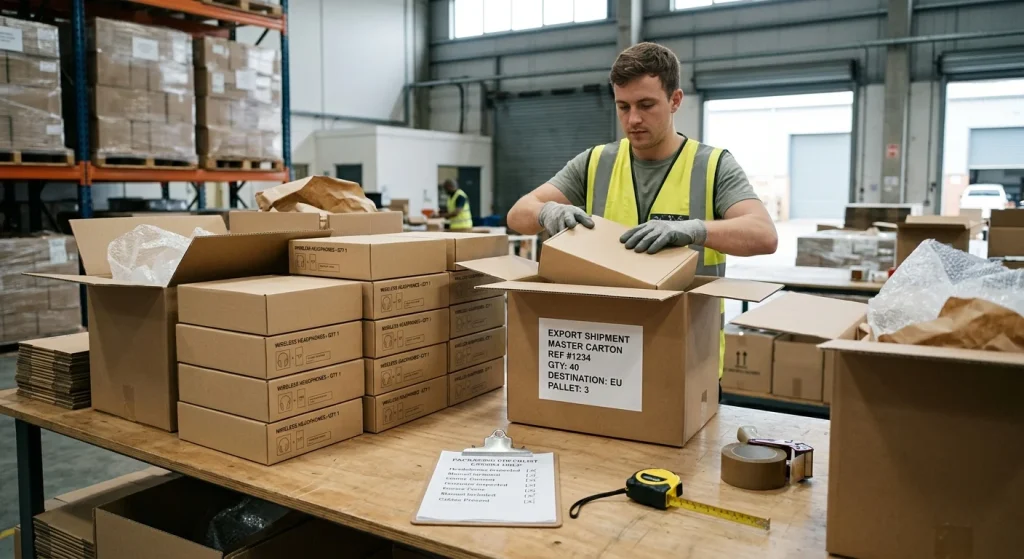
Master cartons and shipment labels
Before packing, confirm:
- The number of retail units per master carton.
- The carton dimensions and gross weight.
- Whether the shipment uses individual cartons or palletized freight.
- The carton-content information required in the shipment plan.
- The correct shipment and carton labels generated through the applicable seller workflow.
- Label placement that keeps the barcodes visible, scannable, and away from seams or edges.
- Whether the actual carton contents match the declared SKU quantities and packing configuration.
Amazon’s official FBA shipping-label requirements explain the importance of correct box labels and accurate carton dimensions, weights, and box-content information. Labels should be generated for the actual shipment and applied to the corresponding cartons; do not reuse a label on multiple boxes.
For the US store, Amazon announced that its FBA prep and item-labeling services would end for shipments created on or after January 1, 2026. Sellers need to arrange product preparation and labeling themselves or through an appropriate service provider before inventory reaches the fulfillment center. Review Amazon’s current FBA Prep Service guidance and verify the applicable requirements in the seller account before dispatch.
If a supplier is preparing FBA inventory, clarify whether the scope includes only retail packaging and carton packing or also the application of buyer-provided labels and the preparation of shipment-specific cartons. Do not assume that a supplier offers a complete FBA preparation service unless the scope has been agreed in writing.
6. Why Product Compliance and Shipment Documentation Must Be Checked Before Dispatch
Product compliance and shipment documentation should be reviewed before the goods are packed and released for shipment. Missing or inconsistent documents may delay shipping, customs processing, listing approval, or receiving, depending on the product and destination.
The applicable requirements depend on the headphone design, wireless functions, battery configuration, destination market, importer responsibilities, and sales channel. Buyers should identify which documents apply to their specific product rather than requesting a generic list of certificates for every order.
Depending on the product and market, the review may include:
- Applicable product compliance documentation and supporting test reports.
- Relevant radio, electrical, chemical, or product-safety requirements.
- Battery and transport documentation requested by the carrier, where applicable.
- Commercial invoice and packing list.
- Accurate product descriptions, quantities, values, and country-of-origin information.
- Shipping instructions and other documents required by the freight provider or destination authorities.
- Any listing-specific documentation required by the marketplace.
Do not assume that CE, FCC, RoHS, Bluetooth qualification, or ISO 9001 documentation is universally required or that one document proves compliance with every requirement. Their relevance and purpose differ. A quality-management certificate for a facility, for example, is not the same as product-specific evidence.
Before dispatch, compare the document details against the final product configuration, model numbers, packaging versions, and shipping quantities. Where documents are required, confirm who prepares them, who reviews them, and whether approval is needed before goods leave the factory or warehouse.
For Amazon-bound inventory, also check that the final product identifiers and shipment information match the active listing and shipment plan. A correct retail box alone does not ensure that the shipment meets every current receiving requirement.
7. Which Cost Items May Need Separate Clarification?
A quotation should make clear which costs are included in the unit price and which may be charged separately. This is especially important when an order combines product customization, retail packaging, trial quantities, and international shipping.
Depending on the project, buyers may need to clarify the following items:
| Cost category | Questions to ask |
|---|---|
| Product unit price | Which exact model, configuration, and quantity does the price cover? |
| Branding | Are artwork setup, logo application, and other branding processes included? |
| Custom color | Are color preparation, material requirements, or color-specific quantities charged separately? |
| Packaging | Does the price include the printed retail box, insert, manual, labels, and accessories? |
| Tooling or engineering | Are design changes, tooling, or other project-specific work separate from the unit price? |
| Samples | Are sample products, customization, or sample shipping charged separately? |
| Inspection and testing | Which agreed inspections or tests are included, and which require separate approval or cost? |
| Export and shipping | Which charges are included under the named Incoterm, and which are quoted by the freight provider? |
| Insurance and destination costs | Who arranges insurance, and which destination charges, duties, taxes, or local transport costs remain outside the offer? |
| FBA preparation | Does the service include labels, carton preparation, packing data, or only product packaging and carton packing? |
These are items to clarify, not fees that necessarily apply to every order. Some may be included in a supplier’s offer; others may not be relevant to a particular product or route.
Ask for written confirmation of the cost basis, currency, quote validity, and assumptions. Where charges depend on final shipment dimensions, weights, destination, or the freight arrangement, request an updated estimate when those details are available.
A useful comparison is not simply the lowest quoted unit price. It is the cost of the same defined product and packaging configuration under comparable trade terms, with exclusions made visible.
8. How to Plan a Trial Order Without Assuming Every Customization Has a Low MOQ
A trial order can help buyers evaluate product quality, packaging, market response, and operating requirements before committing to a larger order. However, the plan needs to distinguish between what is being tested and which customization costs or minimums apply.
A practical trial-order discussion should cover four areas.
First, define the trial objective. Decide whether the order is intended to check a standard model, evaluate a logo application, test a custom retail box, or validate a more extensively modified product. Different objectives may require different samples, quantities, and approval criteria.
Second, separate the quantity requirements. Ask whether the supplier can offer a trial quantity using an existing product configuration and whether the requested colors, logo, packaging, and accessories have separate minimums. A smaller quantity of finished headphones does not automatically make a small run of custom-printed packaging or special components commercially feasible.
Third, identify one-time costs. Clarify whether the trial requires artwork setup, engineering work, tooling, sample fees, or other project-specific charges. Record which costs would apply again to a later order and which are specific to the trial.
Fourth, set approval criteria before production. Confirm what the buyer will inspect, including the agreed product configuration, branding, packaging, barcodes, carton arrangement, and any applicable compliance documents. If the trial is intended for Amazon FBA, confirm the marketplace’s preparation and shipment requirements before the order is released.
A trial-order plan should also establish the next decision point. For example, the buyer may approve a larger order only after evaluating the agreed samples, reviewing any issues, and confirming the final quotation and shipment plan.
The purpose is to reduce uncertainty before scaling an order—not to assume that all custom options will be available at the same MOQ or unit price as a standard model.
Industry Insight
MOQ, FOB pricing, and Amazon FBA preparation are related, but they answer different commercial questions.
MOQ defines the quantity that can be ordered under the proposed product and customization arrangement. FOB defines a particular delivery point, responsibility allocation, and risk-transfer point under the agreed trade term. FBA preparation concerns how inventory must be identified, packaged, labeled, and documented for a specific fulfillment shipment.
A buyer who reviews these issues separately can then bring them together in one order plan. The product specification determines what is being purchased; the quotation defines the commercial scope; the Incoterm clarifies the agreed delivery arrangement; and the seller-account shipment plan determines the relevant FBA preparation details.
For OEM/ODM orders, the important step is to confirm these details before production and packaging commitments are made. This gives the buyer a more reliable basis for comparing quotations and estimating the cost of receiving usable inventory at the intended destination.
Buyer Tips
- Ask for MOQ by model, color, logo method, packaging version, and other relevant customizations.
- Compare quotations against one shared specification and an itemized list of inclusions and exclusions.
- Require the FOB quotation to name the port and specify the Incoterms version; check additional freight and destination costs separately.
- Confirm product identifiers, retail packaging, carton dimensions, weights, and shipment labels before packing the order.
- Review the applicable product compliance and shipment documents before dispatch, and verify current FBA requirements in the correct marketplace account.
Common Mistakes
- Comparing different product configurations by unit price alone. A standard model and a deeply customized order may include different materials, packaging, setup work, and approval requirements.
- Treating FOB as a delivered-to-Amazon price. International freight, insurance, import-related charges, destination handling, and onward transportation may remain separate.
- Assuming every variation shares the same MOQ. Colors, models, logo processes, and packaging can have different quantity requirements.
- Finalizing the packaging before confirming FBA details. Barcode eligibility, carton configuration, labels, dimensions, weights, and shipment plans need to be checked for the actual order.
- Assuming that the supplier’s general service description guarantees FBA readiness. Agree on the exact preparation and labeling tasks that are included.
- Waiting until dispatch to review documentation. Product configuration, listing details, and shipment records should be checked before goods are released.
Key Takeaway
Custom headphones MOQ, FOB pricing, and Amazon FBA requirements should be evaluated together when planning a B2B order. Confirm minimum quantities for the actual customization scope, compare suppliers using equivalent specifications, and clarify the named FOB port and all excluded logistics costs. For Amazon-bound inventory, verify product barcodes, packaging, carton information, shipment labels, and applicable documentation before dispatch. A clearly defined quotation and order plan helps buyers avoid assumptions about low MOQ, total delivery cost, or FBA readiness.
Related Questions
- What Specifications Should You Prepare Before Requesting a Custom Headphones Quote?
- How Should Buyers Verify IPX8 Waterproof Claims for Bone Conduction Headphones?
- What Can Be Customized in Private-Label Headphones: Logos, Colors and Packaging?
- Which Audio Features Can Be Customized in Sports Headphones?
- When Does a Custom Headphones Project Need CNC Prototypes or New Injection Molds?
CTA
Planning a custom headphones order for a private-label brand or Amazon marketplace? Prepare a shared product specification, identify the requested customization and packaging options, and ask for a quotation that clearly separates unit price, MOQ, one-time costs, and delivery terms. Confirm the named port and any separate logistics charges, then verify the applicable marketplace preparation and labeling requirements before approving the final packaging and shipment plan.