
Quick Answer
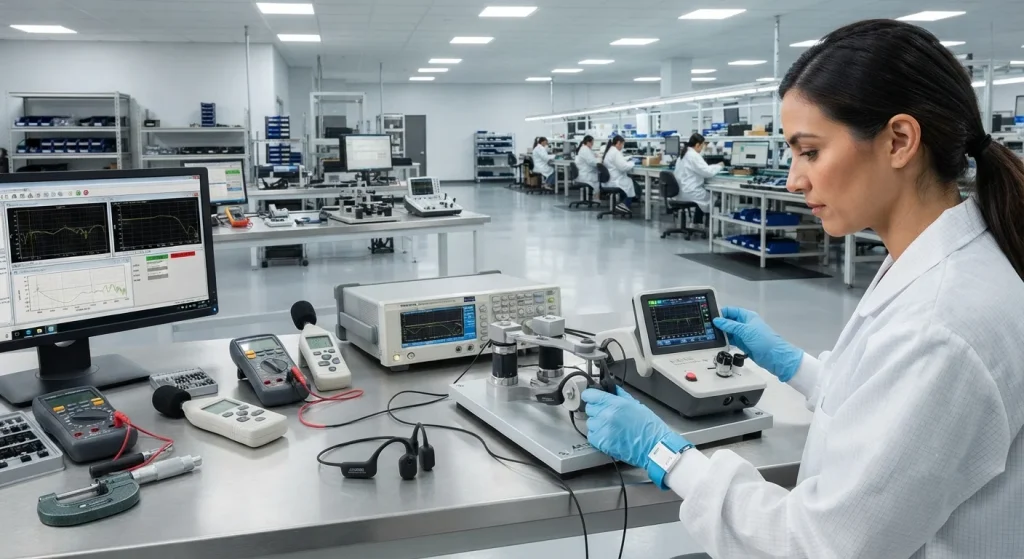
Bone conduction headphones quality control is the foundation of product reliability, involving rigorous pressure testing and acoustic analysis.For specialized devices like OEM bone conduction headphones, factories also perform rigorous acoustic performance and waterproofing tests. These systematic checks are essential to ensure the durability and reliability of both ODM bone conduction headphones and high-performance swimming headphones manufacturer output.
Detailed Answer
Quality control in the production of bone conduction technology is more complex than standard earbuds because of the structural sensitivity of the vibration modules. A capable bone conduction headphones manufacturer follows a rigorous four-pillar QC system to ensure every unit meets the required specifications.
First, IQC focuses on raw materials. This includes testing the quality of titanium alloy bands, vibration transducers, and battery cells. If the raw material quality is compromised, no amount of assembly line precision can fix it. For OEM bone conduction headphones, this phase also involves verifying component certifications, such as battery safety reports.
Second, IPQC occurs during assembly. As the headphones are being built, inspectors monitor critical points. For instance, the adhesive application for waterproofing is critical. If the seal is not perfect, the device will fail the waterproof test later. This is especially vital for a swimming headphones manufacturer, where any imperfection in the structural seal results in immediate product failure upon submersion.
Third, FQC (Final Quality Control) checks the finished product. This involves automated testing rigs that measure Bluetooth connectivity, battery charging cycles, and, most importantly, sound quality and vibration output. Technicians verify that the transducer provides the correct frequency response and that there is no rattling at high volumes.
Finally, OQC (Outgoing Quality Control) ensures that the packaged product includes all accessories, that the boxes are not damaged, and that the serial numbers match the batch records. For brands developing ODM bone conduction headphones, this final inspection acts as the last line of defense against shipping defective goods to end consumers, which is critical for maintaining high ratings on e-commerce platforms.
Comparison Table
| QC Stage | Primary Focus | Defect Prevention Goal |
| IQC | Raw Materials | Prevent faulty components entering line |
| IPQC | Assembly Precision | Ensure structural integrity/sealing |
| FQC | Functional Testing | Verify acoustic/vibration consistency |
| OQC | Final Packaging | Ensure shipment quality and safety |
Industry Insight
In the consumer electronics supply chain, the difference between a high-tier factory and a low-tier assembler lies in their AQL (Acceptable Quality Limit) standards. A reliable bone conduction headphones manufacturer operates with an AQL standard typically set at 0.65 or lower for critical defects. Many factories rely on manual labor for assembly, so consistent IPQC monitoring is the only way to mitigate human error. When sourcing private label bone conduction headphones, buyers should inquire about the factory’s data logging systems. Top-tier facilities log test results for every serial number, allowing them to trace defects back to a specific shift or machine. This level of transparency is standard for high-volume ODM bone conduction headphones but often overlooked in cheaper, high-risk manufacturing setups.
Buyer Tips
- Request an Audit: Ask for the factory’s ISO 9001 certification and specifically review their internal QC reports for the last three production batches.
- Third-Party Inspection: Always hire an independent inspection agency to perform a pre-shipment inspection (PSI) based on AQL standards before final payment.
- Define Critical Specs: Clearly define what constitutes a “major” vs. “minor” defect in your purchase agreement, particularly regarding acoustic clarity and waterproof sealing.
- Sample Testing: Conduct destructive testing on random units from your production batch to verify the build quality under stress.
Common Mistakes
- Ignoring IP Rating Validation: Assuming that all waterproof labels are equal; always verify that the swimming headphones manufacturer performs vacuum pressure testing, not just shallow submersion.
- Focusing Only on Unit Price: Choosing the lowest price quote often leads to “QC corner-cutting,” where factories skip FQC stages to save time.
- Lack of Traceability: Failing to demand serial number tracking, which makes it impossible to perform a targeted recall if a specific component batch is faulty.
Recommended Internal Links
Related Questions
- How does the QC process differ between standard and waterproof headphones?
- What documents should a manufacturer provide to prove QC compliance?
- Can third-party inspectors accurately test audio quality?
- How do serial numbers improve QC in B2B headphone manufacturing?
Summary
Maintaining high production standards is the backbone of any successful audio business. Whether you are ordering OEM bone conduction headphones to test a new market or scaling up a successful private label bone conduction headphones line, a systematic QC process is non-negotiable. Always verify that your chosen bone conduction headphones manufacturer follows strict AQL protocols and provides transparent testing data. Remember that MOQ should never come at the expense of quality. By ensuring rigorous oversight from a qualified swimming headphones manufacturer or ODM bone conduction headphones expert, you protect your brand reputation and ensure that your customers receive reliable, high-performance audio products every time.