
Quick Answer
A professional bone conduction headphones manufacturer must provide verified documentation covering electronic safety, wireless compliance, and environmental standards. Essential certifications include CE, FCC, and RoHS, which are mandatory for selling electronics in most major markets. For any swimming headphones manufacturer, IP68 waterproof verification is critical. These documents are vital for importing OEM bone conduction headphones, ensuring your private label bone conduction headphones meet international legal standards and avoid costly customs seizures or compliance issues on platforms like Amazon.
Detailed Answer
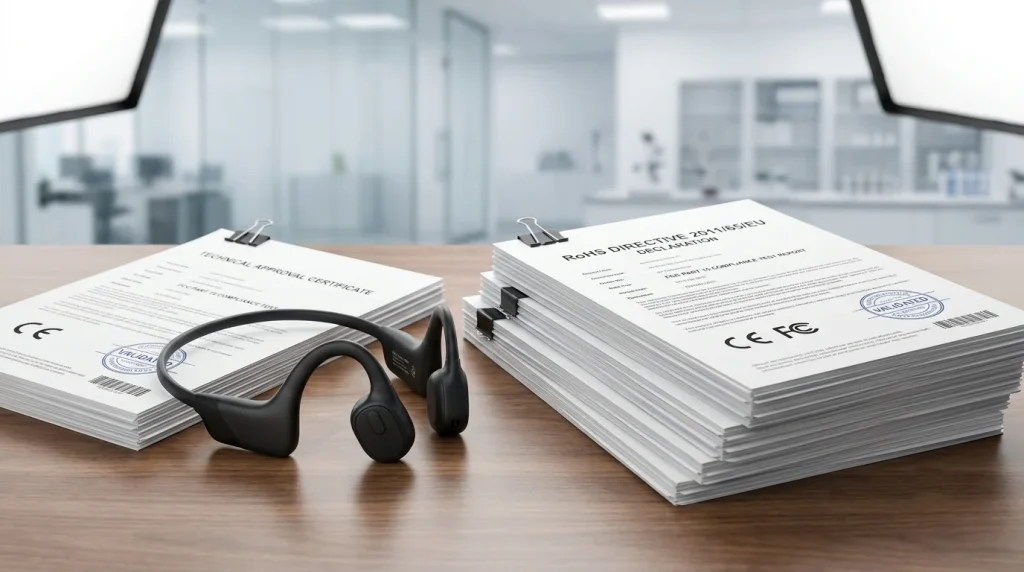
When selecting a bone conduction headphones manufacturer, documentation is the primary evidence of product safety. For OEM bone conduction headphones, CE marking is mandatory for the European market, while FCC is essential for the United States. RoHS compliance is globally recognized, ensuring no hazardous substances are used in the product housing or internal electronics.
Beyond general safety, Bluetooth SIG (BQB) certification is non-negotiable for wireless connectivity. This confirms the device adheres to Bluetooth standards and ensures compatibility with various playback devices. For a swimming headphones manufacturer, the IP68 rating is the industry gold standard. It is not enough to simply claim waterproof capability; official test reports from accredited laboratories like Intertek or SGS are required to confirm the device can withstand submersion in water for specified periods.
Furthermore, quality management systems such as ISO 9001 define the reliability of a factory’s production process. Whether you are developing ODM bone conduction headphones or sourcing ready-made solutions, these certifications mitigate the risks of product failure and legal liability. Brands specializing in private label bone conduction headphones must treat valid, third-party certification as a non-negotiable requirement. This approach ensures smooth customs clearance and builds consumer trust, protecting the brand from potential recalls or market entry bans.
Comparison Table
| Certification Type | Requirement | Typical Target Market |
| CE / FCC | Safety & Radio | Global (EU / US) |
| RoHS | Environmental | Global |
| Bluetooth SIG (BQB) | Connectivity | Global |
| IP68 | Waterproofing | Swimming / Sports |
| ISO 9001 | Quality Systems | Manufacturing |
Industry Insight
Sourcing professionals often encounter factories offering “in-house” test results instead of official certifications. However, a credible bone conduction headphones manufacturer always supports claims with third-party testing. Copycat or expired certificates are common risks when procuring private label bone conduction headphones. Buyers should verify certificate numbers against the issuing database. For those pursuing OEM bone conduction headphones, a thorough documentation audit prevents costly recalls. Reliability in ODM bone conduction headphones development starts with transparent compliance records, distinguishing top-tier partners from sub-standard assembly lines. By demanding verified compliance upfront, brands can ensure their product development process adheres to international standards from the very start.
Buyer Tips
- Verify Certificate Validity: Always check that the certificate number matches the factory name and the specific product model on the test report.
- Request Full Reports: Do not settle for the front page; ask for the complete test report to understand the testing conditions.
- Check Expiration Dates: Certifications require periodic renewal. Ensure the documents provided are current and compliant with the latest regional regulations.
- Component Compliance: Ensure key components, particularly lithium-ion batteries, hold their own safety certifications (e.g., UN38.3).
Common Mistakes
- Trusting Self-Declarations: Accepting a manufacturer’s promise of compliance without official documentation is a leading cause of shipment rejection at customs.
- Assuming Global Coverage: Believing that a certificate for one market (e.g., US) automatically covers regulations for another (e.g., EU) without localized testing.
- Ignoring IP Standards: Assuming a water-resistant label implies swimming capability; specific IP68 test results are required for true swimming headphones manufacturer verification.
Recommended Internal Links
Related Questions
- How can I verify the authenticity of a manufacturer’s CE certificate?
- Does an IPX8 rating mean the headphones can be used for swimming?
- What is the difference between CE and FCC certification requirements?
- Do I need additional certifications to sell headphones on Amazon?
Summary
Verifying certifications is critical when selecting a bone conduction headphones manufacturer. Whether you need OEM bone conduction headphones or are developing complex ODM bone conduction headphones, safety compliance ensures successful distribution. Never overlook the importance of valid IP68 test reports for a swimming headphones manufacturer, as this is a key quality indicator. Always discuss compliance documents during the initial negotiation phase, alongside discussions on MOQ and production capacity. By prioritizing certified suppliers, you ensure your private label bone conduction headphones meet international market standards, minimizing long-term liability and establishing a strong foundation for your brand’s commercial success.