
Quick Answer
When comparing Bluetooth and MP3 swimming headphones, buyers should distinguish wireless streaming from playback of music stored directly on the device. Bluetooth connections are generally unreliable when the radio path passes through water, while onboard MP3 playback can operate without a continuous connection to a phone. Before approving a sample, verify supported modes, memory capacity, file compatibility, controls, charging behavior, mode switching, and usability in the intended swimming environment.For a broader framework for assessing a supplier before project commitment, see How to Evaluate a Custom Bluetooth Headphones Manufacturer Before Starting a Project.
Detailed Explanation
1. Why Bluetooth Streaming Can Be Unreliable Underwater
Bluetooth uses radio signals to communicate between devices. Water, particularly the water encountered during swimming, can substantially attenuate these signals. As a result, a Bluetooth connection that works well on land may become unstable when the headphone antenna and transmitting phone are separated by water.
This creates a practical limitation for swimming headphones: buyers should not assume that a phone on the pool deck can continuously stream music to a swimmer underwater over ordinary swimming distances.
The actual experience depends on several factors, including antenna design, the position of the transmitting device, the amount of the radio path passing through water, the swimmer’s movements, and the product’s implementation. However, these variables do not remove the fundamental limitation of attempting to maintain a conventional Bluetooth radio link through water.
For product selection, the important question is not simply whether a swimming headphone supports Bluetooth. Buyers should establish where and under what conditions Bluetooth is intended to be used.
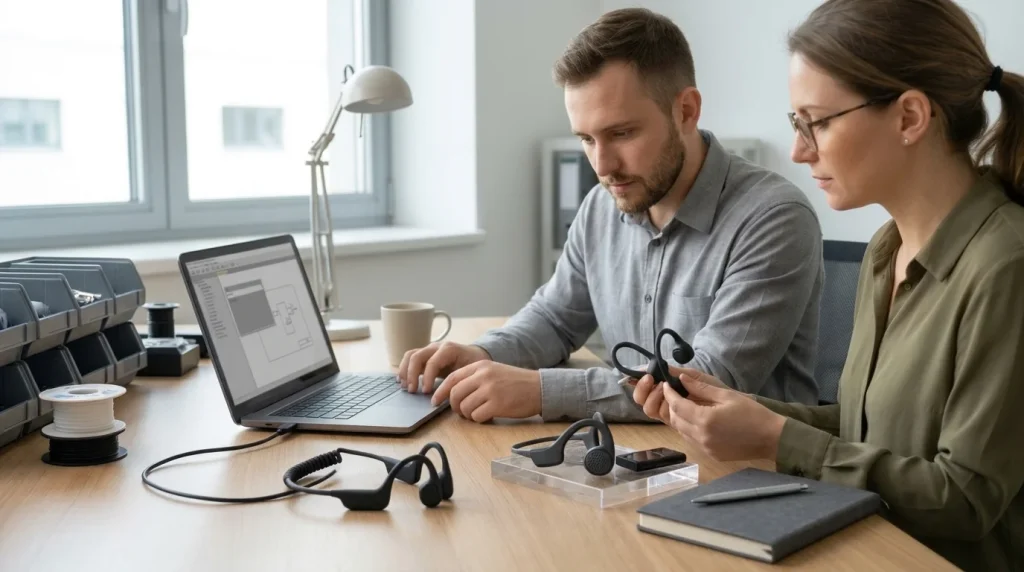
For example, Bluetooth may be useful for pairing, configuration, or listening before and after swimming. A particular product may also support Bluetooth playback in suitable above-water conditions. These functions should be verified against the actual product specification rather than assumed.
2. How Onboard MP3 Playback Supports Swimming
Onboard MP3 playback uses audio files stored in the headphone itself or in its integrated storage system. Once compatible files have been transferred to the device, playback does not require a continuous Bluetooth connection to a phone.
This makes local playback a practical option for swimming environments where a reliable phone-to-headphone radio link cannot be maintained.
However, buyers should not assume that every swimming headphone has onboard storage simply because it is marketed for swimming. They should verify whether the exact model and version include local playback, how files are transferred, which formats are supported, and whether the storage capacity meets the intended use case.
Buyers should also clarify whether the product supports a single playback mode or multiple modes. A product that offers Bluetooth and MP3 playback may require the user to select a mode manually. Other implementations may use different switching procedures. The product documentation and sample should establish the actual behavior.
3. Understand the Difference Between Streaming and Local Playback
The two modes differ in their audio source, connection requirements, and operational workflow.
In Bluetooth mode, the headphone receives audio wirelessly from a compatible source device. The source must remain within a workable connection range under the actual conditions. For swimming, this makes the location of the phone and the amount of water between the devices particularly important.
In onboard MP3 mode, compatible audio files are stored locally. The headphone reads and plays those files without depending on a continuous Bluetooth audio stream. This can simplify use during a swim, although the experience still depends on the product’s controls, firmware, storage implementation, and audio playback behavior.
For buyers, the distinction affects more than the feature list. It changes how users prepare their music, start a session, navigate tracks, manage the battery, and troubleshoot playback.
A product specification should therefore describe each mode separately. Avoid accepting a combined statement such as “Bluetooth and MP3 supported” without confirming the operation of both modes and the relationship between them.
4. Verify Memory Capacity and File Compatibility
Memory capacity determines how much audio can be stored locally, but the advertised capacity alone does not establish how many tracks a user can actually keep on the device. File size varies with track length, encoding, and audio bitrate.
Ask the supplier to identify the actual onboard storage capacity for the exact model and version. Confirm whether the stated capacity refers to total installed memory or user-accessible storage, and whether any portion is reserved for system use.
File compatibility is a separate issue. Do not assume that every MP3 player supports all common audio formats, bitrates, or file-management methods. Ask for a written list of supported formats and any relevant encoding limitations. If buyers expect users to load music from computers, clarify the supported transfer connection and the required workflow.
For sample approval, use representative audio files that reflect the intended customer experience. Confirm that files transfer successfully, appear in the expected playback sequence, and play without obvious interruptions under the agreed test conditions.
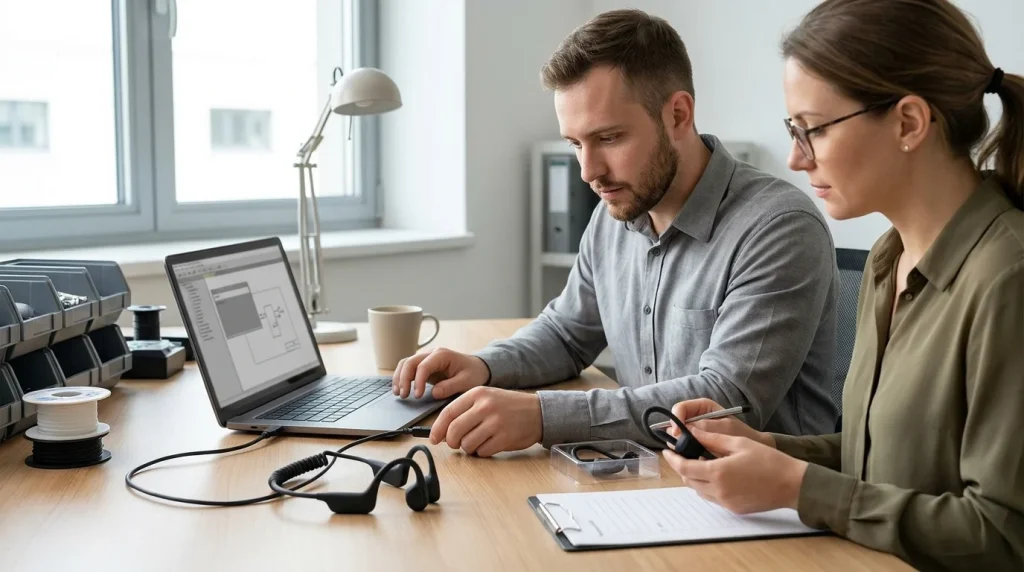
5. Check Controls and Mode Switching
Swimming headphones may be operated with wet hands, while moving, or without a clear view of the controls. Button size, tactile feedback, control layout, and the steps required to change modes can therefore affect usability.
Buyers should establish how users enter Bluetooth pairing, select MP3 playback, start or pause a track, skip tracks, adjust volume if supported, and respond to low-battery or connection indications if these are part of the design.
Do not assume that a long press, short press, or combination of buttons performs the same function across different products. Request the control instructions for the exact sample and verify them directly.
Mode switching deserves particular attention. Confirm whether switching modes interrupts playback, changes the selected track, requires a restart, or involves a specific sequence of button presses. These details should be documented rather than left to user interpretation.
6. Match the Playback Architecture to the Intended Swimming Environment
The intended use environment should guide the comparison.
For recreational pool swimming, buyers may prioritize dependable local playback, straightforward track controls, and an uncomplicated preparation process. For users who also listen while walking, commuting, or warming up, Bluetooth playback may be useful outside the water.
Open-water swimming introduces additional practical considerations, including where the phone is carried, whether the user expects to listen while above water, and whether the product’s documented operation matches that use case. Buyers should not infer that a product will maintain continuous Bluetooth streaming simply because it is suitable for aquatic use.
For products intended for the European Economic Area, buyers should review the European Commission guidance on CE marking and determine which requirements apply to the specific product.
Some customers may need both modes; others may primarily need local playback. The decision should be based on the product’s intended use, the expectations of the target market, and verified functionality—not simply on the number of features listed in a catalog.
Water-resistance claims are a separate purchasing consideration. Buyers should review the relevant product documentation for the exact model, but this article’s focus is playback architecture and functional selection, not a full waterproof-rating verification procedure.For an overview of the company’s published product categories and OEM/ODM information, visit the custom headphones OEM/ODM manufacturer page.
7. Test the Sample Before Approving the Specification
A sample evaluation should convert general feature claims into observable pass-or-fail requirements.
First, confirm the model number and hardware or software version of the sample. Record which modes are claimed to be supported. Then test Bluetooth pairing and playback in an appropriate above-water environment using a compatible source device. Record connection behavior under the agreed setup, without treating one successful pairing as proof of underwater streaming performance.
Next, transfer representative audio files to the device. Verify that the transfer process works as documented, the files are recognized, and playback starts and continues as expected. Test supported track-navigation and volume controls where applicable.
If both modes are specified, switch between them using the documented procedure. Confirm that the device enters the intended mode and that the result is repeatable. Test charging with the supplied or approved charging equipment, and verify that the charging indicator and subsequent startup behavior match the agreed requirements.
Finally, evaluate usability in the intended environment. Any water-based trial should follow the product’s documented use limitations and a separately agreed test procedure. Do not treat a brief functional trial as proof of a waterproof rating or a substitute for the relevant technical evidence.
8. Define Sample Acceptance Criteria in Writing
Before approving a sample, buyers should document what the product must do and how each requirement will be checked.
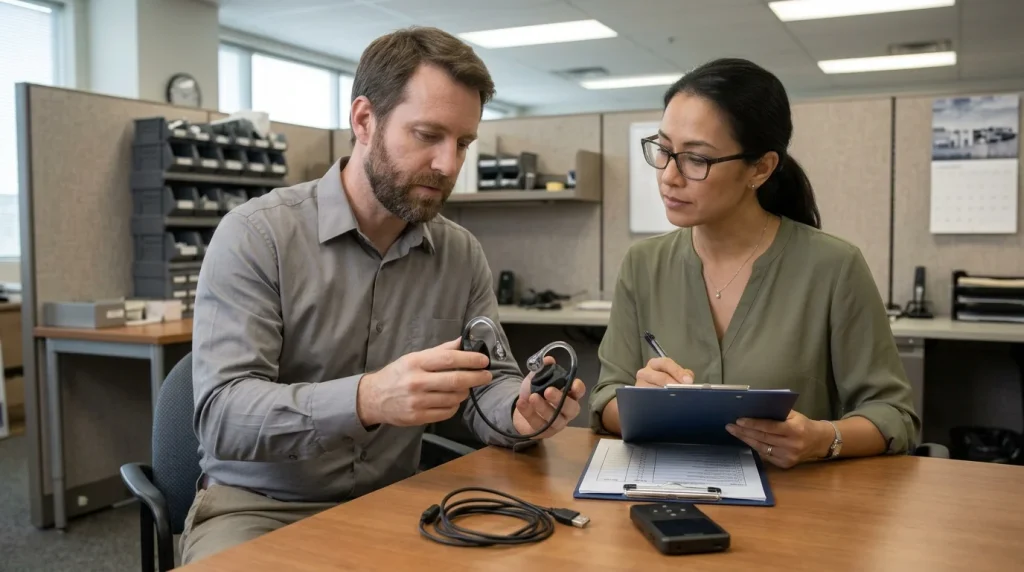
A practical acceptance specification may include:
- The exact model number and hardware or firmware version.
- Whether Bluetooth playback, onboard MP3 playback, or both are required.
- The documented Bluetooth pairing and playback procedure.
- Confirmed onboard memory capacity and supported audio formats, where applicable.
- The approved file-transfer method and expected playback behavior.
- Required button functions and the procedure for switching modes.
- Charging behavior and the agreed method for checking battery status, if available.
- The expected response when files are incompatible or a connection is unavailable, where applicable.
- The test environment, equipment, steps, and pass/fail criteria.
- The handling of deviations and the process for approving any specification changes.
Acceptance criteria should distinguish a verified product function from a supplier’s general description. If a feature cannot be demonstrated or documented, mark it as unresolved rather than silently treating it as approved.
For B2B sourcing, this creates a more reliable basis for comparing suppliers, approving samples, and aligning the final product specification with the buyer’s intended market.Buyers preparing a Bluetooth-enabled product for market should review the official Bluetooth Qualification Process and clarify which company is responsible for completing the applicable requirements.
9. Comparison Table
| Evaluation Factor | Bluetooth Mode | Onboard MP3 Mode | What Buyers Should Verify |
|---|---|---|---|
| Audio source | Receives audio from a compatible paired device | Plays compatible files stored on the headphone | Confirm the source and workflow for each mode |
| Underwater use | Continuous streaming can be unreliable when the radio path passes through water | Local playback does not require a continuous phone connection | Confirm the intended use case; do not assume underwater Bluetooth streaming |
| Phone dependency | Requires a compatible source device for streamed audio | Does not require a phone during local playback once files are stored | Check whether independent playback is required |
| Memory | Local music storage is not inherently required for Bluetooth streaming | Requires onboard storage or a documented local-playback system | Confirm installed and user-accessible capacity |
| File compatibility | Depends on the source device and the Bluetooth audio implementation | Depends on the product’s supported file formats and encoding limits | Request the supported-format list and test representative files |
| Music preparation | Pair the source device and select the audio | Transfer compatible files before use | Confirm pairing and file-transfer instructions |
| Track navigation | Depends on the headphone controls and source-device behavior | Depends on the local player and supported controls | Test play, pause, next/previous track, and volume where supported |
| Mode switching | May require pairing or selecting Bluetooth mode | May require selecting local playback mode | Verify the exact switching sequence and repeatability |
| Charging | Requires sufficient power for the headphone’s supported operation | Requires sufficient power for local playback | Test charging and startup behavior for the actual sample |
| Best-fit scenario | Listening in suitable above-water conditions with a compatible source nearby | Listening during swimming without relying on continuous phone-to-headphone streaming | Match the required mode to the intended user and environment |
| Sample acceptance | Pairing and playback meet documented criteria under the agreed setup | File transfer and local playback meet documented criteria | Record test conditions, results, and any unresolved deviations |
10. Industry Insight
Swimming headphones are often described by a list of headline features, but the value of those features depends on how they work in the intended environment. Bluetooth and MP3 are not interchangeable labels: one describes wireless communication with a source device, while the other commonly refers to playback of locally stored audio files.
For buyers, this distinction has implications for user instructions, sample evaluation, product comparisons, and customer expectations. A specification that simply lists both modes may conceal differences in file transfer, controls, supported formats, or mode switching.
The more useful approach is to treat playback as a defined user workflow. Identify where the customer will listen, how music will reach the device, what controls must be available, and how the sample will demonstrate each requirement. This allows procurement teams to compare products on verifiable functions rather than broad marketing language.
11. Buyer Tips
- Request the exact model specification. Confirm the model number and version before comparing feature lists or approving a sample.
- Ask for separate mode instructions. Obtain the documented procedure for Bluetooth pairing and local MP3 playback, including mode switching if both are supported.
- Verify memory and file support in writing. Do not infer storage capacity or supported formats from product photos or general descriptions.
- Use representative audio files. Test files typical of the intended customer workflow, including track navigation where supported.
- Agree on sample test conditions. Record the source device, connection setup, file-transfer procedure, charging method, and the criteria used to judge each function.
- Separate playback checks from waterproof evidence. Successful music playback does not establish a product’s water-resistance rating.
- Confirm the final approved configuration. Ensure that the sample, specification sheet, and purchase documentation refer to the same model and required functions.
12. Common Mistakes
- Assuming Bluetooth will stream reliably underwater. A product’s aquatic positioning does not remove the limitations of radio transmission through water.
- Treating MP3 playback as a universal feature. Confirm that the exact model includes local storage and playback.
- Assuming all audio formats are supported. Obtain the documented compatibility list and test representative files.
- Comparing memory figures without context. Clarify whether capacity is installed, user-accessible, or partly reserved for system use.
- Ignoring the switching procedure. A product that supports two modes may require specific button operations or a restart.
- Testing only one function. Pairing success does not establish local playback, charging, track navigation, or mode-switching behavior.
- Approving a sample without written criteria. Record the required functions, test conditions, results, and unresolved issues before sign-off.
- Using a short water trial as proof of a waterproof rating. Functional checks and formal water-resistance evidence serve different purposes.
13. Key Takeaway
When sourcing Bluetooth and MP3 swimming headphones, compare the two modes as different playback workflows rather than interchangeable features. Bluetooth is useful for wireless listening in suitable conditions, while onboard MP3 playback can provide local audio without a continuous phone connection. Verify the exact model’s storage, file compatibility, controls, switching behavior, and charging process, then approve the sample against written acceptance criteria.
14. Related Questions
The current weekly cluster has six supporting FAQ articles. The exact title confirmed for FAQ #1 is listed below. The approved titles for FAQ #3–#6 were not available for verification at the time of drafting, so they must be copied from the approved weekly content plan before publication.
- FAQ #1: What Should Buyers Define Before Choosing a Custom Bluetooth Headphones Manufacturer?
- FAQ #3: Exact approved title required — do not publish a guessed title.
- FAQ #4: Exact approved title required — do not publish a guessed title.
- FAQ #5: Exact approved title required — do not publish a guessed title.
- FAQ #6: Exact approved title required — do not publish a guessed title.
These are related planning references only; they should not be converted into links unless their destination URLs are verified and linking is appropriate.
15. CTA
If you are evaluating swimming headphones for a brand, distribution channel, or product-development project, define the playback functions your customers actually need before comparing samples. YONG YUNG welcomes B2B inquiries about headphone product requirements and project considerations. Share your intended use environment, required playback modes, and any essential controls or file-compatibility needs so the discussion can start from a clearly defined product brief.