
Quick Answer
Custom Bluetooth headphones feature selection should start with the intended user, product positioning, and real operating requirements—not a long list of available options. Buyers should assess each feature’s practical value, hardware and firmware dependencies, compatibility, development impact, and verification method. A feature should be included only when its expected benefit is clear and the supplier can define how it will be evaluated on a representative sample.
Detailed Explanation
1. Start with the User and the Product’s Intended Role
Before requesting optional features, define who will use the headphones and in what situations. A feature that matters to office professionals may have little value for sports users, while a function designed for occasional calls may not meet the expectations of customers who use headphones for frequent voice communication.Before finalizing optional functions, buyers should understand the broader requirements for selecting a custom Bluetooth headphones manufacturer and defining a suitable product specification.
Consider the product’s main use cases, target price range, customer expectations, and competitive positioning. Separate essential functions from desirable extras. This prevents the specification from becoming a collection of features that increase complexity without improving the actual user experience.

A useful starting point is to classify each requested feature as:
- Essential: Required for the product’s primary use or market positioning.
- Differentiating: Offers a meaningful user benefit that supports the product’s positioning.
- Optional: Worth considering only if technical feasibility and commercial impact are acceptable.
2. Evaluate EQ and Sound-Profile Options by Their Intended Benefit
Equalization (EQ) and sound-profile options can change how users experience audio, but the feature name alone does not explain what the product will deliver.
Buyers should clarify whether they want a fixed sound tuning, multiple selectable profiles, or user-adjustable EQ. These options may involve different acoustic, hardware, firmware, and interface requirements.For an example of how equalizer functions can differ in implementation, buyers can review the Android Equalizer API documentation, which describes preset-based and frequency-band adjustment capabilities.
Ask what listening problem the proposed feature is intended to solve. For example, is the objective to provide different listening preferences, improve perceived vocal clarity, or offer a more adaptable experience across music types?
Then clarify how the feature will be implemented and evaluated. Do not assume that a named EQ function guarantees a particular frequency response or sound quality. Agree on representative audio content, listening conditions, and acceptance criteria before approving the feature.
3. Assess Microphone Configuration and Call Performance Separately
Microphone quantity is not a reliable measure of call quality by itself. Performance may depend on microphone placement, acoustic design, signal processing, firmware, the user’s environment, and the connected device.
Buyers should define the intended call scenarios first. A product intended for occasional indoor calls may have different requirements from one expected to handle conversations in busy offices or outdoor environments.
Clarify whether the proposed microphone configuration supports the intended use and whether additional processing is involved. Ask the supplier to explain the limitations as well as the expected benefits.
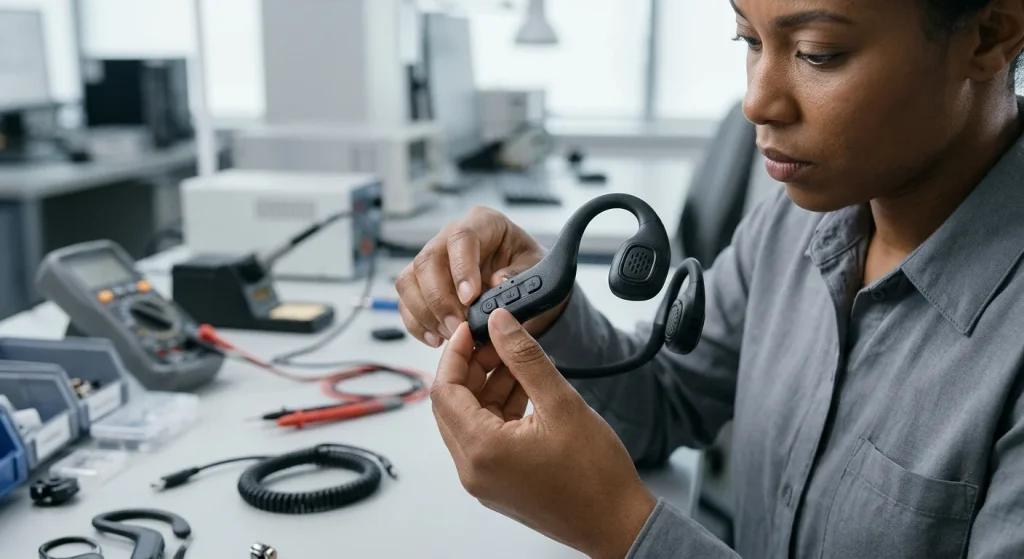
For evaluation, use consistent voice samples and repeatable test conditions. Include quiet and representative background-noise environments where relevant. Assess voice intelligibility and call behavior rather than relying only on a feature label or microphone count.
4. Understand What ENC Does—and Does Not—Mean
Environmental noise cancellation or noise reduction features, including ENC where applicable, are often presented as selling points. However, buyers should not assume that the term describes one universal implementation or guarantees a particular call experience.Buyers comparing call-related processing terminology can refer to Android audio processing effects to understand how functions such as echo cancellation and noise suppression are identified in an audio software environment.
Ask whether the function is intended to reduce background noise picked up during calls, affect the sound heard by the listener, or provide another specific benefit. These are different user expectations and should not be treated as interchangeable.
Clarify the microphone arrangement, processing dependencies, operating limitations, and connected-device behavior. If the feature is included, define how it will be tested using consistent speech and background-noise conditions.
Avoid accepting unsupported numerical claims. A meaningful evaluation requires an agreed test method and evidence from the actual product configuration.
5. Treat Chipset and Firmware Choices as Feature Dependencies
A Bluetooth chipset or platform can influence which functions are technically available, but selecting a named platform does not automatically guarantee that every desired feature is implemented.
For this article, the key question is not how to audit a chipset or verify firmware documentation in detail. It is whether the selected hardware and software configuration can support the features buyers actually intend to offer.When reviewing Bluetooth audio platform options, buyers can consult the Bluetooth LE Audio technical overview to understand the capabilities and design considerations associated with this Bluetooth audio architecture.
Ask the supplier to identify any dependencies that could affect EQ, microphone processing, button behavior, playback functions, or connectivity. Confirm whether a requested feature requires additional development, a different component configuration, or changes to the user interface.
Keep the scope focused on the feature outcome. Detailed platform qualification and firmware verification should be handled as separate technical review activities when necessary.
6. Consider Controls, Battery, Playback, and Connectivity Together
Optional features can affect one another. Additional controls may require more complicated button behavior. New playback functions may change how users switch modes. Some processing or connectivity choices may also affect power consumption, depending on the implementation.
Buyers should therefore evaluate the complete user interaction rather than approving features independently.
For example, if a product offers multiple sound profiles, clarify how users select them, whether the selection is retained, and what happens when the headphones reconnect. If call and playback controls share physical buttons, define the intended behavior for single presses, long presses, and repeated actions.
Battery expectations should be evaluated using the actual feature configuration and agreed operating conditions. Do not assume that performance measured with one configuration will remain unchanged after functions are added.
7. Check Compatibility and Feature Trade-Offs
A feature may work under one hardware, firmware, or device configuration but behave differently in another. Buyers should identify compatibility requirements before treating a feature as a standard product capability.
Consider:
- Whether the feature is available across the intended phone operating systems and device types.
- Whether the function depends on a particular app or companion software.
- Whether users need to install, configure, or update anything.
- Whether the feature affects other controls or playback functions.
- Whether the feature is available in all operating modes or only under specific conditions.
Create a compatibility list based on the target market and intended customer devices. Ask the supplier to identify known limitations and agree on which combinations will be included in sample evaluation.
8. Validate the Feature on a Representative Sample
A feature description or quotation is not evidence that the finished product behaves as expected. Buyers should evaluate the actual sample with the intended hardware, firmware, controls, and operating configuration.Clear headphone product requirements help suppliers understand the intended use, required functions, and expected sample behavior.
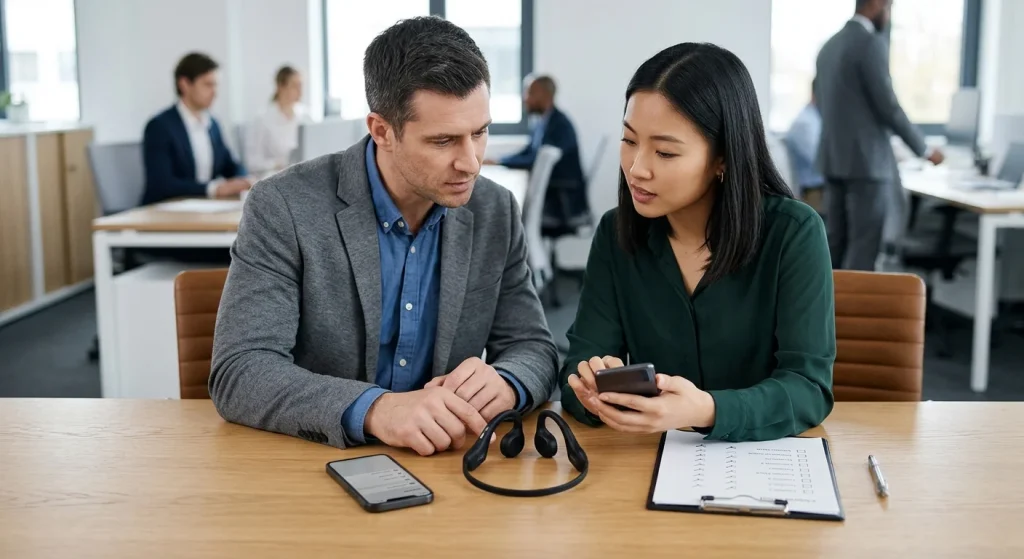
Prepare a short feature-validation plan. For each selected option, define the user action, expected response, operating conditions, and acceptance criteria.
For example, a sound-profile feature should be checked by switching between the agreed profiles and confirming that the selection behaves as specified. A call-noise-reduction feature should be evaluated using consistent speech and background-noise conditions. Button controls should be tested for the agreed press patterns and responses.
If the sample does not represent the proposed production configuration, document the difference. Do not approve a feature solely because it appears in a preliminary demonstration.
9. Confirm Development Impact Before Approving Optional Features
Optional features can affect component selection, firmware work, acoustic tuning, product controls, compatibility testing, and project cost. The impact depends on the existing design and the scope of the requested change.Documenting custom headphone development requirements helps buyers distinguish essential functions from optional features that may need further evaluation.
Ask the supplier to separate the proposed feature from the assumptions behind it. Clarify what is already supported by the current design, what requires additional development, and what remains subject to technical evaluation.
Before approval, document:
- The intended user benefit and product requirement.
- The proposed implementation and any dependencies.
- Known limitations and compatibility boundaries.
- Whether additional hardware, software, or interface changes are involved.
- The sample configuration and test method.
- The acceptance criteria and approval responsibility.
- Any cost or schedule implications confirmed by the supplier.
This makes feature selection a controlled product decision rather than an open-ended request for more functions.
Comparison Table
| Optional Feature | Buyer Objective | Questions to Ask | How to Verify |
|---|---|---|---|
| EQ and sound profiles | Offer a listening experience suited to target users | Is the feature fixed, selectable, or user-adjustable? What implementation is proposed? | Compare the agreed profiles using representative audio and consistent listening conditions |
| Microphone configuration | Support the intended calling scenarios | How many microphones are used, where are they positioned, and what role does each serve? | Conduct repeatable voice-call tests in quiet and relevant background-noise conditions |
| ENC or noise reduction | Improve voice communication in specified environments | What noise is the feature intended to reduce? What are its limitations? | Compare call samples under agreed background-noise conditions |
| Bluetooth chipset or platform | Support the required product functions | Does the proposed platform support the requested feature configuration? | Review the actual sample and confirm the selected functions operate as agreed |
| Firmware-dependent functions | Provide consistent feature behavior | Which functions depend on firmware, and how are they accessed? | Test the agreed functions and operating sequences on the sample |
| Button controls | Make operation clear and predictable | What do single press, double press, and long press do? | Test every agreed control action and check for conflicting commands |
| Battery and playback behavior | Meet intended usage expectations | Under which functions and operating conditions is battery performance evaluated? | Test the agreed configuration under documented playback and usage conditions |
| Connectivity and compatibility | Work with target devices and operating systems | Which devices, operating systems, and connection scenarios are in scope? | Test the agreed device combinations and record any limitations |
Industry Insight
Feature selection in consumer audio is increasingly a product-positioning decision as much as a technical one. A longer feature list may look attractive in a quotation, but every additional function can introduce dependencies involving hardware, firmware, user controls, compatibility, and validation. For B2B buyers, the more useful question is whether each feature solves a recognizable user problem and can be demonstrated in the intended product configuration. A smaller set of well-defined, testable features may be easier to position and maintain than a broad specification built around names that have not been translated into measurable behavior. Clear requirements also make supplier discussions more productive because both parties can distinguish confirmed functions from proposed development work.
Buyer Tips
- Rank features by user value before discussing implementation.
- Separate essential functions from optional differentiators.
- Ask what each feature actually does, not just what it is called.
- Clarify hardware, firmware, app, and device dependencies.
- Request limitations and compatibility boundaries in writing.
- Evaluate microphone and noise-reduction performance under repeatable conditions.
- Include control behavior and user interaction in the specification.
- Agree on sample configuration and acceptance criteria before feature approval.
- Review additional development costs and schedule implications with the supplier rather than assuming they are included.
Common Mistakes
- Choosing features because competitors advertise them. A feature should serve the intended users and product positioning.
- Assuming feature names guarantee performance. Terms such as EQ and ENC need a defined function and verification method.
- Treating microphone quantity as proof of call quality. Placement, processing, acoustics, and test conditions also matter.
- Selecting a chipset before defining requirements. Buyers should first establish the necessary functions, then evaluate suitable platform options.
- Ignoring user-interface complexity. More controls and modes can make a product harder to operate.
- Assuming compatibility across all devices. Compatibility must be defined and tested against the intended device range.
- Approving features from a demonstration alone. A representative sample and documented acceptance criteria provide a stronger basis for approval.
- Failing to record development assumptions. Unclear scope can lead to different expectations about what the supplier is delivering.
Key Takeaway
Effective custom Bluetooth headphones feature selection is based on user value, technical feasibility, compatibility, and verifiable behavior. Buyers should prioritize only the functions that support the product’s intended position, clarify their hardware and firmware dependencies, and assess them on a representative sample. Defining limitations and acceptance criteria before approval helps prevent attractive feature names from becoming unclear or unverified product promises.
Related Questions
The following are the other five titles in the current custom Bluetooth headphones weekly cluster, excluding this FAQ #5. They are navigation suggestions, not hyperlinks.
- FAQ #1: What Should Buyers Define Before Choosing a Custom Bluetooth Headphones Manufacturer?
- FAQ #2: How Should Buyers Compare Bluetooth and MP3 Modes in Swimming Headphones?
- FAQ #3: Which Changes to Custom Bluetooth Headphones May Require New Tooling?
- FAQ #4: How Can Buyers Verify a Headphones Manufacturer’s In-House Production Capabilities?
- FAQ #6: How Should Buyers Compare Custom Headphones Manufacturers Beyond Unit Price?
CTA
Planning a custom Bluetooth headphone project? YONG YUNG welcomes inquiries from brands, importers, distributors, and product-development teams evaluating optional features for a new or existing product. Share your target users, intended applications, preferred functions, and key product requirements. This gives both sides a practical starting point for discussing the project scope, identifying questions that need technical review, and clarifying the criteria for evaluating a sample.