
Quick Answer
Before choosing a custom Bluetooth headphones manufacturer, buyers should define who will use the product, where it will be used, which headphone form and functions are needed, and which markets the product will serve. They should also identify essential documentation, acceptance criteria, business priorities, and unresolved technical questions. These custom Bluetooth headphones project requirements help buyers evaluate whether a potential supplier is suitable before committing to development or production.For a broader supplier-evaluation framework, see How to Evaluate a Custom Bluetooth Headphones Manufacturer Before Starting a Project.
Detailed Explanation
1. Define the Target Users and Use Environments
Start by identifying the intended customer and the conditions in which the headphones will be used. A product designed for commuters may have different priorities from one intended for runners, cyclists, outdoor workers, or swimmers.
Consider the user’s daily routine, expected wearing duration, surrounding noise, weather exposure, device compatibility, and preferred controls. These factors influence the product requirements that a manufacturer needs to assess.
For example, sports users may prioritize a secure fit and resistance to sweat, while commuters may value comfortable long-duration wear and convenient call controls. A swimming product introduces different questions about water exposure, audio playback, and operating conditions.
Avoid defining the target market only as “people who use Bluetooth headphones.” A more useful description identifies the intended user, principal activity, and conditions that could affect product design or performance.
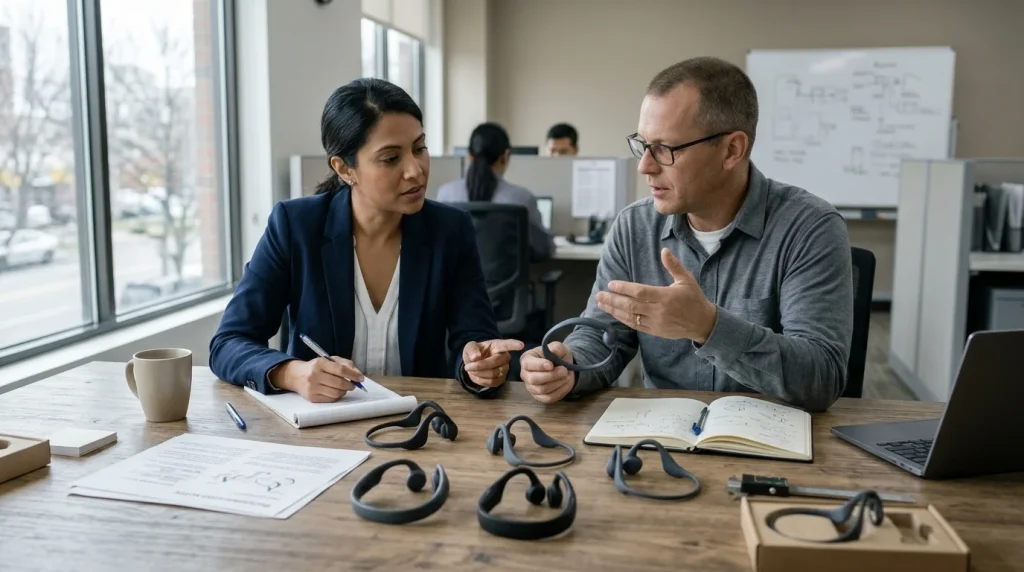
2. Choose the Intended Product Form and Primary Use Case
Headphones can use different wearing structures, including in-ear, open-ear, ear-hook, and bone-conduction designs. These categories are not interchangeable: each involves different trade-offs in fit, comfort, sound delivery, appearance, and intended use.
Buyers should identify the product form they prefer and explain why it suits the target user. If the exact structure is still undecided, describe the desired wearing experience and the constraints that matter most.
Clarify the primary use case before discussing optional features. A product intended mainly for everyday commuting may not need the same feature priorities as a model designed for running or water sports.
If the project may serve multiple use cases, rank them. Trying to optimize one product equally for every activity can create competing requirements. The manufacturer should understand which needs are essential and which can be treated as secondary.
3. Separate Essential Functions from Optional Features
List the functions the product must support, then distinguish them from features that would be desirable but are not essential to launch.
Depending on the intended product, requirements might include Bluetooth connectivity, physical or touch controls, microphone functionality, battery operation, local audio playback, or specific environmental protection. These are examples to evaluate—not a guarantee that any particular feature is available from a prospective supplier.
For each important function, explain the user need behind it. “Good call quality,” for example, is not a complete acceptance criterion. Buyers should clarify the intended call environment and determine how performance will be evaluated.
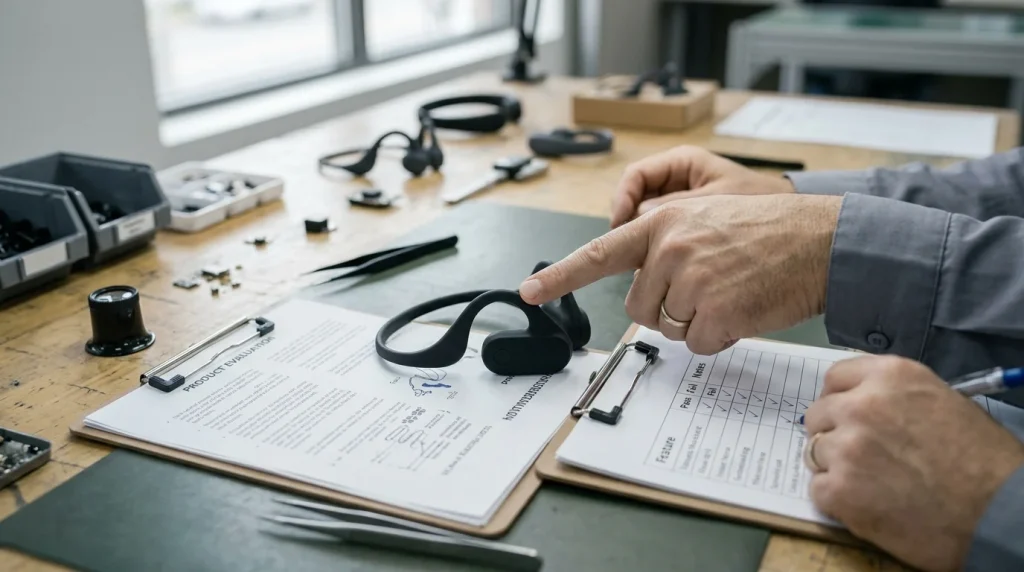
The same principle applies to battery life, comfort, sound quality, and water resistance. Avoid treating broad marketing phrases as measurable requirements. Where performance matters commercially, define an agreed evaluation method and acceptance condition before development proceeds.
4. Identify Target Markets and Compliance Considerations
The intended sales markets should be identified early because applicable product obligations, documentation, labeling, and commercial responsibilities can differ by destination.
For the United States, Canada, the United Kingdom, European markets, or Australia, buyers should determine which regulatory and market-access requirements apply to the specific product. Do not assume that a document or approval for one model automatically covers another model or a modified configuration.
For Bluetooth products, buyers should also clarify the applicable Bluetooth SIG qualification responsibilities. The official Bluetooth Qualification Process explains that Bluetooth products must complete the relevant qualification process before being brought to market. Responsibility should be established according to the buyer’s product, brand, and membership circumstances.
The goal at this stage is to identify questions that require confirmation, not to complete a full compliance review before selecting a supplier. Buyers should establish who will determine applicable requirements, provide supporting documents, and address any gaps.
5. Establish Design Expectations and Product Differentiation
Buyers should communicate what the product needs to achieve in the market without assuming that every idea requires a completely new design.
Identify the features that distinguish the product from alternatives: for example, its wearing experience, intended application, user controls, visual direction, or a particular functional requirement. Then distinguish between desired outcomes and preferred implementation methods.
An existing product platform may be a reasonable starting point for one project, while another may require more substantial development. That decision should follow a feasibility review rather than an assumption that every customization requires new tooling or that an existing model can satisfy every requirement.
Buyers should also identify any known constraints, such as compatibility with an existing product range, a required material, a target user experience, or the need to preserve certain design elements. The purpose is to help potential manufacturers assess fit and identify unresolved decisions.For an overview of the company’s published product categories and OEM/ODM information, visit the custom headphones OEM/ODM manufacturer page
6. Define Documentation and Acceptance Criteria
Before evaluating suppliers, decide what evidence will be needed to judge whether the project is progressing as agreed.
Relevant records may include product requirement documents, a feasibility review, a development scope, sample evaluation notes, test reports where applicable, and records of approved changes. The exact set depends on the project’s complexity and intended market.
Acceptance criteria are particularly important. They describe how the buyer and supplier will determine whether a requirement has been met. For example, a requirement may call for a defined function to operate under agreed conditions, with the result checked using a specified evaluation method.
Not every early project needs a fully completed technical specification. However, buyers should identify which requirements are already defined, which need supplier input, and which must be resolved before sample approval or production authorization.
7. Rank Priorities, Constraints, and Open Questions
A project becomes easier to evaluate when its priorities are explicit. Separate mandatory requirements from preferences, and record constraints that could affect technical feasibility or commercial decisions.
Useful categories include:
- Must-have: Requirements the product needs to satisfy.
- Preferred: Features that improve the proposition but may be negotiable.
- Constraint: A condition that limits acceptable solutions.
- Open question: An issue that needs technical, regulatory, or commercial clarification.
This approach helps prevent a supplier from interpreting every request as equally important. It also gives the buyer a consistent basis for comparing different proposals.
9. Practical Buyer Table

| Requirement Area | Questions Buyers Should Answer | Why It Matters |
|---|---|---|
| Target users | Who will use the headphones, and in what conditions? | Helps establish relevant design and performance priorities. |
| Product form | Which wearing structure best fits the intended user and activity? | Narrows the range of suitable product approaches. |
| Primary use case | Is the product mainly for commuting, sports, outdoor use, swimming, or another activity? | Prevents competing needs from being treated as equally important. |
| Core functions | Which functions are essential, and which are optional? | Helps assess technical fit without assuming every feature is available. |
| Target markets | Where will the product be sold, and which obligations need confirmation? | Identifies relevant compliance and documentation questions early. |
| Differentiation | What should distinguish the product from alternatives? | Helps evaluate whether a supplier’s proposed approach fits the commercial goal. |
| Documentation | Which records and evidence will be needed at each project stage? | Makes project review and approval more consistent. |
| Acceptance criteria | How will buyers determine whether key requirements have been met? | Reduces subjective decisions and later disagreements. |
| Constraints and open questions | What is mandatory, negotiable, or still unresolved? | Helps suppliers assess feasibility and identify risks transparently. |
Industry Insight
In custom audio development, uncertainty often comes not from a lack of ideas but from different interpretations of the same request. A buyer may describe a product as suitable for sports, while the manufacturer still needs to understand the activity, wearing expectations, environmental exposure, and essential performance conditions.
The most useful early project brief is therefore not necessarily the longest document. It is the one that separates confirmed requirements from preferences and unanswered questions. This allows a prospective manufacturer to explain which parts appear feasible, which need further investigation, and what evidence would be needed to validate them.
Buyers should use the initial discussion to assess the supplier’s reasoning as well as its proposed solution. Clear questions, explicit assumptions, and documented responsibilities create a stronger basis for deciding whether to proceed.
Buyer Tips
- Prepare a short description of the target user and the main use environment.
- Rank essential functions before discussing optional enhancements.
- Identify target markets and assign responsibility for confirming applicable requirements.
- Ask potential suppliers to distinguish existing features from proposed changes.
- Agree on how important requirements will be evaluated before approving a sample.
- Keep unresolved technical questions visible rather than treating them as confirmed decisions.
Common Mistakes
- Defining the project only by a competitor’s product or appearance.
- Combining several use cases without ranking their importance.
- Treating every requested feature as technically confirmed before feasibility review.
- Using vague terms such as “premium sound” or “long battery life” without defining how they will be assessed.
- Assuming that documentation for one model automatically applies to a modified product.
- Moving into development without recording assumptions, constraints, and approval responsibilities.
Key Takeaway
Clear custom Bluetooth headphones project requirements give buyers a practical basis for evaluating manufacturer suitability. Define the target user, product form, principal use case, essential functions, target markets, evidence needs, and acceptance criteria. Separate confirmed decisions from preferences and unresolved questions. This helps buyers compare supplier proposals more consistently and identify important gaps before committing to development or production.
Related Questions
The other five approved FAQ titles in this weekly cluster were not supplied with this configuration, and the available prior context contains titles from a different cluster. To avoid inventing article titles, confirm the approved weekly FAQ list before publishing this section.
CTA
Planning a custom Bluetooth headphones project? Contact YONG YUNG to discuss your intended product category, target users, primary use case, and key requirements. Sharing what is already defined—and what still needs clarification—can help establish the questions that should be addressed during an initial project discussion. Any proposed scope, technical approach, and responsibilities should be confirmed against the specific project.