
Private-label headphone packaging requirements involve more than checking whether a retail box looks correct. Before shipment, buyers need to verify that the approved artwork, printed materials, product contents, product identifiers, outer-carton markings, and shipping documents match the purchase order and the requirements of the intended sales channel.
A packaging error can create problems even when the headphones themselves meet the agreed specifications. Incorrect artwork, missing accessories, outdated manuals, mismatched barcode data, or inconsistent carton quantities may lead to relabeling, shipment delays, inventory discrepancies, or additional handling after delivery.
For B2B buyers, the goal is to establish a documented pre-shipment verification process. Each critical item should have a clear verification method, a responsible party, and an approval status before the goods are released.
For a broader supplier assessment framework, see How to Evaluate a Private Label Bluetooth Headphones Supplier: Product Fit, Quality Evidence and Order Readiness.
1. Confirm the Final Approved Packaging Artwork and Revision
The first step is to establish which packaging artwork is authorized for the current order. Buyers may have reviewed several design drafts, corrected product information, or updated the packaging after an earlier sample was prepared. Without clear revision control, the supplier may use an outdated file during printing or packing.
Before shipment, compare the production packaging with the final approved artwork and the relevant order records.
Check the following items:
- Artwork revision: Confirm that the version used for production matches the approved file or revision reference.
- Product name and model: Verify the product name, model number, and other agreed product identifiers.
- Brand presentation: Check the approved logo artwork, positioning, spelling, and other required brand elements.
- Printed product information: Review specifications, feature descriptions, and other statements against the approved content.
- Language and layout: Confirm that the required language versions, text placement, and layout are correct.
- Change history: Check whether any corrections were approved after the initial artwork sign-off.
A filename alone may not be sufficient to establish that a file is current. Buyers and suppliers should use a clear revision reference or another agreed method to identify the approved version.
If the artwork changes after approval, the responsible parties should confirm whether the change affects the printed packaging, inserts, labels, product identifiers, or other order documents. Any affected materials should be reviewed before the order is released.
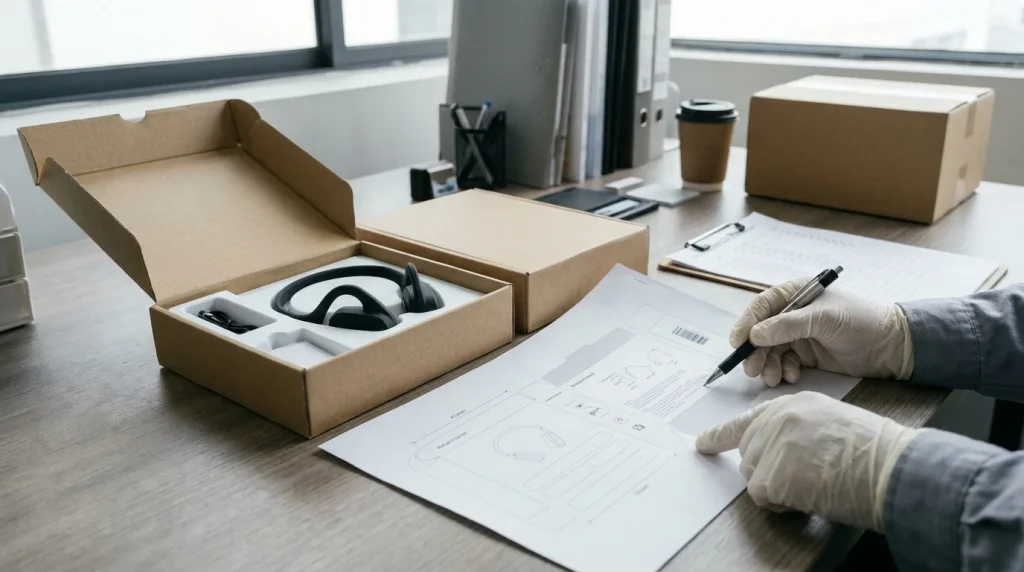
2. Check the Retail Box, Product Fit, and Package Contents
The printed appearance is only one part of packaging verification. The physical packaging must also accommodate the headphones and agreed accessories correctly, protect the contents as intended, and present the product consistently with the approved packaging sample or specification.
For custom printed retail gift box packaging, review both the exterior and the internal arrangement.
Retail box and internal fit
Check whether:
- The retail box corresponds to the approved packaging specification or sample.
- The headphones fit in the intended position without unexpected movement or pressure.
- The insert, tray, or protective material is positioned correctly.
- The box closes properly and shows no obvious damage, deformation, or printing defects.
- The packaging can be opened and handled as intended without damaging the product or its accessories.
The appropriate fit and protection requirements depend on the product construction and the agreed packaging design. Buyers should evaluate the actual package rather than assume that a previously approved design guarantees every production unit will be packed correctly.
Product and accessory completeness
Compare the packed contents with the approved package-content list. Depending on the order, this may include headphones, charging cables, earplugs, storage accessories, manuals, warranty information, or other agreed items.
Do not assume that every headphone model includes the same accessories. The verification list should reflect the specific model, order configuration, and approved contents.
Where practical, inspect representative packed units and record any missing, substituted, or incorrectly positioned items. If a discrepancy is found, clarify its scope and corrective action before shipment approval.
3. Verify Manuals, Labels, Warnings, and Market-Specific Information
Printed materials may contain product instructions, safety information, model identifiers, contact details, warranty statements, or other content relevant to the intended market. Buyers should confirm that the materials packed with the headphones are the correct approved versions for the order.
Review the following:
- User manual: Confirm the model, language, instructions, and product information.
- Product and package labels: Check the required identifiers and other agreed label content.
- Warnings and notices: Verify the applicable wording against the approved documentation and current requirements for the target market.
- Warranty or support information: Check that the content matches the buyer’s approved commercial and after-sales arrangements.
- Market-specific content: Confirm whether the order requires different language versions or market-specific information.
- Consistency: Compare printed claims and identifiers with the approved product information and other relevant records.
Requirements can vary by destination market, product type, importer, and sales channel. A packaging review should not be treated as a substitute for regulatory or legal assessment. Buyers should verify applicable obligations with their importer, compliance adviser, retailer, or other responsible party where necessary.
If a manual or label is revised after the packaging sample has been approved, the updated version should be reviewed before it is used in production. This helps prevent an otherwise correct retail box from containing outdated or inconsistent information.
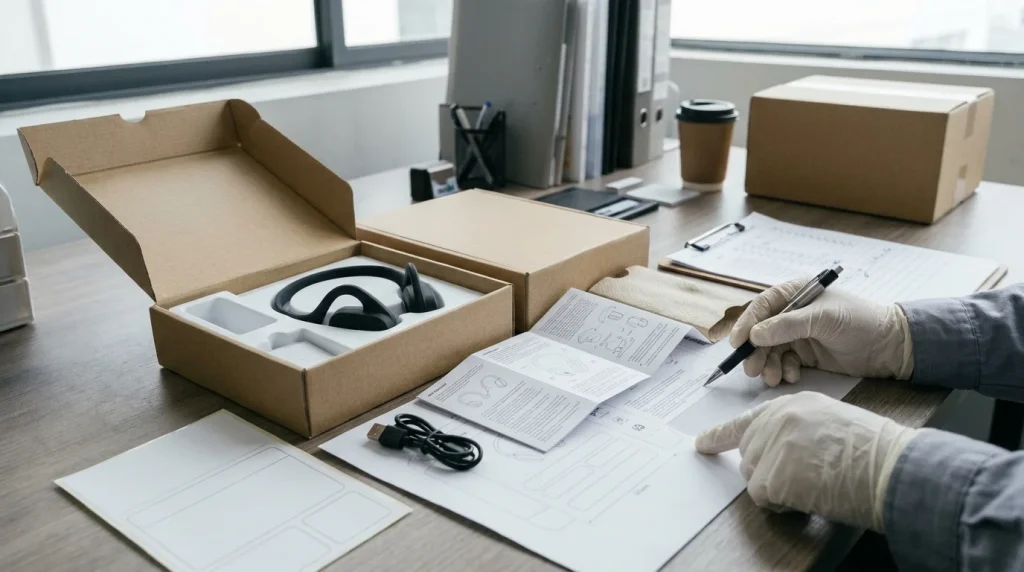
4. Confirm Barcode Data and Placement for the Intended Sales Channel
Barcode verification deserves separate attention because errors may affect receiving, inventory identification, or product listing operations. A barcode that looks visually correct is not necessarily the correct identifier for the product or sales channel.
Before shipment, buyers should confirm the barcode information against the current records and instructions applicable to the order.
Verify these points:
- Identifier accuracy: Confirm that the printed barcode data matches the identifier assigned to the relevant product, variant, or package level.
- Product mapping: Check that the barcode corresponds to the correct model, color, bundle, or other applicable configuration.
- Placement: Review the barcode position and orientation against the approved packaging artwork and the intended channel’s current instructions.
- Print quality: Check that the printed code is not visibly blurred, obscured, damaged, or placed across an unsuitable surface.
- Scan verification: Where required by the buyer’s process or sales channel, test the printed barcode using an appropriate scanning method.
- Outer-carton identifiers: If cartons use separate identifiers, verify those against the relevant packing and receiving information.
Do not assume that one barcode format or placement rule applies to every retailer or fulfillment channel. The requirements may differ according to the product, packaging level, marketplace, retailer, or receiving process.
For orders intended for Amazon or another third-party sales channel, use the buyer’s current product and packaging instructions. Confirm any required identifiers, labeling method, and preparation steps before the packaging is finalized for shipment.
5. Check Carton Markings, Quantities, and Shipping Documents
Retail packaging verification does not end at the individual product box. Buyers should also check the master cartons and the documents used to identify and account for the shipment.
A mismatch between the purchase order, packing information, carton markings, and shipping documents can create receiving or reconciliation problems even if each retail package is correct.

Outer-carton markings
Verify the agreed carton information, which may include:
- Product model or item reference.
- Quantity per carton.
- Carton number or sequence, if used.
- Gross and net weight, where required.
- Carton dimensions, where required.
- Destination or handling information specified by the buyer.
- Any other markings explicitly agreed for the order.
Not every shipment requires every field listed above. Use the approved packing instructions and the requirements applicable to the specific order instead of applying a generic marking template.
Quantities and document consistency
Compare the following records where applicable:
- Purchase order and order confirmation.
- Approved packing list or packing details.
- Actual packed quantity and carton count.
- Carton markings.
- Commercial invoice and other shipment documents prepared for the order.
- Any additional documents required by the buyer, importer, forwarder, or destination process.
The responsible parties should clarify discrepancies before shipment. For example, if the packing list states a different quantity per carton from the actual packing configuration, the discrepancy should be investigated and the relevant records corrected as appropriate.
Document preparation and transport arrangements may involve different parties. Buyers should confirm who is responsible for preparing, checking, and approving each document rather than assuming that all shipping-related tasks are included in a supplier’s packaging scope.
6. Review Packaging Samples and Production Proofs Where Needed
A previously approved packaging sample is a useful reference, but it does not automatically establish that all production packaging matches that sample. Printed materials can vary, packaging components can be substituted, and revisions can occur between approval and production.
Where the order risk, packaging complexity, or buyer’s procedure warrants it, request or review suitable production proofs or packaging samples before authorizing shipment.
The review may include:
- Comparing printed colors, text, layout, and artwork revision with the approved reference.
- Checking the physical construction and fit of the retail box and insert.
- Confirming that the correct manual, labels, and accessories are included.
- Verifying barcode content and placement against the applicable instructions.
- Reviewing the actual outer-carton configuration and markings.
- Recording any differences between the approved reference and the production materials.
A digital proof may help verify artwork and text, but it cannot establish every aspect of physical packaging fit or finished print quality. Conversely, a physical sample may not prove that all cartons in the shipment have been packed correctly. Use the type of evidence that matches the risk being checked.
If the buyer does not require a separate production sample, the agreed inspection procedure should still identify how packaging conformity will be verified and recorded.
Any deviation should be assessed before release. The responsible parties should agree whether the affected materials must be corrected, reworked, replaced, or handled through another documented disposition. Shipment approval should not be inferred from silence or from an earlier design approval.
7. Verify Current Amazon FBA or Retailer Preparation Instructions
Buyers selling through Amazon FBA or other retail and fulfillment channels may have additional preparation requirements. These requirements can depend on the product, packaging configuration, inventory program, destination, and current platform or retailer instructions.
The important distinction is between verifying channel requirements and assuming that a supplier automatically provides a particular preparation or fulfillment service.
Before shipment, buyers should:
- Identify the intended sales channel and the relevant order or inventory configuration.
- Review the current instructions available through the applicable seller account, retailer documentation, or authorized channel contact.
- Confirm any required product identifiers, packaging labels, carton information, or preparation steps.
- Determine which party is responsible for applying labels, preparing cartons, checking identifiers, and completing any required documentation.
- Verify that the actual shipment configuration matches the approved instructions.
- Record any exceptions and obtain approval from the responsible party before release.
For Amazon FBA orders, buyers should consult the current instructions applicable to their specific inventory and shipment rather than rely solely on a generic checklist or an old example. Requirements can change, and not every instruction applies to every product or shipment.
The same principle applies to retailer-specific preparation. A buyer should provide the relevant current requirements and agree on responsibilities with the supplier and any other parties involved. Do not assume that retail packaging compliance automatically means that a shipment meets every fulfillment or receiving requirement.
8. Record the Final Packaging and Shipment Sign-Off
A packaging inspection is most useful when it produces a clear decision record. Before shipment, the buyer and supplier should know which items have been checked, which issues remain unresolved, and who is authorized to approve the final release.
The sign-off process should cover the relevant evidence for the order, such as:
- Approved artwork and revision reference.
- Packaging sample or inspection findings, where applicable.
- Confirmation of manuals, labels, and package contents.
- Barcode and product-identifier verification, where applicable.
- Carton markings and quantity checks.
- Review of relevant packing and shipping documents.
- Records of discrepancies, corrective actions, and any approved exceptions.
A simple status system can help distinguish work that has not yet been checked from work that has been accepted or rejected. For example, use Pending, Approved, and Rejected. Add a separate note for corrective action or conditional approval if the buyer’s process permits it.
An item should not be marked approved merely because a document exists. The responsible person should verify the evidence required for that item. If a discrepancy remains unresolved, record it and obtain a documented decision from the authorized approver before shipment.
The final sign-off should also identify the order or shipment it covers. This reduces the risk of applying an approval from a previous order, packaging revision, or product configuration to a different shipment.
9. Pre-Shipment Packaging Checklist
The following checklist can be adapted for private-label headphone orders. The responsible party may be the buyer, supplier, or another designated participant, depending on the agreed workflow. Mark an item as approved only after the relevant verification has been completed.
| Item | Verification Step | Responsible Party | Approval Status |
|---|---|---|---|
| Approved artwork | Confirm the production artwork matches the latest approved revision. | Buyer / Supplier | Pending / Approved / Rejected |
| Product identification | Check the model, product name, and agreed identifiers on the packaging. | Buyer / Supplier | Pending / Approved / Rejected |
| Retail box | Compare the finished box with the approved packaging specification or reference sample. | Supplier; Buyer review where required | Pending / Approved / Rejected |
| Product fit and insert | Verify the product fits correctly and the insert or protective material is positioned as agreed. | Supplier | Pending / Approved / Rejected |
| Package contents | Confirm headphones, accessories, and printed materials match the approved contents list. | Supplier | Pending / Approved / Rejected |
| Manual and labels | Check the approved language, product information, warnings, and applicable market-specific content. | Buyer / Supplier | Pending / Approved / Rejected |
| Barcode | Verify the identifier, product mapping, print quality, and placement against current applicable instructions. | Buyer / Supplier | Pending / Approved / Rejected |
| Production proof or sample | Review the required proof or physical sample and record any deviations. | Buyer / Supplier | Pending / Approved / Rejected / Not Required |
| Outer-carton markings | Check agreed product references, quantities, carton numbering, and other required markings. | Supplier | Pending / Approved / Rejected |
| Carton count and quantities | Reconcile the actual packing configuration with the order and packing details. | Supplier / Buyer | Pending / Approved / Rejected |
| Shipping documents | Check relevant documents for consistency with the order, packing information, and shipment details. | Supplier / Buyer / Forwarder, as applicable | Pending / Approved / Rejected |
| Channel-specific preparation | Verify the current instructions for the intended marketplace, retailer, or fulfillment channel. | Buyer / Supplier / Designated service provider | Pending / Approved / Rejected |
| Open discrepancies | Confirm that identified issues have a documented disposition and the required approval. | Responsible owner / Authorized approver | Pending / Approved / Rejected |
| Final shipment sign-off | Confirm required checks are complete and the authorized party has approved release. | Authorized approver | Pending / Approved / Rejected |
Making the Shipment-Release Decision
Use the checklist as a record of verification, not as a substitute for the evidence behind each decision. Supporting records may include approved artwork, photographs, sample-review notes, packing details, barcode verification results, or relevant document checks.
Before authorizing release, confirm that:
- All critical packaging items have been checked.
- The approved artwork and product configuration match the order.
- Required printed materials and package contents are correct.
- Applicable barcode, carton, and channel instructions have been verified.
- Quantities and relevant shipment documents are consistent.
- Unresolved discrepancies have been addressed or formally dispositioned by the authorized party.
- The final approval identifies the relevant order or shipment.
If any critical requirement remains unverified, the buyer should clarify the issue and agree on the next step before release. The appropriate action may be correction, reinspection, document revision, or another documented decision, depending on the nature of the discrepancy and the agreed acceptance process.
Conclusion
Private-label headphone packaging requirements should be verified against the approved order, current artwork, agreed package contents, applicable channel instructions, and relevant shipment records. A visual review of the retail box alone is not enough to establish that the complete shipment is ready for release.
For B2B buyers, a documented pre-shipment checklist creates a practical way to assign responsibility, identify discrepancies, and record approval. By checking printed materials, product identifiers, carton information, and shipping documents before dispatch, buyers can reduce avoidable packaging and receiving issues and make the shipment-release decision on a clearer evidential basis.