
Bulk headphones approved sample consistency is an important part of private-label production control. A sample may meet a buyer’s expectations, but that alone does not establish that every production unit will use the same components, firmware, appearance, accessories, and packaging.
Before mass production begins, buyers should define which sample has been approved and document the specifications that production must follow. During manufacturing, inspection records and deviation management help identify differences between the approved reference and the finished goods.
The objective is not to assume that every unit will be identical in every measurable detail. It is to establish agreed acceptance criteria, identify unacceptable deviations, and make a documented shipment-release decision based on the available evidence.For a broader supplier assessment framework, see How to Evaluate a Private Label Bluetooth Headphones Supplier: Product Fit, Quality Evidence and Order Readiness.
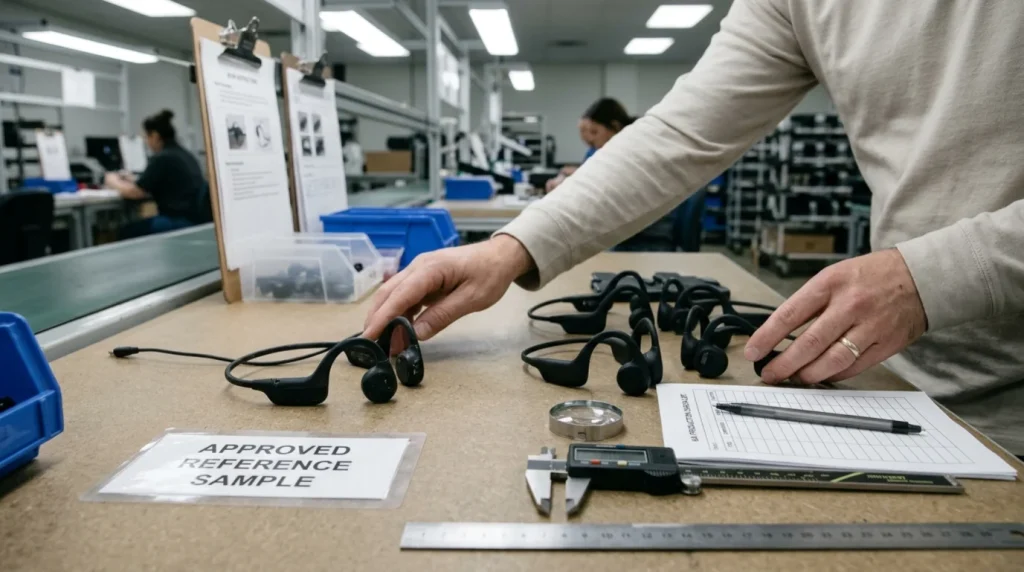
1. Identify and Preserve the Approved Reference Sample
The first step is to establish exactly which sample the supplier and buyer have approved. Informal approval based only on photographs, messages, or a general product description can leave room for disagreement later.
Record the product model, sample date, sample identifier where applicable, hardware configuration, and approval status. If the product has multiple versions, distinguish the approved version from earlier prototypes, revised samples, or other models with a similar appearance.
The reference sample should be retained in a suitable condition so that it can be used for comparison when questions arise. Both parties should understand which physical sample and associated documentation define the approved baseline.
A practical sample approval record should include:
- Product name and model number
- Sample identifier or revision, where applicable
- Date and method of approval
- Approved appearance, color, and logo placement
- Required functions and agreed performance criteria
- Included accessories and package contents
- Packaging artwork and labeling references
- Applicable hardware, firmware, and specification versions
- Outstanding issues or explicitly accepted deviations
If approval is conditional, record the conditions and identify who must close them before production or shipment. A sample should not be treated as fully approved when important requirements remain unresolved.
The approved sample provides a physical reference, while the specification and supporting records explain which characteristics must be maintained and how they should be assessed.
2. Establish a Controlled Specification for Mass Production
A physical sample alone cannot communicate every production requirement. Some characteristics need written specifications, version-controlled files, or defined inspection methods.
Before mass production, confirm that the supplier is working from the correct approved documents. These may include a product specification, relevant bill of materials (BOM), firmware or configuration reference, logo artwork, packaging artwork, user manual, and labeling requirements.
The exact documents will depend on the product and the project. Buyers do not necessarily need to obtain confidential information that is unrelated to their requirements, but they should establish enough traceability to verify the agreed product configuration.
Pay particular attention to changes made after sample approval. A component substitution, firmware revision, revised logo file, or packaging update may affect the finished product even if the model name remains unchanged.
For each controlled document, record its version or revision, approval status, and effective date where applicable. Make sure the supplier can identify which version was used for production.
Where changes are proposed, require the agreed review and approval process before the change is introduced. If a change may affect product function, compliance, appearance, or customer experience, determine whether a revised sample or additional testing is necessary.
A controlled specification reduces reliance on memory and helps both parties evaluate production against the same requirements.
3. Compare Appearance, Logo Placement, and Physical Construction
Visual inspection should compare production units with the approved sample and the agreed appearance criteria. The goal is to identify meaningful differences rather than assume that every minor variation is automatically unacceptable.
Depending on the headphone design, the inspection may cover:
- Housing shape and visible assembly gaps
- Color and surface finish
- Button, port, and control placement
- Headband, ear-hook, or open-ear structure
- Visible seams, scratches, contamination, or damage
- Logo artwork, orientation, position, and legibility
- Differences between the left and right sides, where applicable
Use the approved artwork and any agreed dimensional or appearance specifications when judging logo placement or other critical features. A photograph can support comparison, but it may not be sufficient to verify dimensions, color accuracy, or fine surface details.
Where appearance tolerances matter, define the inspection conditions and acceptance limits before production. For example, the buyer and supplier can agree on viewing distance, lighting conditions, approved color references, and which cosmetic defects are unacceptable.
Inspect more than one production unit where the agreed inspection plan calls for it. A single unit may reveal an obvious problem, but it cannot establish that an entire order is consistent.
Record identified defects with a description, photograph where useful, quantity observed, and the relevant acceptance criterion. This makes it easier to distinguish a confirmed deviation from a subjective preference raised after approval.
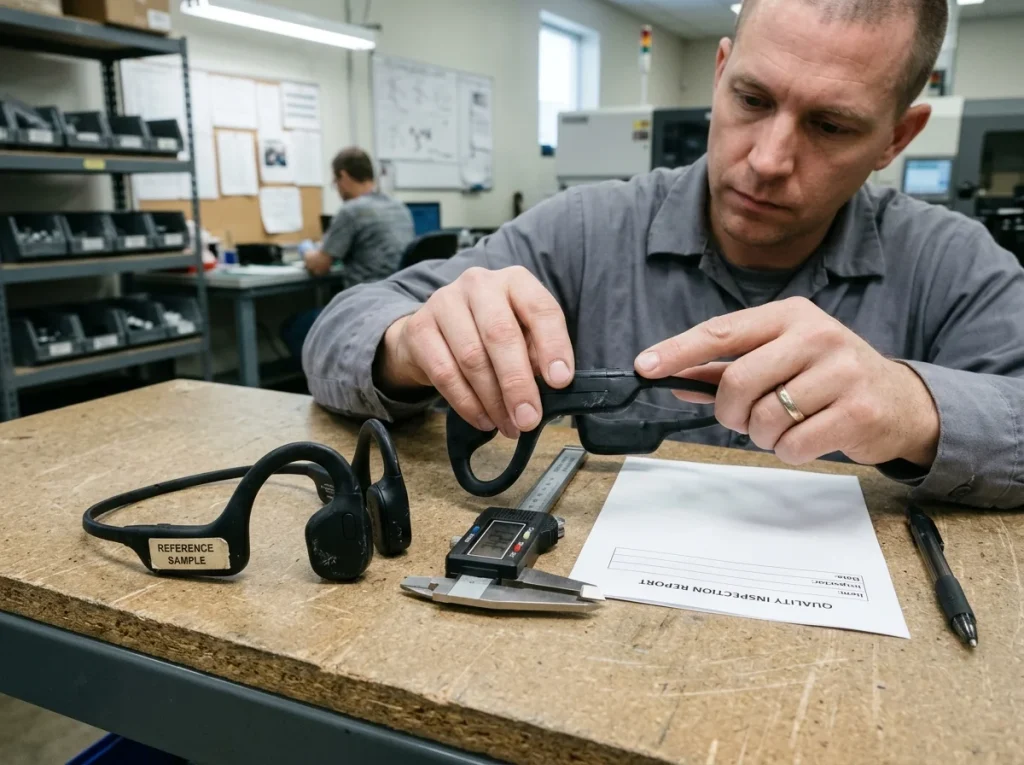
4. Verify Core Functions and Agreed Performance
A production unit can look similar to the approved sample and still behave differently. Functional verification should therefore be based on the product requirements, not visual appearance alone.
For Bluetooth headphones, the applicable checks may include power-on and power-off behavior, pairing, reconnection, audio playback, controls, charging, microphone operation, and other functions required for the particular model.
For sports or open-ear headphones, the relevant checks depend on the design and intended use. If water resistance, swimming use, or a particular audio feature is part of the agreed specification, use the applicable documented test method and acceptance criteria. Do not infer waterproof performance from appearance or from a general product description.
Before production, define:
- Which functions must be tested
- The procedure or equipment used where relevant
- The conditions under which the test is performed
- The expected result or acceptance threshold
- How failures are recorded and escalated
- Whether additional testing is required after a repair or rework
If a requirement involves a measurable performance value, document the applicable method and limit rather than relying on vague terms such as “good sound” or “stable connection.”
Testing should also consider configuration differences. If the approved sample used a particular firmware version or hardware revision, confirm that the production units being evaluated correspond to the approved configuration.
A functional check is useful only when the test method and expected result are clear enough for the buyer and supplier to interpret the outcome consistently.
5. Check Accessories, Package Contents, and Labeling
Approved-sample consistency includes everything the customer is supposed to receive, not just the headphones themselves.
Compare the production package contents with the approved bill of materials, packing list, or other agreed product documentation. Depending on the product, this may include charging cables, earplugs, storage cases, user manuals, spare accessories, or other specified items.
Check the following where applicable:
- Accessory type and quantity
- Cable or connector specification
- Manual language and revision
- Product model and variant identification
- Retail box design and artwork revision
- Product labels and required markings
- Barcode value and placement, if required
- Carton labels and shipment identification
- Consistency between the product, packaging, and order documents
Do not assume that a packaging file approved earlier is the same file used for the production run. Confirm the revision and compare the actual printed packaging with the approved artwork.
Labeling and compliance requirements depend on the product configuration, destination market, and applicable rules. A visual match with the approved sample does not, by itself, prove regulatory compliance.
If a missing accessory, incorrect language, wrong barcode, or outdated label is discovered, record the discrepancy and determine how it will be corrected before shipment.
6. Use Incoming, In-Process, and Final Inspection Records Appropriately
Inspection records provide evidence of what was checked, when it was checked, and what was recorded. Their value depends on the relevance and completeness of the information.
Incoming inspection may help identify issues with components or materials before they enter production. In-process inspection may identify assembly or process deviations while corrective action is still practical. Final inspection evaluates finished products and shipment-related requirements before release.
Ask the supplier which inspection stages apply to the product and what records can be provided. Depending on the agreed process, relevant records may identify the model, production batch or order, inspection date, inspection criteria, quantity checked, results, defects found, and disposition of nonconforming items.
Review whether the records correspond to the actual order and product configuration. A record for another model, a previous production run, or an unrelated inspection does not automatically demonstrate that the current shipment meets the requirements.
Also distinguish between a documented inspection and independent verification. A supplier’s internal inspection record can be useful evidence, but the buyer may require additional checks or third-party inspection depending on the order risk and agreement.
No single record proves every aspect of product consistency. Use the relevant documents together with the approved sample, controlled specifications, and the agreed inspection plan.
7. Understand Sampling Inspection and AQL
Buyers may use sampling inspection to assess a production lot without examining every unit. The sampling method and acceptance rules should be agreed before inspection rather than selected after results are known.
AQL, or Acceptance Quality Limit, is a term used in certain acceptance-sampling systems. It is not a promise that a specific percentage of the shipment will be defective, nor does it mean that every unit has been inspected.
An appropriate inspection plan depends on factors such as product risk, defect severity, order requirements, applicable standards or procedures, and the buyer-supplier agreement. Different defect categories may need different acceptance rules, and some critical characteristics may require specific controls beyond ordinary sampling inspection.
Before using an AQL-based plan, clarify:
- The sampling standard or procedure, if one is specified
- The lot definition and inspection scope
- The inspection level and sample-size method
- How critical, major, and minor defects are classified, if those categories are used
- The acceptance and rejection rules
- What happens if the lot fails inspection
- Whether reinspection or corrective action is required
Do not assume that one AQL level or sample size is suitable for every headphone order. The plan should reflect the agreed risk and acceptance requirements.
Sampling also has limitations: a passing result does not prove that every unit is defect-free. Buyers should combine the sampling plan with appropriate process controls, functional checks, documentation, and a clear procedure for handling discovered deviations.
8. Record Deviations and Verify Corrective Actions
When production differs from the approved sample or specification, the difference should be documented and assessed before the goods are released.
A deviation record should identify the affected model or batch, the requirement that was not met, the observed condition, the quantity or scope affected, and any available supporting photographs or test results.
The buyer and supplier should then agree on the disposition. Depending on the issue, this may involve rework, replacement, additional inspection, a revised sample, a formal concession, or rejection of affected goods. The appropriate response depends on the nature of the deviation and the applicable agreement.
Corrective action should address more than the immediate visible defect when the underlying cause may affect additional units. Ask the supplier to explain the suspected cause, the action taken, and how the effectiveness of that action will be checked where appropriate.
After rework or correction, define what must be reinspected and retain the results. Do not assume that a repaired unit or revised process has passed merely because the supplier reports that the problem has been fixed.
If the proposed change affects a previously approved feature, component, firmware version, label, or packaging file, determine whether the buyer must review and approve the change before the affected goods can proceed.
Maintain a record of unresolved issues and the person responsible for each follow-up. A clear deviation process prevents informal messages from becoming the only record of a production decision.
9. Manage Changes After Sample Approval
Changes can occur between sample approval and shipment for a variety of reasons, including component availability, supplier revisions, firmware updates, artwork corrections, or production-process adjustments.
Not every change has the same impact. A correction to a noncritical document may need a different review from a component substitution that could affect product performance, compliance, durability, or customer experience.
Establish a change-control process that requires the supplier to identify relevant changes and explain their potential impact. The process should clarify when buyer approval is required, what supporting evidence must be provided, and whether a revised sample or additional testing is necessary.
Before accepting a change, consider whether it affects:
- Product appearance or physical construction
- Hardware, components, or relevant BOM references
- Firmware or feature behavior
- Agreed functional or performance requirements
- Applicable compliance documentation
- Accessories, manuals, labels, or packaging
- Inspection procedures or acceptance criteria
Keep the previous and revised references identifiable so that the approved baseline is not silently replaced. Where a revised sample is approved, update the relevant documents and communicate which version applies to the production order.
Change control helps preserve consistency across repeat orders and reduces the risk that a product changes without the buyer understanding the consequences.
10. Pre-Shipment Checklist: Does the Order Match the Approved Sample?
Use the following checklist before authorizing shipment. Adapt it to the product, the purchase agreement, and the inspection plan.
| Comparison item | What to verify | Evidence to review | Shipment acceptance decision |
|---|---|---|---|
| Product identity and version | Model, variant, hardware revision, and other agreed identifiers | Approved sample record and controlled specification | Confirm the shipment matches the approved identity and version |
| Appearance and construction | Shape, color, finish, assembly, and visible defects | Reference sample, appearance criteria, inspection results | Accept only within the agreed criteria |
| Logo and artwork | Logo design, size, position, orientation, and approved file revision | Approved artwork and production-unit comparison | Confirm the agreed design and tolerances are met |
| Core functions and performance | Required Bluetooth, audio, control, charging, or other functions | Functional test records and defined acceptance criteria | Confirm required tests pass or resolve failures |
| Hardware and firmware | Relevant component and firmware configuration | Configuration records and change approvals, where applicable | Confirm no unapproved material change remains |
| Accessories and contents | Correct accessory types and quantities | Approved contents list and packing checks | Confirm package contents meet the order requirements |
| Retail packaging and manual | Correct artwork, language, revision, and presentation | Approved packaging files and physical packaging sample | Confirm approved versions are used |
| Labels and barcodes | Model identifiers, required markings, barcode values, and placement | Approved label artwork and inspection results | Resolve incorrect or missing required information |
| Inspection results | Applicable incoming, in-process, and final inspection outcomes | Order-specific inspection records | Confirm the agreed inspection requirements are met |
| Defects and deviations | Open nonconformities, corrective actions, concessions, and reinspection | Deviation log and closure evidence | Do not treat unresolved material issues as closed |
| Shipment documentation | Relevant order, carton, packing, and destination-market documents | Applicable shipment and compliance records | Confirm required documents are complete and consistent |
| Final release | Whether all required acceptance conditions have been met | Completed checklist and authorized approval record | Record the release decision and any approved exceptions |
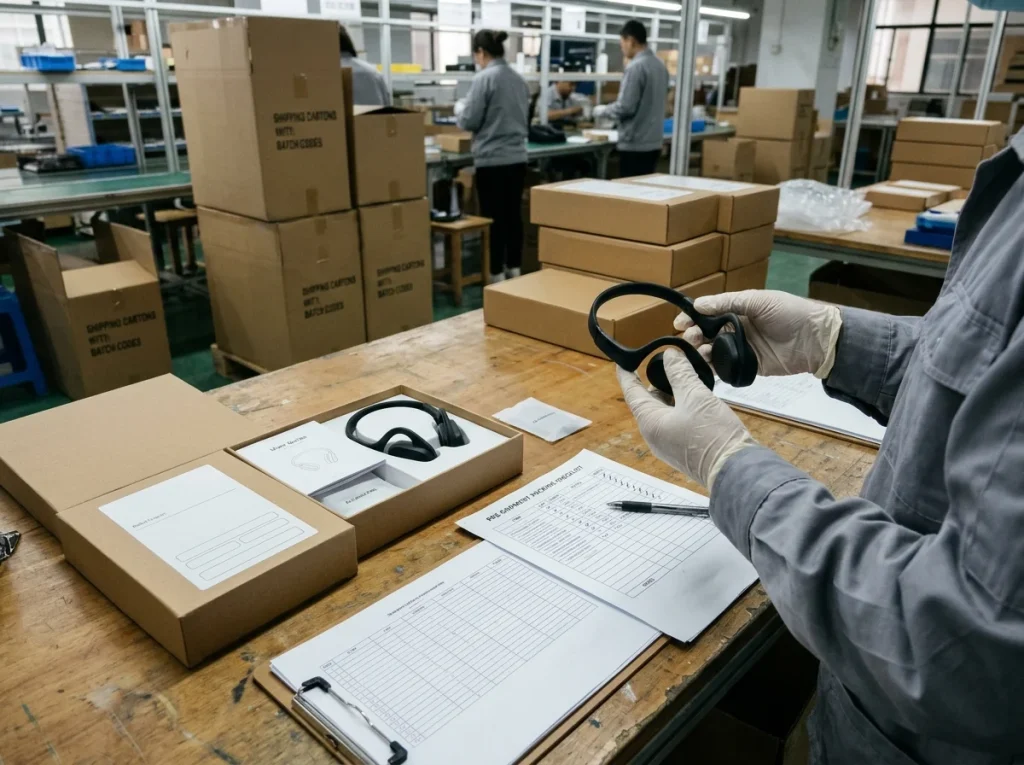
Making the Shipment-Release Decision
A shipment should be released according to the agreed acceptance requirements, not solely because the supplier says production is complete.
Before release, confirm that required inspections have been completed, material deviations have been resolved or formally accepted by the authorized party, and the product and shipment documentation are consistent with the order.
If important evidence is missing or a material discrepancy remains unresolved, document the issue and agree on the next action before making the release decision. Depending on the contract and the nature of the issue, that may mean additional inspection, corrective work, a revised approval, or holding the affected goods.
Keep the final checklist, relevant inspection records, deviation decisions, and approval status together with the order documentation. This creates a traceable record of the basis for shipment acceptance.
Conclusion
Confirming that bulk headphones match the approved sample requires a defined reference, controlled specifications, appropriate inspection, and documented handling of deviations.
Buyers should verify product identity, appearance, core functions, accessories, packaging, labels, and relevant hardware or firmware configurations against the approved baseline. Inspection records and sampling plans can support the decision, but their scope and limitations should be understood.
Most importantly, changes and unresolved defects should not disappear into informal communication. A documented pre-shipment review gives the buyer and supplier a common basis for deciding whether the order meets the agreed requirements and is ready for release.