
Bluetooth headphones chipset and firmware requirements should be confirmed before a buyer approves a supplier’s product sample. A chipset may support certain Bluetooth functions, but that does not automatically mean every function is implemented, configured, or validated in the finished headphones.
For B2B buyers developing a private-label product or evaluating an existing headphone model, technical due diligence should cover the hardware platform, firmware behavior, device compatibility, audio features, update arrangements, and version control. These details help prevent misunderstandings between the supplier’s stated capabilities and the product that is ultimately approved for production.
The objective is not simply to identify a chipset brand. It is to establish what the specific product can do, which requirements have been demonstrated, what limitations remain, and how the approved configuration will be maintained throughout the order.
For a broader supplier assessment framework, see How to Evaluate a Private Label Bluetooth Headphones Supplier: Product Fit, Quality Evidence and Order Readiness.

1. Identify the Chipset or Bluetooth Platform Used in the Exact Model
Start by asking the supplier which Bluetooth chipset, module, or platform is used in the specific headphone model under consideration.
Depending on the product design, the supplier may be able to provide a chipset manufacturer, part number, module identification, platform summary, or relevant technical documentation. The level of detail available may depend on commercial confidentiality and the supplier’s role in the product development process.
Request clarification on:
- The chipset or module manufacturer and exact part number, where disclosable
- The hardware or platform revision used in the proposed product
- The Bluetooth version and relevant supported functions
- The relationship between the chipset, firmware, and finished-product features
- Any known hardware limitations relevant to the intended application
- Whether the same platform is used across different product variants
Do not assume that two headphone models use the same platform simply because they look alike or share similar product descriptions. Products with similar external designs may use different electronic components, firmware versions, or feature configurations.
If the supplier references platforms from manufacturers such as Jerry, Actions, or BES, treat those names as starting points for technical verification rather than proof of a particular product capability. Ask for the exact platform information applicable to the proposed model.
If full component disclosure is not available, request an appropriate alternative, such as a technical summary, documented feature matrix, or demonstration of the relevant functions.
The key question is whether the proposed hardware platform is suitable for the product requirements—not whether a particular chipset name sounds familiar.
2. Confirm Which Bluetooth Functions Are Actually Supported
A chipset specification describes potential capabilities. The finished product’s available functions depend on the complete hardware design, firmware implementation, configuration, and validation.
Ask the supplier to distinguish among three categories:
- Supported by the platform: The chipset or module is technically capable of supporting the function under appropriate conditions.
- Implemented in the product: The function has been integrated into the proposed headphone model’s hardware and firmware.
- Validated against requirements: The function has been tested against defined use cases and acceptance criteria.
These categories are not interchangeable.
For example, a platform may support a particular Bluetooth function, but the finished product may not implement it. Alternatively, the function may be implemented but behave differently from what the buyer expects.
Depending on the intended product, relevant questions may cover pairing, reconnection, multipoint connectivity, audio playback controls, microphone behavior, call handling, supported codecs, or other Bluetooth-related functions.
Not every product requires every feature. The buyer should identify which functions are essential, which are optional, and which are outside the project scope.
Ask for a feature matrix that identifies the functions supported by the specific model and configuration. Where necessary, request a demonstration or test record rather than relying solely on a general platform specification.
The agreed feature matrix should become part of the product requirements used for sample evaluation and approval.
3. Evaluate Pairing Behavior and Device Compatibility
Bluetooth compatibility should be assessed against the devices and use cases relevant to the target market. No supplier should be assumed to provide universal compatibility with every phone, operating system, application, or Bluetooth implementation.
Before sample approval, define the devices that matter to the project. Depending on the intended customer base, these may include representative smartphones, tablets, computers, or other Bluetooth audio sources.
Ask the supplier to explain and demonstrate the following behaviors where applicable:
- Initial pairing and entry into pairing mode
- Reconnection to a previously paired device
- Connection behavior after the headphones are switched off and on
- Behavior when the source device’s Bluetooth connection is interrupted
- Audio playback and pause controls
- Call answering, ending, and microphone behavior
- Device switching or multipoint operation, if required
- Relevant operating-system or device-specific limitations
Use a repeatable test procedure. Record the source device, operating-system version where relevant, headphone model, firmware version, test steps, and observed results.
For example, if automatic reconnection is a requirement, define the conditions under which reconnection should occur, how long the test should run, and what constitutes a failure. Avoid acceptance criteria such as “connects quickly” unless the project defines a measurable threshold.
If compatibility differs across devices, ask the supplier to document the observed behavior and any known limitations. A controlled test on one phone is not proof that the product behaves identically across all devices.
The aim is to establish a practical compatibility baseline that matches the product’s intended users and the buyer’s support expectations.
4. Clarify Firmware Dependencies for Controls and Audio Features
Firmware determines how many product functions behave in practice. Buttons, touch controls, power management, connection logic, audio processing, and microphone behavior may depend on firmware settings and implementation.
A buyer should therefore ask not only which features are available, but also how each feature is implemented in the specific model.
For physical buttons or touch controls, clarify:
- Which actions are assigned to each control
- Whether single press, double press, or long press behavior is required
- How playback and call controls behave with the intended source devices
- Whether the control assignments are fixed or configurable
- How accidental activation or conflicting commands are handled, where relevant
For audio-related functions, clarify whether the requested behavior depends on hardware, firmware, a companion application, or a combination of these elements.
For example, a buyer may request a particular EQ profile, tailored sound tuning, or dual-microphone environmental noise cancellation (ENC). The supplier should explain whether the proposed model’s hardware and firmware support the requirement, whether it is already implemented, and how the result will be demonstrated.
An EQ requirement may involve the available audio-processing path, firmware configuration, acoustic tuning, or other design constraints. A dual-microphone ENC requirement may depend on microphone placement, signal processing, firmware implementation, and the conditions under which performance is evaluated.
The presence of two microphones does not, by itself, establish that a particular ENC performance level has been achieved. Likewise, a chipset’s theoretical audio-processing capability does not prove that a requested EQ profile is implemented in the finished product.
Where a feature is important, ask for a demonstration, relevant technical documentation, or test results tied to the exact model and firmware configuration.

5. Distinguish Standard Functions from Configuration and Development Work
Before requesting samples or negotiating a project schedule, ask the supplier to classify each required function.
A practical classification is:
- Standard: Already implemented in the proposed model and available in the current configuration.
- Configurable: Potentially available through supported settings or parameter changes without major hardware redesign.
- Requires firmware development: Needs software changes, integration, or additional validation.
- Requires hardware changes: Depends on a different component, circuit design, microphone arrangement, or other physical modification.
- Not confirmed: Evidence is insufficient to determine feasibility.
This classification helps prevent a common sourcing problem: a feature is discussed during early negotiations but is later treated as a new development request or found to be technically unsuitable.
Ask the supplier to explain the basis for each classification. If a feature is described as configurable, confirm which parameters can be changed, who controls the configuration, and how the change will be tested.
If additional development is required, document the requested behavior, dependencies, deliverables, validation process, and commercial responsibilities before proceeding. Do not assume that every software change is possible on the existing platform.
The same principle applies to named chipset families. The fact that a platform supports a function in one product does not prove that the function is available in another model using the same family or manufacturer.
A written feasibility assessment is more useful than a broad statement that the supplier can customize firmware.
6. Confirm Firmware Versions, Updates, and Change Control
Firmware version control is particularly important when a buyer expects to reorder the same product or maintain consistency across multiple production batches.
Ask how the supplier identifies firmware versions and distinguishes between production configurations. Depending on the product, relevant identifiers may include a firmware version, build number, hardware revision, configuration record, or other traceable reference.
Clarify:
- How the firmware version used in a sample is recorded
- Whether the production version can be identified before shipment
- How firmware changes are reviewed and approved
- Whether changes can affect pairing, controls, audio behavior, or compatibility
- How known defects and corrective updates are documented
- Whether update mechanisms are available for the specific product
- Who is responsible for testing and approving a revised version
Do not assume that every Bluetooth headphone supports over-the-air firmware updates. Some products may have no user-accessible update mechanism, while others may require a particular application, tool, or service process. The available method must be confirmed for the exact model.
If a firmware update mechanism exists, clarify who can initiate an update, how the update is distributed, what happens if an update fails, and whether the buyer or end user needs additional software or hardware.
Firmware changes should also be assessed for unintended effects. A change intended to improve one function may affect another behavior, so regression testing should reflect the agreed product requirements.
Before mass production, record the approved hardware and firmware configuration. If the supplier later proposes a change, determine whether it requires a new sample, additional testing, renewed compliance review, or written buyer approval.
A clear change-control process helps preserve consistency between the approved sample and subsequent orders.
7. Define Acoustic and Functional Acceptance Criteria
Technical discussions become more useful when each important feature has a clear method of evaluation.
For audio-related requirements, buyers should distinguish subjective listening preferences from measurable performance criteria. Both may matter, but they should not be confused.
Depending on the project, acceptance criteria may address:
- Playback behavior and basic audio functionality
- Left-right channel operation, where applicable
- Defined EQ or sound-profile requirements
- Microphone and call performance under specified conditions
- ENC behavior under agreed test conditions, if required
- Button or touch-control response
- Pairing, reconnection, and connection stability
- Battery and power-management behavior where relevant
If the supplier refers to acoustic testing equipment, an acoustic chamber, or specialized measurement facilities, ask what tests are actually performed, how the results are recorded, and whether the setup is suitable for the required measurement.
Do not assume that a supplier owns a particular test chamber or has validated a specific audio performance simply because such equipment is mentioned in a discussion. Request evidence relevant to the actual project.
For a feature such as dual-microphone ENC, the test method should identify the relevant use conditions and performance criteria. For EQ tuning, record the agreed profile or measurable target where applicable, rather than relying exclusively on vague descriptions such as “better bass” or “clearer vocals.”
The buyer and supplier should agree on the sample evaluation procedure before testing begins. Define the test device, environment, steps, expected behavior, tolerance where relevant, and how failures will be recorded.
A repeatable evaluation process reduces disagreement during sample approval and helps establish a reliable basis for production acceptance.
8. Document the Technical Baseline Before Sample Approval
Before approving a sample, compile the agreed technical requirements into one controlled record. This may be a product specification, technical agreement, sample approval sheet, or another document used by the project team.
At a minimum, the record should identify:
- Product model and hardware configuration
- Chipset or module information to the extent agreed and available
- Required Bluetooth functions
- Pairing and reconnection expectations
- Target devices and compatibility test conditions
- Required control behavior
- Audio and microphone requirements
- Firmware version or other applicable configuration identifier
- Known limitations and approved exceptions
- Test procedures and acceptance criteria
- Change-approval responsibilities
The record should distinguish confirmed facts from open questions. If a function has not yet been demonstrated, mark it as pending verification rather than treating it as approved.
When a sample passes the agreed evaluation, record which sample and configuration were approved. Where practical, retain the relevant firmware and hardware identifiers alongside the sample approval record.
This provides a reference for later production checks. If a delivered batch behaves differently, the buyer can compare the production configuration with the approved baseline and investigate the difference.
Technical documentation should be proportionate to the project. A standard product may require a relatively straightforward specification and test record, while a product involving new firmware behavior or custom audio processing may require more detailed development and validation documentation.
The important point is to agree on the required evidence before approval—not after a problem appears.
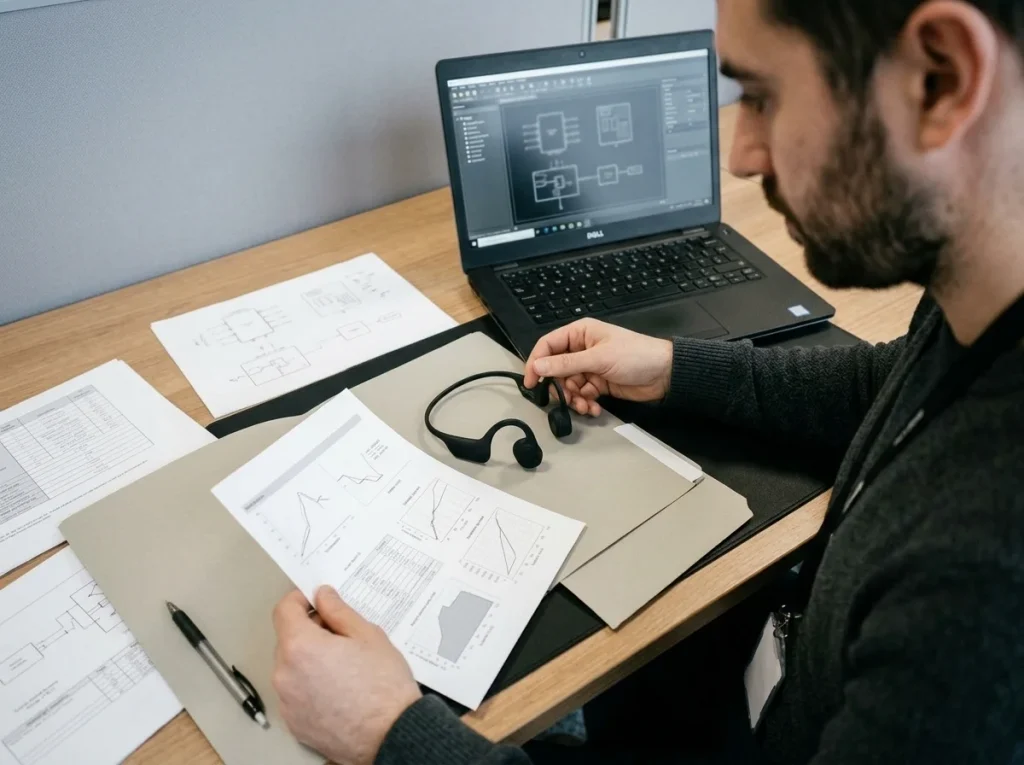
9. Buyer Checklist: Chipset and Firmware Due Diligence
Use the checklist below when evaluating a headphones supplier. Tailor the acceptance criteria to the intended product, target devices, and commercial requirements.
| Technical item | Question to ask | Evidence or demonstration to request | Acceptance criteria to define |
|---|---|---|---|
| Chipset or platform identity | Which chipset, module, or platform is used in this exact model? | Technical summary, part number where available, or model-specific documentation | Platform information is sufficiently clear for the project’s technical and compliance review |
| Hardware revision | Which hardware revision is used in the proposed sample? | Model or configuration record | Sample and production configuration are identifiable |
| Bluetooth functions | Which required functions are supported and implemented? | Model-specific feature matrix and demonstration | Each required function is confirmed as supported and implemented |
| Pairing | How does initial pairing work? | Live demonstration and repeatable test steps | Pairing follows the agreed procedure on defined test devices |
| Reconnection | What happens after disconnection or power cycling? | Test record or witnessed demonstration | Reconnection behavior meets the agreed steps and timing criteria |
| Device compatibility | Which target devices have been evaluated? | Compatibility matrix or documented test results | Required device and operating-system combinations are defined and assessed |
| Controls | How do buttons or touch controls behave? | Control-function table and sample demonstration | Each required action produces the expected behavior |
| EQ or audio processing | Is the requested profile implemented on this model? | Relevant configuration information, demonstration, or test results | The agreed profile or audio criteria are met |
| Dual-mic ENC | Is the requested ENC behavior supported and validated? | Model-specific feature confirmation and relevant test evidence | Performance criteria and test conditions are agreed and satisfied |
| Firmware identity | How is the firmware version identified? | Version record, build identifier, or configuration document | Approved firmware can be distinguished from other versions |
| Firmware updates | Does the product support updates, and how are they delivered? | Description or demonstration of the actual update method, if available | Update method and responsibility are documented; unsupported mechanisms are not assumed |
| Feature development | Is the request standard, configurable, or a development task? | Written feasibility assessment and defined scope | Dependencies, deliverables, and validation requirements are agreed |
| Change control | How are hardware or firmware changes approved? | Change-control procedure or agreed written process | Material changes require review and approval under the agreed process |
| Functional and acoustic testing | How are the required functions measured or evaluated? | Relevant test procedure and results, where available | Test conditions, methods, and pass/fail criteria are defined |
| Sample approval | Which exact configuration has been approved? | Sample approval record and applicable specification | Approved sample, hardware, firmware, and requirements are traceable |
Questions to Resolve Before Approving a Sample
Before signing off on the sample, confirm that:
- The supplier has identified the relevant chipset or platform to an appropriate level of detail.
- Required Bluetooth functions are confirmed for the exact model rather than inferred from chipset specifications.
- Pairing, reconnection, controls, and compatibility have been assessed against defined use cases.
- Any required EQ, ENC, or other audio behavior has been demonstrated or supported by relevant evidence.
- The supplier has clarified which requirements are standard, configurable, under development, or not confirmed.
- Firmware and hardware configurations can be identified and changes can be reviewed.
- Acceptance criteria and outstanding technical issues are documented.
- The approved configuration can be used as the reference for production consistency checks.
Conclusion
Choosing a headphones supplier requires more than checking a chipset name or accepting a general statement about Bluetooth compatibility. Buyers need to understand how the hardware platform, firmware, and finished-product implementation work together in the exact model being considered.
The most effective approach is to define the required functions, ask for model-specific evidence, test against representative devices, agree on measurable acceptance criteria, and record the approved hardware and firmware configuration.
For products involving customized controls, EQ, ENC, or other software-dependent behavior, additional technical clarification and validation may be necessary. These requirements should be resolved before sample approval wherever possible.
A documented technical baseline helps buyers make a better-informed supplier decision and provides a reference for evaluating later production batches and proposed product changes.