
Choosing a private label Bluetooth headphones supplier involves more than comparing product photos, quoted prices, or customization options. Buyers need to determine whether a supplier’s products fit the intended market, whether technical and quality claims can be verified, and whether the supplier can support the documentation and approvals required before an order moves into production.
A structured private label Bluetooth headphones supplier evaluation helps reduce avoidable sourcing risks. It gives brand owners, importers, and distributors a consistent way to compare suppliers using product specifications, quality records, sample results, compliance documentation, and order controls rather than relying on verbal assurances alone.
The objective is not to find a supplier that claims to do everything. It is to establish whether a specific supplier, product model, and proposed order meet the buyer’s documented requirements.
1. Start With Product and Market Fit
Begin by defining the product category, intended users, target market, and essential product requirements. Bluetooth headphones designed for running may have different priorities from swimming headphones or everyday open-ear audio products.
For example, a sports-focused product may require a secure fit, sweat resistance, straightforward controls, and stable wireless performance during movement. A swimming model may require a different playback approach and independently verified waterproof performance. A general-purpose Bluetooth headset may place more emphasis on microphone performance, call quality, and device compatibility.
Ask each supplier to identify the exact model being proposed and provide its current specification sheet. Confirm details such as:
- Product type, dimensions, weight, and wearing design
- Bluetooth version and supported operating modes
- Battery capacity, charging method, and stated playback conditions
- Microphone and control functions
- Supported audio formats or local playback functions, where applicable
- Waterproof or dust-resistance claims, if relevant
- Included accessories, packaging contents, and available variants
Do not assume that two products with similar appearances share the same internal components, firmware, performance, or compliance status. Evaluate the actual model and configuration being quoted.
2. Distinguish Standard Products From Custom Development
A supplier may offer an existing model for private labeling, a modified version of a standard product, or a product-development project. These are different sourcing situations and should be evaluated separately.
For an existing model, confirm which features are fixed and which can be changed without altering the underlying product design. Branding, color, packaging, accessories, and firmware behavior may have different technical and commercial implications.
For a modified product, request a written description of every proposed change and ask whether it affects tooling, component selection, testing, lead time, or the approval process. A change that appears cosmetic may still affect fit, assembly, sealing, or packaging compatibility.
For a new-development project, assess the proposed engineering scope, deliverables, sample stages, and design-approval responsibilities before making assumptions about production readiness.
Buyers can use the supplier’s custom headphones OEM/ODM manufacturer page as a starting point for understanding the product and customization categories offered. The final evaluation should still be based on the specific model, agreed scope, and evidence supplied for the project.
3. Verify Factory and Quality-Control Evidence
A supplier’s website may describe manufacturing and quality-control capabilities, but buyers should establish which activities are performed at the supplier’s own facility, which are outsourced, and which records can be provided for the proposed order.
Useful evidence may include dated factory or production-area photographs, a process overview, sample inspection records, incoming-material inspection records, in-process inspection records, final inspection criteria, and examples of nonconformance handling. Where third-party manufacturing or testing is involved, clarify the responsible organization and the scope of its work.
A quality-control statement is not the same as a documented control process. Ask how the supplier identifies defects, records inspection outcomes, handles failed units, and determines whether corrective action is needed.
For an initial evaluation, look for traceability between the product model, the inspection record, and the order being discussed. A record for a different model or an undated generic checklist may not establish that the proposed product is controlled in the same way.
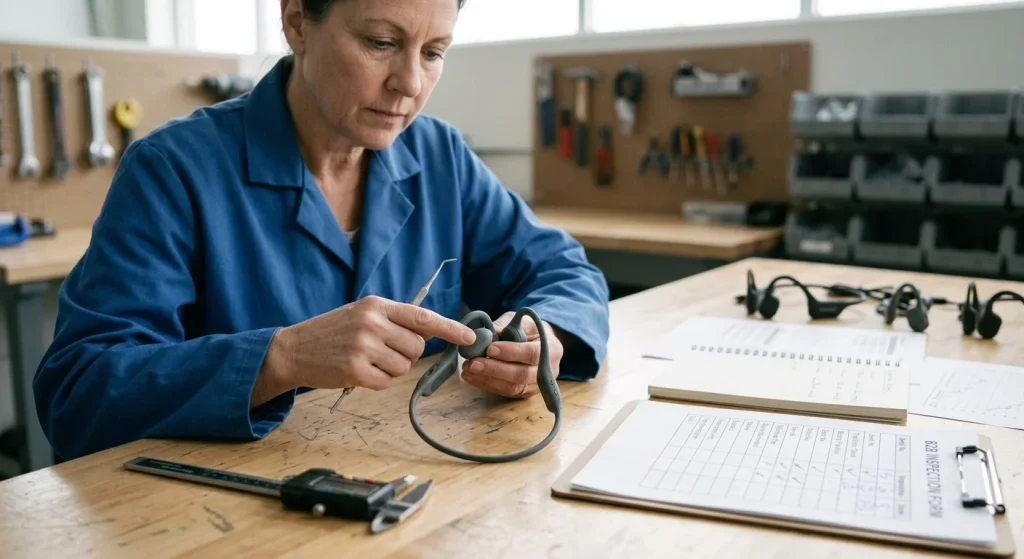
Do not judge a supplier solely by the number of machines shown in photographs or by broad claims about factory size. The more useful question is whether the supplier can demonstrate relevant controls for the product and order you intend to place.
4. Check Technical Compatibility and Bluetooth Documentation
Technical evaluation should connect the specification sheet to practical use and the buyer’s target market. Confirm the intended phone and operating-system compatibility, pairing behavior, supported controls, microphone functions, charging method, and any application or firmware dependencies.
If the product uses a particular Bluetooth chipset, ask for the relevant component or platform information where it affects compatibility, functionality, maintenance, or future product changes. Do not assume a named chipset guarantees a particular audio experience. Real-world behavior also depends on implementation, firmware, antenna design, acoustic components, and the product configuration.
For private-label products, clarify who controls firmware changes, how version updates are documented, and whether the approved sample and production units must use the same firmware version. If the supplier proposes a change after sample approval, require a review of its impact before accepting the revised configuration.
Bluetooth qualification deserves separate attention. The Bluetooth SIG explains that Bluetooth products must complete the applicable qualification process before being marketed or distributed, and that product names and model numbers must align with the relevant product information. Buyers should review the official Bluetooth SIG product qualification guidance and establish which company is responsible for the applicable qualification and licensing obligations.
Do not treat a chipset datasheet, a Bluetooth version printed in a brochure, or a supplier’s general statement as proof that the finished private-label product has completed every required step. Confirm the relevant product and model information and agree on responsibility before launch.
5. Request Evidence for Waterproof and Performance Claims
Waterproof claims need evidence that corresponds to the actual product and the conditions under which it is intended to be used. A label such as IPX7 or IPX8 should not be interpreted as a universal guarantee of suitability for swimming, diving, or every water-related activity.
Ask for the available test report or other traceable evidence. Check that the report identifies the correct model or a demonstrably equivalent configuration, the tested condition, the test date, the test method, and the reported outcome. If a report covers only a component or a different model, ask the supplier to explain its relevance to the finished product.
Also clarify whether changes to the housing, buttons, charging interface, seals, materials, or assembly process could affect the validity of earlier test evidence. A previously tested design should not automatically be treated as equivalent to a modified product.
Performance checks should reflect the product’s intended use. Depending on the model, buyers may request evidence or sample checks covering Bluetooth connection stability, audio output, microphone behavior, battery performance, charging, controls, and durability-related concerns.
The important distinction is between a supplier’s claim, a test plan, a test record, and a verified result. These are not interchangeable. If the necessary evidence is unavailable, record the gap and decide whether testing is required before approval.
6. Verify Certifications and Market-Specific Compliance
Compliance requirements depend on the product configuration, destination market, applicable regulations, and the way the product is marketed. Do not assume that a supplier’s general certificate list proves that every model or private-label variation is covered.
Ask for the relevant certificates, declarations, and supporting reports. Verify the issuing organization, document number, date, product description, model identifiers, and scope. Where possible, confirm the document with the issuer or through its official verification system.
Check that the documentation matches the actual product and the intended market. A report for a different model, a component-only report, or a document with inconsistent brand and model details may not establish coverage for the product you plan to sell.
Clarify who will supply the documents, who will review them, and who is responsible for any additional testing or regulatory work required for a modified version. Keep this responsibility in writing before the order is approved.
Avoid treating a logo on a website or a certificate image as sufficient evidence by itself. The goal is to verify applicability, not simply collect documents.
7. Confirm Branding, Packaging, and Sample-to-Production Consistency
Private labeling introduces additional approval points. Buyers should confirm the exact logo artwork, placement, color references, packaging version, labels, manual language, accessories, and model identifiers that will be used for the order.
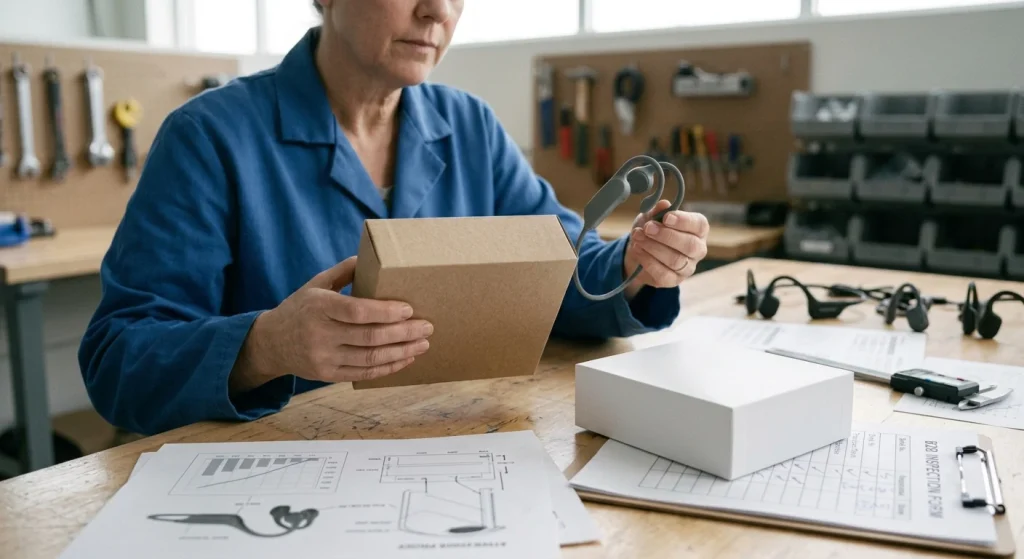
Request a final artwork proof or packaging sample where relevant. Check that the product and packaging use consistent model names and that required warnings, ratings, and market-specific information have been reviewed. If packaging is supplied by another party, identify who approves the final files and who checks the delivered materials.
Sample approval should also create a clear reference for bulk production. Record the approved product model, hardware configuration, firmware version where relevant, color, logo, accessories, packaging, and any agreed acceptance criteria. Keep dated photographs or signed approval records when appropriate.
Ask the supplier how changes are controlled after approval. Substituting a component, changing a firmware version, modifying a seal, or revising packaging without authorization may affect product performance or compliance. Agree on a process for reviewing and approving material changes before production continues.
The purpose of sample approval is not simply to confirm that one sample looks acceptable. It is to establish an agreed reference against which the delivered order can be evaluated.
8. Check Order Documentation and Shipment Readiness
Before placing an order, ensure that the commercial and technical documents describe the same product and agreed scope. The quotation, purchase order, specification sheet, approved sample record, packaging files, and inspection criteria should not contradict one another.
At minimum, confirm the model and variant, quantity, customization scope, unit configuration, packaging contents, inspection expectations, required documents, shipment terms, and the process for handling changes or nonconforming goods. Identify who approves production release and who provides final shipment documentation.
If the order has destination-specific labeling or logistics requirements, confirm them before production and packing. Do not assume that a supplier’s general shipping experience means every marketplace, carrier, destination, or fulfillment arrangement is covered.
A supplier is more ready for an order when responsibilities, documents, approval points, and unresolved issues are explicit. If key information remains unconfirmed, assign an owner and a deadline for resolving it before committing to the next stage.
9. Use a Practical Supplier Evaluation Checklist
Compare suppliers against the same requirements rather than relying on a single overall impression. For each item, record the evidence received, whether it applies to the proposed model, and any outstanding action.
A supplier may be suitable for a standard private-label product but not yet ready for a more complex customized version. That distinction is useful: it helps buyers identify what can proceed now and what needs further verification.
The final decision should consider product fit, evidence quality, technical compatibility, compliance coverage, sample consistency, communication, and order documentation together. A low quotation cannot compensate for missing critical evidence, and a polished presentation cannot replace model-specific verification.
Before approving a supplier, ensure that critical requirements are either verified or explicitly listed as conditions that must be resolved before production or shipment.