
Quick Answer
When testing waterproof bone conduction headphones, manufacturers utilize rigorous pressure chambers and controlled submersion tanks to verify their durability. A professional bone conduction headphones manufacturer follows these strict protocols to ensure IP68 standards, guaranteeing that devices can withstand prolonged underwater use.
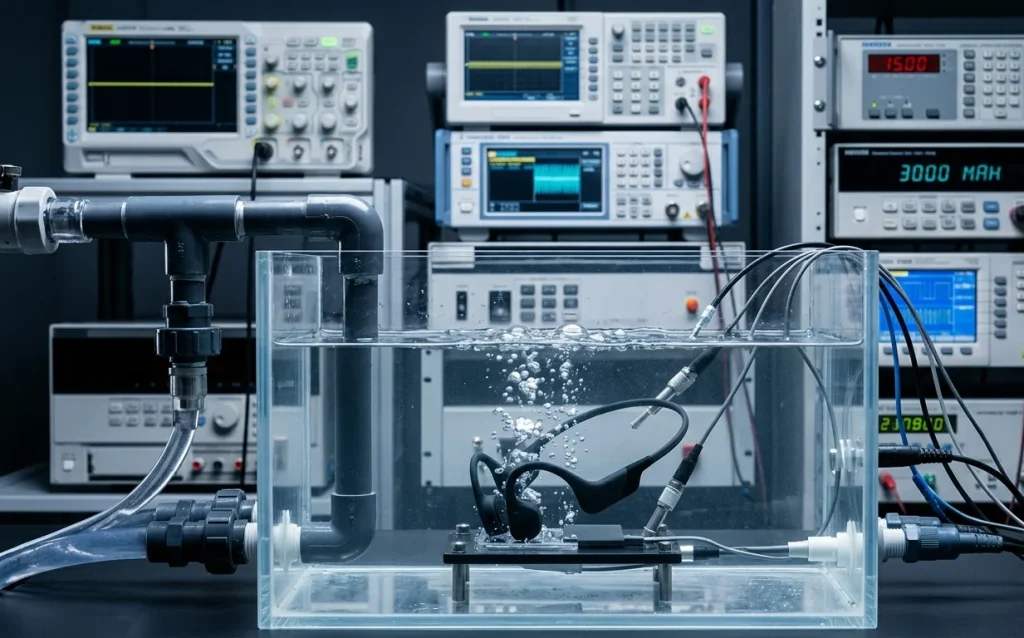
Featured Image Suggestion
Image File Name: bone-conduction-headphones-waterproof-testing.jpg
Image Title: Waterproof Testing for Bone Conduction Headphones
ALT Text: Bone conduction headphones waterproof testing procedures
AI Image Prompt: A professional laboratory setting, close-up of bone conduction headphones being tested in a transparent water tank, high-tech industrial testing equipment in the background, professional lighting, photorealistic, 8k, engineering and technology aesthetic. –ar 16:9
Detailed Answer
Waterproof testing for audio devices is a scientific process designed to ensure structural integrity under extreme conditions. For high-end electronics, factories follow the Ingress Protection (IP) code, which defines the levels of sealing effectiveness against foreign bodies and moisture. The testing process typically involves several stages to ensure that ODM bone conduction headphones can handle real-world usage.
The primary method involves a pressure chamber. This device simulates the physical stress of water at various depths. By applying atmospheric pressure to the headphones, manufacturers can identify structural weaknesses in the housing, buttons, or charging ports. This is a critical step for a swimming headphones manufacturer, as the pressure encountered while swimming is significantly higher than simple surface splashing.
Following pressure chamber validation, devices undergo physical submersion tests. For an IP68 rating, headphones are placed in a tank of water at a specified depth (usually 1.5 meters or more) for a set duration, often 30 to 60 minutes. After the immersion, the devices are inspected for any sign of moisture ingress. Furthermore, manufacturers test the functionality of the device immediately after testing to ensure that the internal circuitry, including the battery and Bluetooth chipsets, remains operational.
Integrity testing is not just about the final product; it is about the manufacturing process. Technologies like ultrasonic welding and the application of specialized liquid silicone sealants are tested for consistency. A consistent assembly line ensures that every unit from an OEM bone conduction headphones batch meets the same waterproof standard. Without these stringent testing phases, the risk of device failure during intense athletic activity or swimming increases, which can severely impact brand reputation.
Comparison Table
| IPX Rating | Testing Condition | Application |
| IPX4 | Splash-proof test | Light rain/sweat |
| IPX7 | 1 meter for 30 mins | Temporary immersion |
| IPX8 | 1.5+ meters for 1+ hour | Professional swimming |
Industry Insight
In the consumer electronics market, there is a clear distinction between “water-resistant” and “waterproof.” Many manufacturers may label a product as waterproof based on design specifications alone, but only rigorous testing confirms it. A professional bone conduction headphones manufacturer will provide official test reports from third-party certification bodies like SGS or TUV. Relying solely on internal testing can be deceptive, as it may not be calibrated to international standards. For brands sourcing private label bone conduction headphones, requesting an official IPX8 test report is the only way to ensure the product is truly swim-ready. Professional factories maintain these protocols as part of their standard QC workflow to minimize the high return rates associated with moisture-damaged electronics.
Buyer Tips
- Request Lab Reports: Always ask for third-party test reports (e.g., SGS, TUV) rather than relying on a manufacturer’s internal claims.
- Clarify IPX8 Details: IPX8 is not a standardized depth; ask the manufacturer for the exact depth and duration used during the certification test.
- Check Assembly: Inquire if the factory uses ultrasonic welding, as this is more reliable for long-term waterproofing than standard adhesives.
- Sample Testing: Conduct your own real-world “stress test” on pre-production samples before committing to a large order.
Common Mistakes
- Confusing IPX7 with IPX8: Assuming a product rated for IPX7 (temporary submersion) can be used for regular lap swimming, which requires IPX8.
- Ignoring Saline/Chlorine Effects: Forgetting that testing is done in fresh water; swimming in salt or chlorinated water is more corrosive and requires specific testing considerations.
- Relying on Self-Declarations: Accepting a “waterproof” label on the packaging without verified test documentation, leading to post-purchase reliability issues.
Recommended Internal Links
Related Questions
- What is the difference between IPX7 and IPX8 ratings?
- Can waterproof bone conduction headphones be used in saltwater?
- How often should a manufacturer perform waterproof testing on a batch?
- Do I need specialized certifications to market swimming headphones?
Summary
Understanding waterproof testing is vital for any brand looking to succeed in the sports audio market. Whether you are sourcing OEM bone conduction headphones or working on ODM bone conduction headphones, the manufacturer’s testing methodology defines product reliability. Always ensure your chosen swimming headphones manufacturer provides verified IPX8 documentation. During negotiations, remember that MOQ considerations should never override quality compliance requirements. Verified testing data is the foundation of a successful private label bone conduction headphones business, ensuring that your products deliver consistent performance and help build long-term customer loyalty in a competitive global market.