
Quick Answer
Evaluating bone conduction headphone quality before placing a bulk order requires analyzing structural clamping force, acoustic transducer frequency curves, waterproof sealing integrity, and battery safety compliance. Partnering with a vetted ODM headphones manufacturer allows procurement managers to conduct pre-production golden sample audits, verify automated testing protocols, and review component traceability standards. Establishing rigorous quality benchmarks prevents costly field return rates and protects brand reputation across international consumer retail markets.
Detailed Explanation
Assessing open-ear audio quality demands specialized evaluation protocols distinct from conventional air-conduction headphones. Because bone conduction devices rely on mechanical vibrations transmitted directly through the temporal bones, acoustic clarity and physical ergonomics are closely tied to mechanical enclosure tolerances. Evaluating prototype samples through structured testing ensures performance meets international commercial benchmarks.
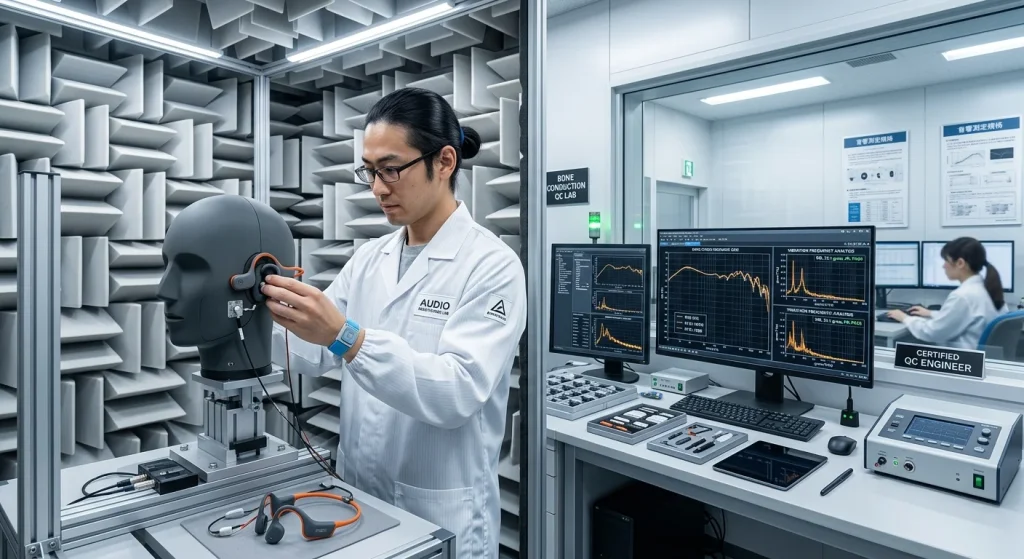
Acoustic evaluation begins with measuring transducer frequency response curves and sound leakage levels. Engineers utilize artificial head simulators inside anechoic chambers to measure distortion, clarity, and mechanical vibration transfer efficiency. Reviewing technical testing criteria in a comprehensive china bone conduction headphones factory guide helps procurement teams verify that pre-production samples deliver balanced sound without causing uncomfortable skin resonance or severe acoustic leakage during phone calls.
Waterproof testing represents another critical quality pillar, particularly for aquatic and sports headsets. Qualified suppliers subject finished enclosures to high-pressure water immersion tanks to verify IPX8 waterproofing compliance, alongside salt-spray corrosion tests for sweat resistance. During the design verification phase, collaborating with an experienced ODM audio headset developer ensures that liquid silicone overmolding and magnetic charging ports maintain hermetic sealing under continuous dynamic flex conditions.
Structural reliability testing must also evaluate headband elasticity, memory wire retention, and drop impact resistance. High-grade titanium alloy bands should withstand over 10,000 bending cycles without permanent deformation or internal wire fatigue. Working alongside a established original design headphone manufacturer ensures that physical housing materials undergo full environmental chamber testing, exposing units to extreme heat and humidity ranges before authorization of full-scale production tooling.
Evaluating operational firmware stability and wireless performance rounds out the quality audit process. Testing Bluetooth connection stability across varied obstacle environments, multi-device switching latency, and battery power management prevents field failures post-launch. Contracting with a turnkey ODM headphone factory provides end-to-end quality documentation, ensuring every bulk production batch mirrors the verified golden sample standards.
Finally, long-term operational success depends on selecting an ODM headphones manufacturer with stringent internal QA systems. Conducting thorough incoming material inspections (IQC) and in-process quality control (IPQC) guarantees component consistency. Establishing clear Acceptable Quality Limit (AQL) standards with your ODM headphones manufacturer ensures predictable output quality across every container shipment.
Comparison Table
| Quality Test Phase | Key Testing Parameters | Industry Benchmark Standard | Procurement Risk Mitigated |
| Acoustic & Vibration | Frequency response curve, sound leakage, THD distortion | Artificial head simulator analysis, <5% THD at max volume | Poor audio clarity, severe sound leakage |
| Waterproof & Sealing | IPX8 pressure tank immersion, salt-spray corrosion | 2 meters water depth for 2 hours, 48-hour salt spray | Ingress short-circuits, sweat erosion |
| Mechanical Stress | Titanium band flex cycles, multi-angle drop testing | 10,000+ flex cycles, 1.5-meter drop test on concrete | Frame breakage, internal solder joint failure |
| Environmental Reliability | Thermal shock, high heat/humidity storage | -20°C to +60°C operating, 95% RH humidity exposure | Material degradation, battery degradation |
| Firmware & Wireless | RF signal strength, multipoint pairing, battery burn-in | Zero dropouts within 10m, 72-hour aging test | Connection dropping, firmware bricking |
Industry Insight
Quality verification in open-ear audio manufacturing is transitioning from passive post-production testing to real-time automated inline inspection. Advanced factories deploy robotic vision systems to verify silicone overmolding alignment and automated acoustic sweep testers on every production line. Rather than relying on simple sample spot-checks, B2B procurement leaders now mandate 100% automated pressure testing for all aquatic models before final packaging. This automated approach eliminates human error, reduces factory defect rates below 0.3%, and guarantees consistent waterproofing across high-volume production runs.
Buyer Tips
- Seal and sign a physical “Golden Sample” to serve as the binding quality baseline for pre-shipment AQL inspections.
- Require full compliance documentation, including CE, FCC, RoHS, REACH, and UN38.3 battery transport certifications before releasing deposits.
- Mandate 100% IPX8 pressure water tank testing records for all swimming model production lots.
- Link progress payment releases to passing third-party AQL Level II Normal (0 Critical / 1.0 Major / 2.5 Minor) inspection reports.
- Partner directly with a certified ODM headphones manufacturer to ensure direct engineering communication during technical root-cause analyses.
Common Mistakes
- Relying exclusively on cosmetic sample inspections while skipping destructive environmental and waterproofing stress tests.
- Failing to verify battery protection circuit board (PCB) quality, leading to rapid capacity degradation or thermal failure in storage.
- Omitting explicit defective return policies (RMA agreements) and spare unit allocations from master procurement contracts.
Key Takeaway
Thorough quality evaluation before placing a bulk order prevents supply chain disruptions and protects your brand image in competitive retail markets. Evaluating acoustic curves, IPX8 waterproofing, titanium band durability, and firmware reliability provides complete operational visibility. Working with an experienced ODM headphones manufacturer ensures your bulk shipments meet strict international quality standards.
Related Questions
- What is the difference between AQL Level II Major and Minor defect limits?
- How is IPX8 waterproofing tested on bone conduction headsets during mass production?
- Why is titanium alloy wire used inside open-ear headband frames?
- What compliance certificates are mandatory for importing audio electronics into North America and Europe?
- How do environmental chamber tests simulate long-term product aging?
Recommended Images
- Featured image: Professional quality assurance inspector using an artificial head simulator inside an acoustic anechoic chamber to evaluate bone conduction headphones.
- Factory production image: High-precision automated robotic arm applying silicone sealants on an assembly line.
- Testing process image: Bone conduction headphones undergoing high-pressure water immersion testing inside a illuminated IPX8 testing tank.
- Comparison chart or workflow diagram: Infographic flowchart illustrating the 5-stage quality evaluation framework from IQC incoming checks to final AQL pre-shipment audits.
Image ALT Text Suggestions
- OEM bone conduction headphones manufacturer quality control laboratory
- Bone conduction headphones waterproof testing in pressure water tank
- IPX8 swimming headphones factory automated testing and inspection
Suggested Internal Links
- /bone-conduction-headphones/
- /oem-bone-conduction-headphones/
- /odm-services/
- /swimming-headphones/
- /blog/
- /contact/
How to Evaluate the Quality of Bone Conduction Headphones Before Bulk Ordering?
Evaluating quality involves testing acoustic vibration curves on artificial head simulators, verifying IPX8 waterproof pressure sealing, conducting titanium band flex stress tests, and auditing battery safety certifications.
What AQL standard should be used for bulk headphone inspection?
Standard B2B audio procurement utilizes AQL Level II Normal sampling, setting limits at 0 Critical defects, 1.0 Major defects, and 2.5 Minor defects.
Why is IPX8 pressure tank testing necessary for swimming headsets?
IPX8 pressure tank testing simulates underwater depths to ensure liquid silicone overmolding and charging seals prevent water ingress during continuous immersion.