
Quick Answer
Developing and producing private label bone conduction headphones typically takes 3 to 6 months for custom ODM projects, while standard OEM logo customization takes only 30 to 45 days. Timelines depend heavily on acoustic tuning, housing mold customization, and IPX8 waterproofing requirements. Partnering with an experienced MP3 swimming headphones supplier ensures streamlined component procurement, rigorous waterproof testing, and faster mass production schedules for brand owners and Amazon sellers.
Detailed Answer
The timeline to bring private label bone conduction headphones to market varies based on the level of customization involved. The development cycle can be categorized into two main paths: standard OEM private labeling and full ODM custom development.
Phase 1: OEM Private Labeling (30–45 Days)
For brands using existing, pre-engineered headphone platforms, the process is streamlined:
- Branding and Packaging Design (1–2 Weeks): Logo placement, custom color selection, firmware startup prompt customization, and retail packaging layout approval.
- Component Procurement (2 Weeks): Securing acoustic transducers, battery cells, Bluetooth chipsets, and local MP3 storage memory modules.
- Mass Production and Assembly (2 Weeks): SMT assembly, silicone injection overmolding, assembly, and automated testing.
- Quality Control & Packaging (1 Week): Final inspection, IPX8 immersion testing, and master carton packing.
Phase 2: Full ODM Custom Development (3–6 Months)
Creating a unique open-ear or underwater audio product requires a structured engineering roadmap:
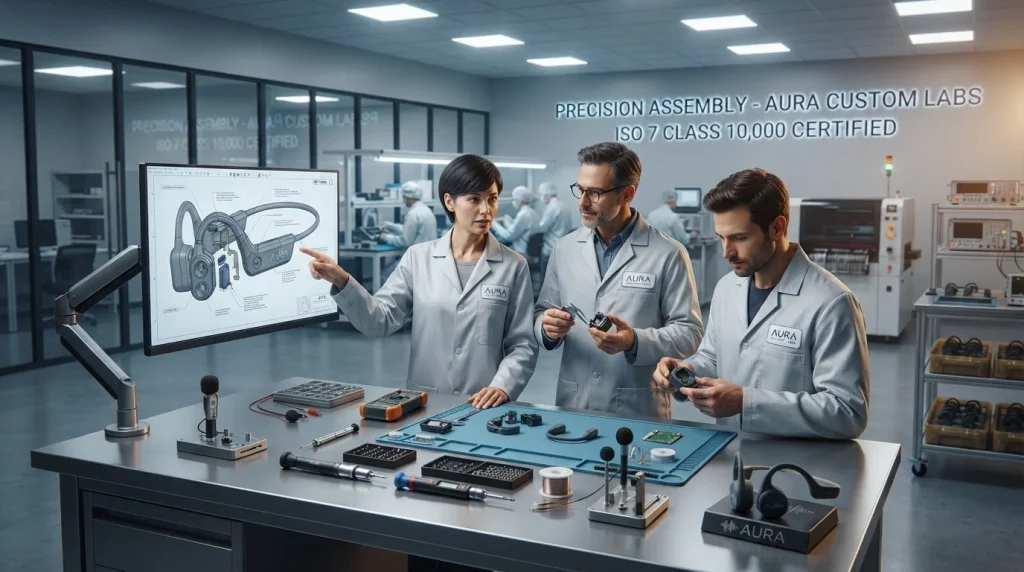
- Industrial Design (ID) & Structural Design (2–4 Weeks): Ergonomic modeling, titanium memory alloy neckband curve drafting, and acoustic chamber optimization.
- Tooling & Plastic Injection Molds (4–6 Weeks): CNC steel mold fabrication for the main housing, magnetic charging ports, and silicone exterior coating.
- Prototyping & Acoustic Tuning (3–4 Weeks): EVT (Engineering Validation Test) units are assembled to evaluate bone conduction transducer vibration, bass response, and sound leakage mitigation.
- Waterproof Optimization & Reliability Testing (2–3 Weeks): DVT (Design Validation Test) phases subject units to deep-water pressure tanks, thermal shock, and continuous vibration tests.
- Pre-Production Run & Pilot Production (2 Weeks): PVT (Production Validation Test) verifies assembly line yield rates before authorizing full-scale bulk fabrication.
By working with an established china bone conduction headphones factory, procurement teams can shorten these cycles by leveraging existing IPX8 waterproof bone conduction headphones mold architectures while focusing customization efforts on brand identity, acoustic tuning profiles, and retail-ready packaging.
Comparison Table
| Development Stage | Standard OEM Customization | Custom ODM Design | Key Critical Path Milestones |
| Design & Engineering | 1–2 Weeks | 4–6 Weeks | ID approval, tooling design, schematic layout |
| Tooling & Molds | N/A (Existing Molds) | 4–6 Weeks | Steel mold CNC machining, sample trial shots |
| Prototyping & Testing | 1 Week | 3–4 Weeks | Acoustic tuning, IPX8 water pressure chamber tests |
| Component Sourcing | 2 Weeks | 3–4 Weeks | Bluetooth ICs, internal MP3 storage, battery cells |
| Bulk Production & QC | 2 Weeks | 2–3 Weeks | SMT assembly, overmolding, final inspection |
| Total Lead Time | 30–45 Days | 3–6 Months | First shipment dispatch ready |
Industry Insight
The open-ear and aquatic audio manufacturing sector relies on precise schedule coordination between component vendors and assembly lines. Bone conduction technology requires specialized transducer calibration to ensure efficient sound transfer through temporal bones without causing excessive housing vibration. Furthermore, integrating onboard storage for swim-grade audio adds complexity to PCB layouts and battery management systems. A specialized swimming headphones OEM manufacturer mitigates supply chain risks by maintaining pre-qualified vendor lists for critical components like titanium memory wire, internal flash storage, and sealed tactile buttons, ensuring predictable mass production throughput.
Buyer Tips
- Lock Product Specifications Early: Finalize housing colors, battery capacity, and MP3 storage size prior to mold fabrication to prevent costly engineering change orders (ECOs).
- Verify Waterproof Testing Standards: Ensure your waterproof bone conduction headphones supplier performs 100% water pressure testing on production units rather than random batch sampling.
- Request EVT and DVT Golden Samples: Require approved physical reference samples for acoustic quality and surface finish before signing off on full-scale manufacturing.
- Plan Around Component Lead Times: High-grade Bluetooth chipsets and specialized bone conduction transducers often carry longer procurement lead times than standard dynamic drivers.
Common Mistakes
- Underestimating Mold Modification Time: Assuming that changing physical housing dimensions is quick; modifying steel injection molds requires weeks of CNC re-tooling and testing.
- Bypassing Pilot Production (PVT): Skipping small-batch trial production runs frequently results in higher defect rates during initial full-scale manufacturing.
- Ignoring Regulatory Certifications: Failing to account for regional certification lead times (CE, FCC, RoHS, TELEC) can block shipments at customs even after production is finished.
Recommended Internal Links
Related Questions
- How does IPX8 waterproof testing impact production lead times for swim headphones?
- What is the typical MOQ for custom bone conduction headphones development?
- How do built-in MP3 storage options affect PCB design and unit cost?
- What testing procedures ensure reliable bone conduction headphones quality control?
Summary
Navigating the production timeline for OEM bone conduction headphones requires balancing engineering validation, mold creation, and quality verification. Partnering with a specialized MP3 swimming headphones supplier allows brand owners to leverage proven structural platforms and streamline manufacturing. Whether launching a basic private label line with a modest MOQ or engineering fully custom IPX8 waterproof bone conduction headphones from scratch, aligning project schedules with realistic manufacturer lead times ensures smooth launch execution and reliable inventory replenishment for global distribution.