
Quick Answer
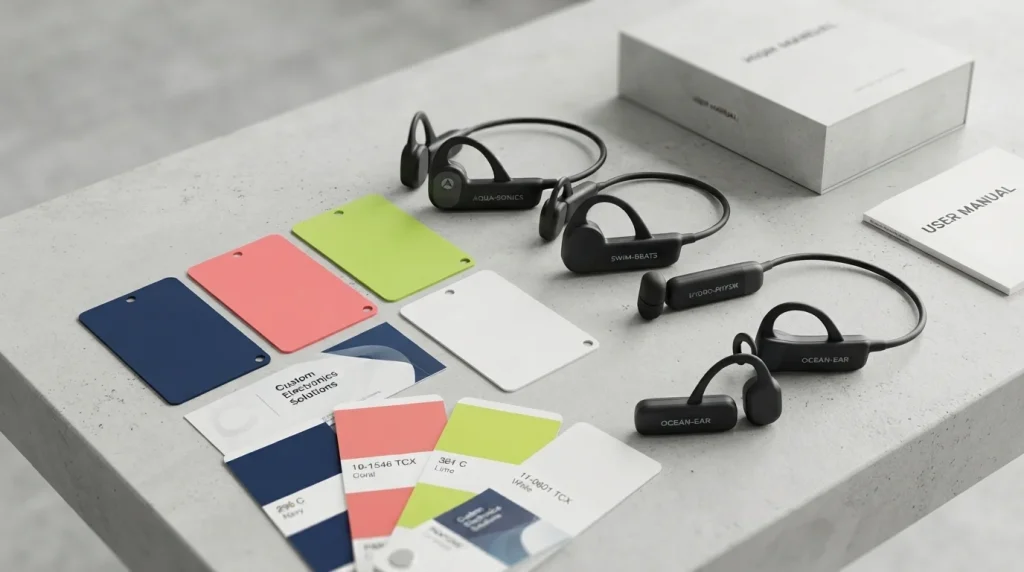
For any professional bone conduction headphones importer or brand owner launching an aquatic audio line, partnering with a verified bone conduction headphones factory unlocks diverse customization levels. Available options range from simple logo silk-screening and bespoke retail packaging to custom Pantone colorways, localized firmware voice prompts, and tailored internal memory configurations. These OEM solutions allow businesses to build a unique product identity while maintaining reliable waterproof performance.
Detailed Answer
Customization in consumer electronics manufacturing is structured across distinct tiers, allowing brands to tailor products to their exact market positioning without requiring massive upfront R&D investments. When collaborating with a professional waterproof bone conduction headphones supplier, brands can modify both the aesthetic presentation and the functional hardware of aquatic headsets.
1. Aesthetic and Branding Customization
The most accessible tier of private label modification focuses on visual brand identity. This includes applying laser-etched or silk-screened logos onto the titanium memory alloy frame. Beyond branding, suppliers frequently offer custom Pantone color matching for the silicone overmolding, enabling companies to align hardware aesthetics with their corporate color schemes. Retail packaging design—including custom unboxing experiences, graphic sleeves, user manuals, and branded accessories—further differentiates the product on shelves or digital storefronts.
2. Functional and Technical Adjustments
For brands seeking higher-tier differentiation, manufacturers can adjust internal configurations. This includes modifying integrated flash memory storage (such as expanding from 8GB to 16GB or 32GB for MP3 and WAV files), customizing startup audio or language voice prompts, and tuning acoustic equalizers for specific audio profiles. Ensuring rigorous bone conduction headphones quality control during these technical adjustments guarantees that acoustic clarity and structural integrity remain uncompromised.
3. Full ODM Design vs. Private Label OEM
While private label solutions adapt existing mature platforms, a specialized china bone conduction headphones factory can also execute full Original Design Manufacturer (ODM) projects. ODM developments involve bespoke industrial design, unique mold creation, and specialized circuit board layouts. However, private label modifications remain the preferred path for most global distributors due to shorter lead times and lower financial thresholds.
Comparison Table
| Customization Category | Typical Implementation | Typical MOQ Range | Primary Benefit |
| Logo & Branding | Laser etching or silk screen on titanium frame | 300–500 units | Low cost, rapid brand recognition |
| Retail Packaging | Custom graphic boxes, manuals, and sleeves | 500–1000 units | Professional retail presentation |
| Colorway Matching | Custom Pantone color matching for silicone body | 1000+ units | Unique brand aesthetic alignment |
| Hardware & Storage | Expanded MP3 memory or customized firmware | 1500+ units | Distinct technical value proposition |
Industry Insight
The aquatic audio sector has evolved rapidly, moving away from generic white-label distribution toward sophisticated private label branding. Modern consumers and athletes demand distinctive styling combined with reliable performance. By utilizing flexible options from an experienced custom bone conduction headphones producer, emerging brands can establish a distinct market footprint. Successful brands focus their customization efforts on elements that directly enhance user experience—such as ergonomic comfort and intuitive interface design—rather than over-complicating internal electronics, thereby balancing differentiation with manufacturing efficiency.
Buyer Tips
- Clearly outline your brand identity requirements and visual assets before initiating formal sample requests with suppliers.
- Verify that any custom color matching or material modifications do not negatively impact the device’s IPX8 waterproof sealing rating.
- Request physical golden samples of your custom packaging and branded hardware to review texture, durability, and printing precision before bulk production.
- Clarify non-disclosure agreements (NDAs) to protect proprietary custom designs and unique firmware files from unauthorized distribution.
Common Mistakes
- Over-customizing internal hardware features prematurely without validating consumer demand, leading to inflated tooling costs.
- Neglecting to test custom retail packaging structural integrity during shipping simulations, resulting in damaged shelf-ready goods.
- Failing to review pre-production proofs for logo alignment and color accuracy, which frequently causes aesthetic defects in mass-produced batches.
Recommended Internal Links
Related Questions
- What is the minimum order quantity for custom-colored swimming headphones?
- How does private label customization affect manufacturing lead times?
- Can internal MP3 storage capacity be modified for private label orders?
- What is the difference between white-label and private label aquatic audio gear?
Summary
Navigating OEM bone conduction headphones customization allows brands to establish a unique market presence efficiently. By understanding available modification tiers—from simple logo branding to color matching and packaging design—procurement managers can balance differentiation with realistic MOQ thresholds. Partnering with an experienced manufacturer ensures that customized swimming headphones meet strict quality benchmarks and waterproof compliance standards, paving the way for scalable long-term brand success.