
Quick Answer
Headphones manufacturer in-house production capabilities should be verified through the actual production site, process ownership, and relevant supplier evidence. Buyers should identify which manufacturing and assembly processes are performed directly, which are outsourced, and who is responsible for process control, traceability, and corrective action. Equipment photos alone are insufficient; evidence should match the specific supplier, facility, and product.
Detailed Explanation
1. Identify the Actual Production Site
A supplier’s registered office, sales office, warehouse, and production facility may be different locations. Buyers should establish which site actually performs the manufacturing and assembly work for the products being discussed.
Start by requesting the production site’s full address, the operating entity’s name, and a description of the activities performed there. If several facilities are involved, ask which site handles each stage and which entity is responsible for coordinating the project.
The distinction matters because a supplier may manage a product project without owning or operating the facility where manufacturing takes place. That arrangement is not automatically unsuitable, but buyers should understand it before evaluating production capability.
Where appropriate, request a live video walkthrough or an on-site visit. Confirm that the facility shown corresponds to the stated address and that the activities demonstrated are relevant to the product under consideration.A broader review of headphone manufacturing and supplier evaluation should also consider the supplier’s production-site identity, process responsibilities, and ability to explain its manufacturing arrangements.

2. Map Each Production Process to Its Actual Location
The phrase “in-house manufacturing” can cover very different arrangements. One supplier may perform product assembly at its own facility while purchasing molded housings and electronic assemblies from external partners. Another may coordinate nearly every production stage through subcontractors.Buyers evaluating headphone manufacturing capabilities should distinguish between processes performed directly by the supplier and those managed through external providers.
Neither arrangement should be described vaguely. Buyers need a process-by-process explanation.
For headphones, the process map may include electronic component assembly, SMT, injection molding, mold tooling, surface coating, cable or accessory preparation, final assembly, and packaging. These are examples of processes to investigate, not assumptions about what a particular supplier operates.
Ask the supplier to identify each process as:
- Performed at the supplier’s own production site.
- Performed at another facility operated by the same business.
- Outsourced to an independent subcontractor.
- Provided by a partner facility under a separate arrangement.
- Purchased as a completed component or service.
This classification helps buyers distinguish direct production capability from supplier coordination.
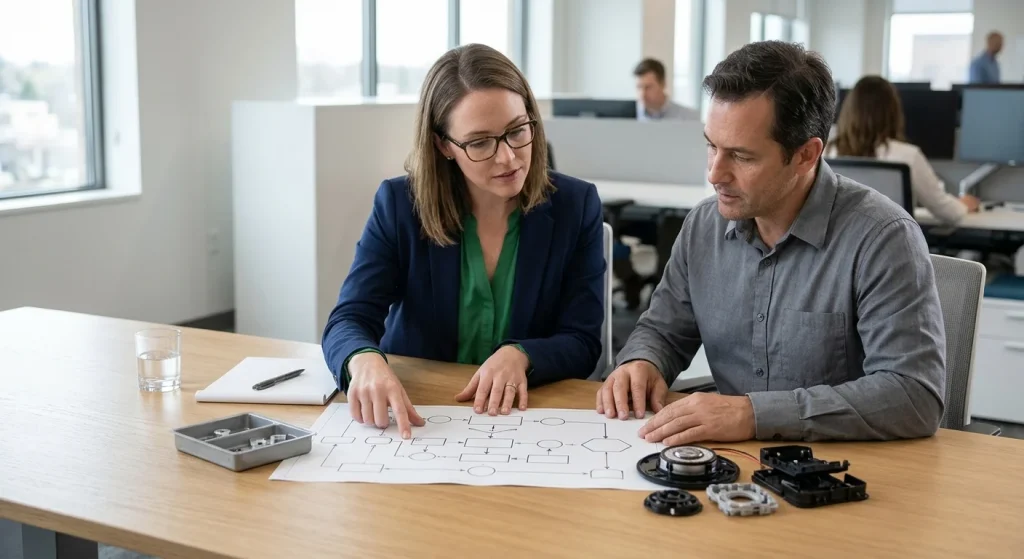
3. Verify Specialized Processes Instead of Assuming They Are Available
Certain manufacturing activities require specialized equipment, facilities, process knowledge, or external providers. Buyers should verify them individually rather than treating a general statement such as “full production capability” as sufficient evidence.
SMT assembly: Ask whether electronic components are mounted on circuit boards at the stated facility or supplied by an external electronics manufacturer. If SMT is outsourced, clarify who selects and manages the provider and who is responsible for resolving process-related issues.
Injection molding: Ask whether plastic housings are molded at the supplier’s site, at a related facility, or by an external molding company. A supplier that purchases molded components may still manage the product project, but this is different from operating an in-house molding process.
Mold tooling: Clarify who designs, fabricates, modifies, stores, and maintains the tooling. Do not assume that a supplier with access to molded parts also owns or operates a mold-making workshop.
Surface coating and finishing: Ask where coating, painting, printing, or other finishing operations take place. Confirm which party is responsible for the agreed finish and for addressing inconsistencies.
The objective is not to require every process to be in-house. It is to establish what the supplier actually performs and what it manages through other organizations.
4. Distinguish Manufacturing from Supplier-Coordinated Production
A supplier may provide meaningful project management even when some production processes are outsourced. The important distinction is whether responsibilities are transparent and controlled.
For example, a supplier may coordinate PCB assembly, source molded housings, arrange surface finishing, and complete final product assembly at a designated site. Buyers should not automatically interpret this as fully in-house manufacturing.
Ask the supplier to explain which activities it performs directly, which it purchases, and which it coordinates. Also clarify who communicates technical requirements to subcontractors, approves process changes, and ensures that supplied components match the agreed product specification.
A clear supplier-coordinated model can be commercially workable. An unclear model creates uncertainty about accountability when a component, process, or production location changes.
5. Check Whether the Evidence Matches the Supplier and Product
Production photos, facility descriptions, and process records can help establish what a supplier does. However, evidence must be relevant to the specific business relationship and product.
A photograph of an SMT line does not prove that the supplier owns or operates that line. A molding-machine photo does not establish that the machine is located at the declared production site. A general factory video may show a partner facility rather than the supplier’s own operation.
Ask for evidence that connects the process to the facility and project. Depending on the process, this may include:
- Dated photos or video showing the stated site and relevant activity.
- A process-flow document identifying the responsible facility.
- Sample production or process records linked to the product or project.
- Component or subcontractor documentation, where appropriate.
- A facility description identifying the operating entity and its role.
Check consistency across the supplier’s website, quotation, project documents, facility information, and supplied evidence. If the descriptions conflict, ask for clarification before relying on the capability claim.
6. Clarify Responsibility for Process Control and Traceability
Knowing where a process takes place is only part of supplier evaluation. Buyers should also establish who is responsible for controlling that process and retaining relevant records.When reviewing how a supplier manages its own and externally provided processes, buyers may also refer to the ISO 9001 quality management system framework as general background on process management and documented responsibilities.
For an in-house operation, clarify who supervises the activity and who authorizes process changes. For an outsourced operation, ask which organization manages the subcontractor, communicates product requirements, reviews relevant records, and handles corrective action when a problem is identified.Clarifying production process responsibility helps buyers understand who manages the work when a manufacturing activity is performed outside the main production site.
Traceability should also be discussed at a practical level. Ask whether the supplier can identify the facility or subcontractor associated with relevant production batches, components, or process records, where such records are maintained.
This is not a request to repeat a full quality-control audit. The purpose is to establish clear accountability across the production arrangement.
7. Document Subcontractor Responsibilities
If a supplier uses subcontractors or partner facilities, buyers should request a written description of the arrangement. It should identify the outsourced process, the responsible organization or facility, and the supplier’s role in managing the work.For additional background on managing outsourced activities, buyers can consult the ISO guidance on external providers when considering how responsibilities and controls should be documented.
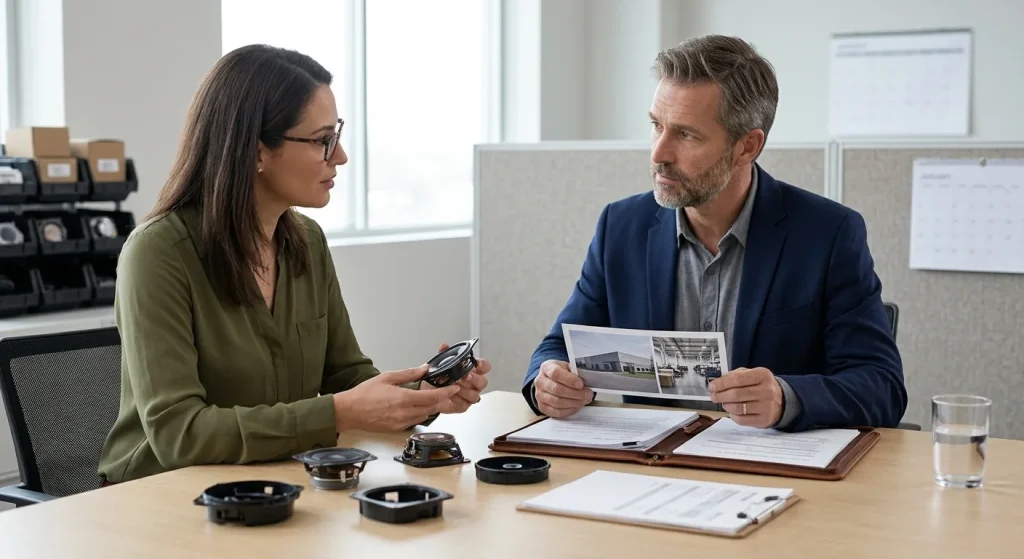
The level of detail can depend on commercial confidentiality and project risk. If a subcontractor’s identity cannot be disclosed immediately, ask what alternative evidence can establish the facility’s role and the supplier’s accountability.
The agreement or project documentation should clarify who approves subcontractor selection, who communicates technical requirements, who reviews changes, and who is responsible for resolving process-related issues.
Avoid relying on broad statements such as “our partners handle everything.” Buyers need to know which party is accountable for each important production activity.
8. Establish Rules for Production-Site or Process Changes
A supplier’s production arrangement may change during a project. A process might move to another facility, a subcontractor may be replaced, or a component may come from a different source.
These changes can affect process ownership, traceability, documentation, and the buyer’s original supplier assessment. For this reason, buyers should establish a change-notification and approval procedure before production begins.
Clarify which changes require prior notification, which require buyer approval, what supporting information must be provided, and whether samples or other evaluations are needed before the revised arrangement is accepted.
The goal is not to prevent every operational change. It is to ensure that important changes are visible, assessed, and documented rather than introduced without the buyer’s knowledge.
9. Practical Buyer Checklist
Use this checklist during supplier evaluation. The evidence requested should be proportionate to the importance of each process and the project’s risk.
| Capability to Verify | Evidence Buyers Can Request | Follow-up Question | Warning Sign |
|---|---|---|---|
| Actual production-site identity | Facility address, operating entity name, site overview, live video walkthrough | Is this the site that will perform the work for our product? | Supplier shows only an office or an unrelated facility |
| Final assembly | Process-flow description, assembly-area photos or video, project-specific records | Which assembly operations take place at this site? | Supplier cannot identify where assembly occurs |
| SMT assembly | PCB supplier details, relevant process evidence, facility identification | Is SMT performed by your company or an external electronics provider? | Equipment photos are presented without identifying the operator or site |
| Injection molding | Molding-process description, facility evidence, component sourcing details | Who molds the housing, and where does that process take place? | Supplier claims in-house molding but cannot explain the actual arrangement |
| Mold tooling | Tooling responsibility statement, relevant agreements or records where available | Who designs, fabricates, modifies, stores, and maintains the tooling? | Tooling ownership and responsibility are unclear |
| Surface coating and finishing | Process location, sample finish, subcontractor or process documentation | Which facility performs the coating or surface treatment? | Supplier cannot identify who performs the finishing operation |
| Component sourcing | Process map, component supplier information, purchasing or traceability records where appropriate | Which components are purchased as completed parts or assemblies? | Supplier describes purchased components as its own manufacturing operations |
| Subcontractor management | Approved provider information, service scope, responsibility matrix, relevant records | Who communicates requirements and manages process changes? | No clear party accepts responsibility for outsourced work |
| Process traceability | Batch, job, or component records linking work to a site or provider | Can relevant production records be traced to the responsible facility? | Records cannot be connected to the product or process being evaluated |
| Corrective-action responsibility | Responsibility matrix, issue-escalation procedure, example of a documented response where available | Who investigates and coordinates corrective action when an outsourced process has a problem? | Supplier redirects responsibility to the subcontractor without a defined process |
| Production-site changes | Change-notification procedure, contract terms, approval records | Will we be notified before a production site or key subcontractor changes? | Supplier reserves the right to change critical production arrangements without notice |
How to use the checklist: Do not treat every missing document as proof of misrepresentation. Ask for clarification and alternative evidence where commercially sensitive information cannot be disclosed. The key is whether the supplier can explain and substantiate the production arrangement consistently.
Industry Insight
Modern headphone production often involves multiple organizations with different specializations. A product may combine electronic assemblies, molded housings, surface treatments, purchased components, and final assembly without every process taking place under one roof. For buyers, the important distinction is therefore not simply whether a supplier calls itself a factory. It is whether the supplier clearly identifies the organizations performing each process and demonstrates how responsibilities are managed.
A supplier-coordinated model can still be workable when process ownership, technical communication, traceability, and change control are defined. In contrast, an unclear production arrangement makes it difficult to understand who is accountable when a process changes or a component does not meet requirements. Transparency is a more useful evaluation criterion than an unsupported claim of complete in-house production.
Buyer Tips
- Request a process map, not just a factory profile. It should identify the facility responsible for each important production stage.
- Verify the operating entity. Confirm the relationship between the supplier, the production site, and any related business entities.
- Separate capability from access. Having access to a partner’s SMT line or molding facility does not mean the supplier operates that process itself.
- Ask for product-relevant evidence. General factory photos are less useful than evidence showing the actual process and site relevant to the product being quoted.
- Clarify responsibility for outsourced work. Identify who manages technical requirements, process changes, and corrective action.
- Protect commercially sensitive information appropriately. If subcontractor identities cannot be disclosed, request alternative evidence and a written accountability statement.
- Document the production arrangement. Record the site, process owner, subcontractor role, and change-notification requirements in the project documentation.
- Reconfirm before production changes. A supplier’s original facility description may no longer reflect the actual arrangement after a site or subcontractor change.
Common Mistakes
- Assuming the supplier’s office is its production facility. A sales or coordination office does not establish where manufacturing takes place.
- Treating equipment photos as proof of ownership. A supplier may photograph a partner’s facility or use images that do not relate to the quoted product.
- Equating supplier coordination with in-house production. Managing an outsourced process is different from performing it directly.
- Assuming every specialized process must be in-house. The more useful question is whether the process location and responsibility are transparent and appropriately managed.
- Accepting broad capability claims. Statements such as “full manufacturing capability” need to be translated into specific processes, sites, and responsible parties.
- Ignoring subcontractor accountability. Buyers should know who controls requirements and handles process-related issues when work is outsourced.
- Failing to document site changes. A production location or subcontractor change can make earlier supplier evidence outdated.
Key Takeaway
Verifying a headphones manufacturer’s in-house production capabilities requires more than reviewing factory photos or a list of equipment. Buyers should identify the actual production site, map each process to the organization performing it, and clarify who controls outsourced work. A transparent supplier can explain both its direct capabilities and its partner arrangements, with evidence and documented responsibilities that match the specific product and project.
Related Questions
The following are the exact titles retrieved from the earlier weekly cluster record associated with this FAQ #4. They are navigation suggestions, not hyperlinks.
- How do bone conduction headphones factories control quality during mass production? — FAQ #1
- How are bone conduction headphones tested before shipment? — FAQ #2
- How are IPX8 waterproof bone conduction headphones tested? — FAQ #3
- What quality inspections should buyers request before ordering bone conduction headphones? — FAQ #5
- What should buyers check when evaluating a bone conduction headphones factory? — FAQ #6
Editorial note: These titles belong to the earlier bone-conduction factory and quality-related cluster record. Confirm that this is the intended weekly cluster for the current article before publishing the navigation list, particularly if the current custom Bluetooth headphones series uses a different approved plan.
CTA
Evaluating a headphone production partner? YONG YUNG welcomes inquiries from brands, importers, distributors, and sourcing teams looking to discuss product requirements and manufacturing arrangements. Share the product type, expected processes, target market, and any specific production-site or subcontractor questions. This provides a practical starting point for discussing the project scope and identifying which capabilities and responsibilities need to be clarified.