

A custom headphones project involves a series of connected decisions rather than a single product order. Product requirements influence engineering choices, engineering choices affect sample development, and sample approval establishes the basis for quality validation and mass production.
For brand owners, importers, distributors, and purchasing managers, a structured project plan reduces avoidable changes, clarifies supplier responsibilities, and makes quotations easier to compare. The objective is not to specify every technical detail at the beginning, but to identify what must be decided, tested, approved, and documented before production commitments are made.
Table of Contents
Define the Product Concept and Commercial Objectives
Begin with the intended user, application, and target market. A pair of open-ear headphones designed for everyday commuting has different priorities from swimming headphones intended for underwater audio playback. Sports headphones may need a secure fit, sweat resistance, accessible controls, and stable wireless connectivity during movement.
Translate the product concept into a clear set of business requirements. Consider the following questions:
- Who will use the product, and in what environment?
- Which product category and use cases are essential?
- Which countries or regions will the product enter?
- What retail positioning and target selling price should the product support?
- Is the project based on an existing design, a modified platform, or a new product concept?
- Which features are mandatory, and which are optional?
These decisions establish the project boundaries. Without them, buyers may receive quotations based on different product configurations, making the quoted prices and proposed delivery schedules difficult to compare.
Also distinguish between the initial launch requirements and future development ideas. A first release may need a defined set of core features, while additional colors, software options, or hardware revisions can be considered for later production runs.
Prepare a Product Requirement Brief
A product requirement brief converts the commercial concept into information that a supplier can evaluate. It does not need to be a complete engineering specification at the first meeting, but it should identify the requirements that influence product design, cost, validation, and manufacturing.
A useful brief normally covers five areas:
| Area | Information to define | Why it matters |
|---|---|---|
| Product configuration | Headphone type, intended use, fit, and physical design | Establishes the basic product architecture |
| Audio and connectivity | Sound expectations, Bluetooth requirements, controls, microphone needs, and playback modes | Identifies functional and engineering requirements |
| Environmental requirements | Water exposure, sweat, dust, temperature, or other operating conditions | Determines which protection and validation requirements need evaluation |
| Branding and packaging | Logo application, colors, retail packaging, labeling, and manuals | Defines customization scope and launch preparation |
| Commercial requirements | Target quantity, target market, launch window, and shipping destination | Supports quotation and production planning |
For example, a buyer requesting waterproof sports headphones should explain whether the product is intended for rain, swimming, or underwater playback. These use cases should not be treated as interchangeable, because they may require different product architectures and validation criteria.
If a requirement is not yet confirmed, mark it as a question rather than assuming the supplier can meet it. This helps the development team distinguish firm specifications from preliminary preferences.
Evaluate the Development Route and Supplier Fit
OEM and ODM arrangements can involve different levels of design ownership, engineering work, and customization. Under an OEM arrangement, a buyer may provide a more complete specification or work from an existing product platform. An ODM arrangement may involve a supplier’s existing design, product-development resources, or proposed modifications to a platform.
Actual responsibilities vary by supplier and contract, so the labels alone are not enough to determine which arrangement fits a project.
When evaluating a potential supplier, examine whether its demonstrated experience matches the product’s requirements. Relevant evidence may include comparable product samples, engineering documentation, documented quality-control procedures, testing records, and clear explanations of development responsibilities.
For a custom headphones manufacturer, the ability to discuss technical trade-offs is particularly important. A supplier should be able to identify requirements that may affect the enclosure, materials, battery configuration, audio performance, water protection, or production process.
Buyers should also clarify who is responsible for industrial design, electronic engineering, tooling, firmware changes, packaging artwork, testing, and regulatory documentation. A responsibility matrix can prevent tasks from falling between the buyer and supplier during development.
Avoid choosing a supplier based solely on a low initial quotation or an attractive sample. The more important question is whether the proposed development route can support the required product, repeatable quality, and commercial launch plan.
Organize Sample Review Around Defined Acceptance Criteria
Samples are a decision point between a product concept and a manufacturable specification. However, a sample that looks correct does not automatically demonstrate that the final product will meet all functional, environmental, or production requirements.
Before sample development begins, agree on what the sample is intended to prove. An early appearance sample may be sufficient to review dimensions, styling, and fit, whereas an engineering sample may be needed to evaluate electronic functions or mechanical integration. A later validation sample should reflect the configuration that the parties intend to approve for production.
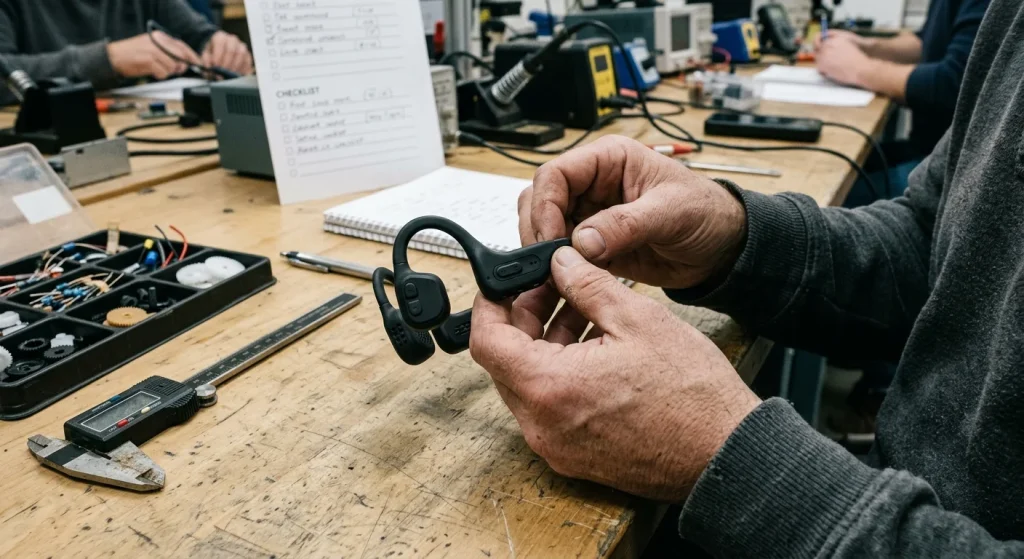
During sample review, document observations against agreed criteria rather than relying on general comments such as “sound good” or “fit is fine.” Depending on the product, the review may cover:
- Physical dimensions, materials, finish, and wearing comfort.
- Audio output, controls, connectivity, and microphone behavior.
- Charging behavior, battery operation, and expected usage conditions.
- Fit stability during the intended activity.
- Packaging layout, labeling, and included accessories.
Record each issue, its severity, the person responsible, and the expected resolution. If a change is made, identify which sample version contains it and whether it requires another review.
The approved sample should be traceable to a specification revision, bill of materials where applicable, firmware version, and relevant drawings or artwork. This provides a clearer reference when production units are inspected later.
Plan Validation Before Mass Production
Validation should address the actual product risks and intended operating conditions. A generic test checklist may miss problems that only appear in a particular application, such as repeated exposure to moisture, movement during sports, or extended use between charges.
The project team should agree on the validation scope before approving mass production. Relevant areas may include functional performance, mechanical durability, charging and battery behavior, environmental protection, and packaging integrity. The exact test methods, sample quantities, acceptance limits, and responsible parties should be documented according to the product design and applicable requirements.
Waterproof claims deserve particular care. Buyers should establish the intended protection level, applicable test method, product configuration, and supporting evidence. A supplier’s general statement that a product is waterproof should not replace review of the relevant test documentation. Detailed waterproof verification should be handled as a separate technical workstream.
Regulatory and market-access requirements also need early attention. The applicable requirements depend on the destination market, product configuration, radio functions, battery design, and claims made in product documentation. Buyers should identify the required documentation and confirm who will arrange testing, maintain records, and handle any required product qualification or conformity activities.
For Bluetooth-enabled products, consult the official Bluetooth SIG qualification guidance rather than assuming that a supplier’s existing documentation automatically covers a buyer’s branded product. The responsible party and qualification route should be confirmed for the specific commercial arrangement.
Bluetooth® Technology Website
+1
The outcome of validation should be a documented decision: approved, approved subject to specified conditions, or not approved pending corrective action. Open issues should have owners and deadlines before production is authorized.
Confirm Manufacturing Readiness and Change Control
A successful prototype is only one part of production readiness. Before a bulk order proceeds, the supplier and buyer need to align on the production configuration, quality requirements, materials, packaging, and inspection arrangements.
The production reference should identify the approved product version and any controlled components or processes that affect performance. Relevant documents may include specifications, approved drawings, a bill of materials, firmware identification, packaging artwork, inspection criteria, and the sample approval record.
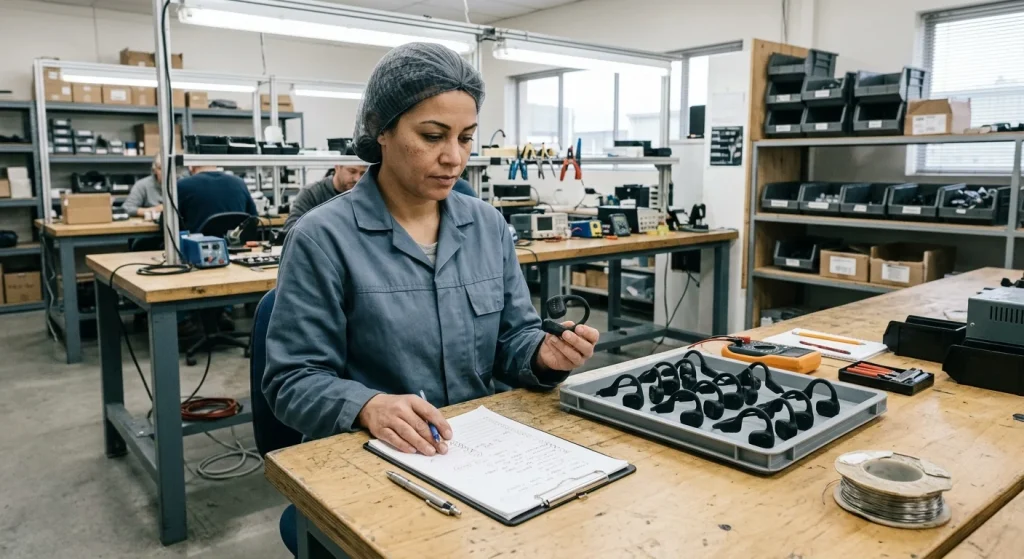
Changes after sample approval should be handled through a defined change-control process. A component substitution, enclosure adjustment, battery change, or firmware revision may affect fit, performance, compatibility, or validation status. The supplier should explain the proposed change, its reason, the likely impact, and whether additional approval or testing is required.
Quality planning should also define how incoming materials, in-process operations, and finished products will be checked. Where applicable, agree on defect classifications, sampling methods, acceptance criteria, inspection records, and procedures for handling nonconforming products. The inspection plan should be appropriate to the product’s risk and the parties’ contractual requirements.
Finally, clarify the production milestones. These may include material preparation, pre-production review, production authorization, in-process quality checks, final inspection, and shipment release. The schedule should reflect actual dependencies rather than relying on an unqualified promise of a fixed lead time.
Align Commercial Terms, Packaging, and Delivery
Commercial planning needs to progress alongside product development. A technically approved product can still face launch delays if order quantities, packaging specifications, labeling, shipping arrangements, or responsibilities for documentation remain unresolved.
Confirm the following before placing the production order:
- Quantity and order structure: Establish the initial order quantity, forecast assumptions, and any planned repeat orders. Confirm the supplier’s applicable MOQ for the specific configuration rather than assuming all models or customizations share the same minimum.
- Quotation scope: Check whether the quotation includes the agreed product configuration, accessories, packaging, customization, testing, and other project-specific charges. Confirm the validity period and the assumptions behind the quoted price.
- Packaging and labeling: Approve retail packaging, product identifiers, manuals, carton markings, and destination-specific requirements. If the product will be sold through a marketplace, verify the applicable fulfillment and labeling rules before packaging is finalized.
- Shipping arrangements: Agree on the delivery term, named destination or port where applicable, shipment responsibilities, documentation, and the party responsible for booking and transportation costs.
- Schedule and payment: Document the expected production milestones, payment terms, inspection arrangements, and the conditions for authorizing shipment.
For marketplace sellers, fulfillment preparation should be treated as part of the product specification rather than an afterthought. Incorrect labels, carton dimensions, or packaging details can create additional work after production is complete.
The final quotation should be evaluated against the same product scope and commercial assumptions as competing offers. A lower unit price may not represent a lower total project cost if it excludes required customization, validation, packaging, or other necessary activities.
Use a Project Gate Before Authorizing Production
A project gate is a formal review that determines whether the project is ready to move to the next stage. It gives the buyer and supplier a shared record of decisions and prevents unresolved assumptions from becoming production problems.
Before authorizing mass production, verify that:
- The product requirements and target-market needs are documented.
- The development scope and responsibilities are agreed.
- The production-intent sample has been reviewed and approved against defined criteria.
- Required validation and documentation have been completed or explicitly scheduled where contractually acceptable.
- The production configuration and change-control process are established.
- Quality inspection, packaging, commercial terms, and delivery arrangements are confirmed.
If critical requirements remain unresolved, the project should not be treated as fully production-ready simply because a sample has been accepted.
A structured OEM/ODM project plan does not eliminate every development risk. It makes assumptions visible, assigns responsibility, and provides evidence for decisions at each stage. For B2B buyers, that is the foundation for a more controlled transition from product concept to repeatable bulk production.
Visible FAQ
What information should buyers prepare before starting a custom headphones project?
Prepare the intended use, target market, product type, required features, customization preferences, estimated order quantity, and launch schedule. Mark uncertain requirements clearly so the supplier can identify which decisions require further engineering or commercial evaluation.
Why should sample approval be documented?
Documented sample approval creates a shared reference for the agreed product configuration, appearance, functionality, and other acceptance criteria. It also helps both parties identify changes made after approval and determine whether further review is necessary.
When should buyers confirm compliance requirements?
Confirm the applicable requirements during early project planning, before finalizing the product configuration and committing to production. Requirements depend on the destination market, product design, wireless functions, battery configuration, and intended claims.
CTA
Planning a custom headphones project? Share your intended application, target market, required features, customization scope, estimated order quantity, and expected launch schedule. These details can help establish an initial development brief and identify the questions that need to be resolved before sample evaluation and mass production. A clear starting scope also makes technical discussions and supplier quotations easier to compare.