
2. Quick Answer
A headphone ODM supplier uses headphone ODM pre-production testing to verify product functionality, reliability, and applicable compliance requirements before mass production begins. Depending on the design and intended use, validation may cover functionality, acoustics, Bluetooth connectivity, battery performance, durability, water resistance, and applicable regulatory requirements. Buyers should review the test scope, acceptance criteria, recorded results, and corrective actions for failed tests before approving production. Passing selected tests does not automatically prove compliance with every applicable requirement.
3. Detailed Explanation
What Should Be Defined Before Headphone Pre-Production Testing?
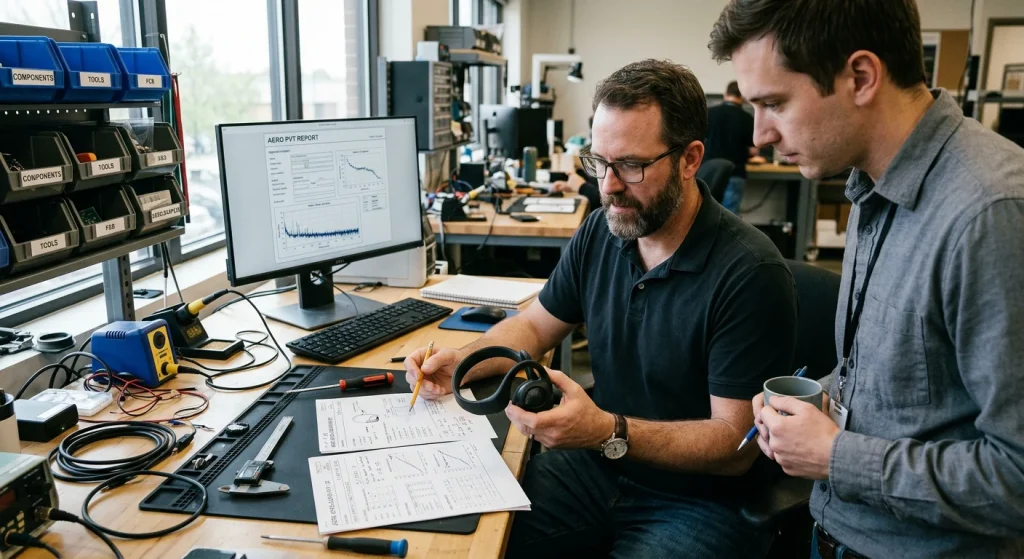
Pre-production testing should begin with an agreed validation plan, rather than an informal inspection of a finished sample.
The plan establishes what must be tested, how each result will be evaluated, and who is responsible for approving the outcome. These decisions should reflect the product specification, intended application, target market, and risks associated with the design.
For example, swimming headphones may require water-resistance validation appropriate to their intended rating and construction. Sports headphones may need greater attention to fit retention, sweat exposure, and repeated physical handling. A wireless model may also require functional checks covering Bluetooth connectivity, charging, battery operation, and controls.
Before testing begins, buyers and the ODM engineering team should agree on:
- Product requirements: Approved specifications, functions, materials, and intended use.
- Test scope: Characteristics and risks that must be evaluated.
- Acceptance criteria: Conditions under which each result is considered acceptable.
- Test conditions: Relevant equipment, operating conditions, sample configuration, and procedures.
- Documentation: How results, failures, design changes, and retests will be recorded.
The specific plan should be proportionate to the product. Not every headphone model needs every possible test, and a general-purpose checklist may not adequately cover different product designs.
Which Tests May Be Required Before Mass Production?
The appropriate test categories depend on the product’s features, construction, target market, and applicable requirements. The following are common areas to evaluate when relevant to the project.
1. Functional and Acoustic Testing
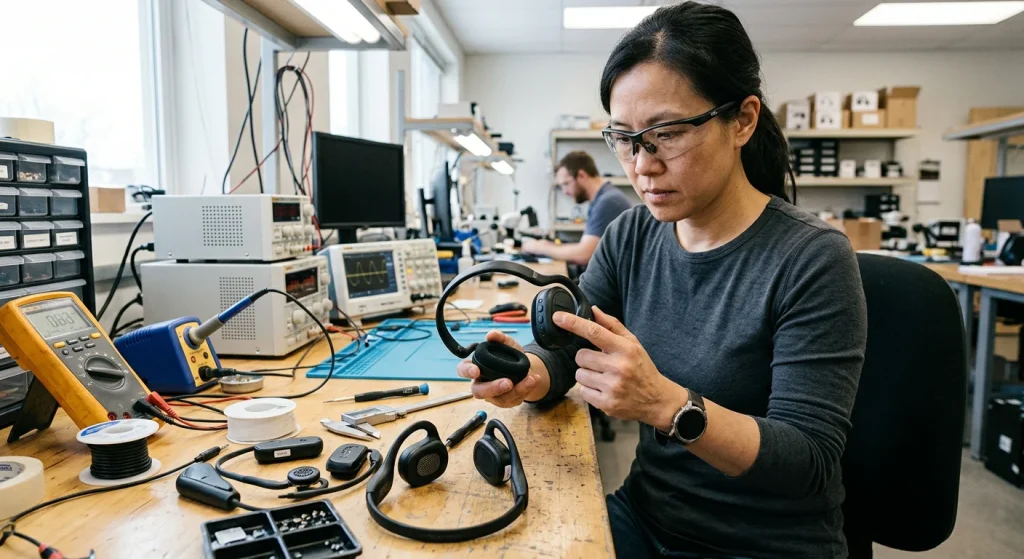
Functional testing checks whether the headphone operates according to its approved specification. Depending on the design, this may include power-on behavior, button functions, charging, Bluetooth pairing, audio playback, microphone operation, and reconnection behavior.
Acoustic evaluation may cover frequency response, output consistency, distortion, channel balance, or other agreed performance parameters. Bone conduction and open-ear headphones may require evaluation methods suited to their specific transducer design and intended listening experience.
The results should be assessed against agreed specifications. A sample that produces sound is not necessarily a sample that meets the required acoustic performance.
2. Battery, Charging, and Connectivity Checks
For wireless headphones, validation may include charging behavior, operating time under defined test conditions, battery-related protection functions, and Bluetooth stability.
Battery runtime results are meaningful only when the test conditions are recorded. Volume level, playback content, wireless settings, battery condition, and other operating factors can affect the result.
Where relevant, the team should also evaluate charging interfaces, charging accessories, and behavior during repeated use. Applicable battery and electrical safety requirements must be assessed separately from basic functional checks.
3. Mechanical Reliability Testing
Mechanical tests help identify weaknesses that may not appear during a short functional inspection. Depending on the product, they may include drop testing, repeated bending or flexing, button-cycle testing, connector durability, or vibration exposure.
For example, headphone drop, bend, and vibration testing can help assess whether a product tolerates the handling and transport conditions defined for the project.
However, the test method and severity should match the product’s construction and intended use. A test designed for one headphone housing or wearing structure should not automatically be applied to another without technical justification.
4. Water-Resistance and Environmental Testing
Water-resistance testing is relevant when the product is marketed for swimming, water exposure, or other wet environments. The test method must correspond to the product’s specified protection rating and applicable requirements.
A water-resistance claim should not be based solely on a visual inspection or a brief splash test. The validation plan should define the applicable test conditions, sample configuration, acceptance criteria, and inspection steps after exposure.
Environmental evaluation may also be relevant when the product is expected to operate or be stored under particular temperature or humidity conditions. The required conditions should come from the product specification and intended application, rather than being assumed to be identical for every headphone.
5. Compliance and Market-Specific Requirements
Product validation and regulatory compliance are related, but they are not interchangeable.
Depending on the product configuration and destination market, the project may need to address applicable radio, electromagnetic compatibility, electrical safety, battery transportation, chemical substance, or other regulatory requirements. The exact obligations depend on the product, its components, claims, and market.
Buyers should confirm which requirements apply and identify the supporting reports, declarations, certificates, or other records required for the specific product. A general functional test or internal quality checklist does not replace required conformity assessment.
It is also important to distinguish engineering validation from formal compliance testing. Some checks can be performed during development, while specific regulatory evaluations may need to follow designated methods or be conducted by an appropriately qualified laboratory.
How Should Failed Tests Be Handled Before Production Approval?
A failed test should trigger a documented review rather than an automatic decision to proceed or reject the entire product.
The engineering team should identify the failure, assess its potential effect on product performance or safety, and determine whether a design change, component change, process adjustment, or additional investigation is required.
A controlled corrective-action process typically includes:
- Record the failure: Document the test conditions, observed result, and relevant sample information.
- Investigate the cause: Determine whether the issue relates to design, components, assembly, firmware, materials, or test conditions.
- Implement a correction: Define the required change and identify which specifications or product configurations are affected.
- Repeat relevant testing: Verify that the correction addresses the original failure and check for any related effects.
- Update approval records: Record the outcome, remaining risks, and authorized disposition of the sample.
The scope of retesting depends on the failure and the change made. A firmware correction may require different verification from a structural redesign or a change to a waterproof enclosure.
For B2B buyers, the important checkpoint is whether the original failure has been adequately addressed and documented. An unresolved failure should not be treated as acceptable simply because the sample looks satisfactory during a later visual inspection.
What Should Buyers Review Before Approving Mass Production?

Pre-production approval should be based on documented evidence that the agreed requirements have been addressed. Buyers do not necessarily need to operate every test instrument themselves, but they should understand the scope and outcome of the validation process.
Review these items before authorizing mass production:
- Approved product specification: Confirm that the sample and its configuration match the intended product requirements.
- Test plan and acceptance criteria: Check that the agreed performance and reliability requirements have been covered.
- Test results: Review the recorded outcomes and identify any failed, incomplete, or conditional tests.
- Corrective-action records: Confirm that significant failures have been investigated and relevant retests completed.
- Compliance documentation: Verify that applicable market-specific requirements and required supporting records have been addressed.
- Sample and production configuration: Confirm that the approved sample represents the intended production design, including relevant components, firmware, and materials.
It is also useful to define who has authority to approve production and how outstanding issues will be handled. If a change occurs after sample approval, the parties should determine whether the change requires renewed testing or formal approval.
The goal is not to accumulate the largest possible number of test reports. It is to establish that the right requirements have been evaluated and that the evidence supports a clear production decision.
Comparison Table: Pre-Production Testing and Approval
| Validation Stage | Main Purpose | Typical Evidence | Buyer Checkpoint |
|---|---|---|---|
| Requirement definition | Establish what the product must meet | Approved specifications and test plan | Requirements and acceptance criteria are clear |
| Functional and acoustic testing | Verify operation and agreed audio performance | Functional records and acoustic results | Results meet the specified limits |
| Reliability testing | Evaluate relevant mechanical and environmental risks | Test records and observations | Failures and limitations are documented |
| Compliance assessment | Address applicable market requirements | Relevant reports and conformity documents | Required assessments are identified and completed |
| Corrective action and retesting | Resolve identified failures | Investigation, corrective action, and retest records | Significant failures are closed or formally dispositioned |
| Production approval | Confirm readiness to proceed | Approval record and final sample identification | Approved configuration matches production intent |
The exact stages, evidence, and approval criteria depend on the product design, intended market, project requirements, and applicable regulations.
Industry Insight
Pre-production testing is most useful when it is treated as an engineering decision process rather than a final inspection event. A test report has limited value if the acceptance criteria were never agreed upon or if a failed result has no documented follow-up.
For headphone ODM projects, the relationship between design changes and validation is particularly important. A revised housing, battery, PCB, transducer, waterproof seal, or firmware version may affect characteristics that were previously evaluated. The necessary retesting should therefore be determined by the nature and impact of the change.
Buyers should also distinguish between an engineering sample that has passed selected checks and a production configuration that has completed the agreed approval process. Clear sample identification, test records, and change-control responsibilities help both parties understand exactly what has been validated before mass production begins.
Buyer Tips
- Agree on acceptance criteria before testing. Avoid relying on subjective descriptions such as “good sound” or “strong enough.”
- Ask for evidence, not just a pass/fail statement. Confirm which tests were performed, under what conditions, and against which requirements.
- Match tests to the product’s intended use. Swimming, sports, and general-use headphones can have different validation priorities.
- Clarify how failed tests are handled. Establish responsibilities for investigation, corrective action, retesting, and approval.
- Control changes after sample approval. Ask whether changes to components, firmware, materials, or construction trigger additional validation.
Common Mistakes
1. Assuming One Passed Sample Proves Every Requirement
A sample may pass functional checks while important reliability or compliance evaluations remain incomplete.
Risk: The production decision may be based on evidence that covers only part of the product requirements.
How to avoid it: Compare the completed test records with the agreed validation plan and identify any outstanding items before approval.
2. Using the Same Test Plan for Every Headphone Design
Different products have different construction, usage conditions, and potential failure modes.
Risk: Important product-specific risks may be overlooked, while irrelevant tests consume time without addressing the main concerns.
How to avoid it: Develop the validation plan around the actual design, intended use, technical specifications, and applicable requirements.
3. Accepting a Corrected Sample Without Reviewing the Retest
A design or component change does not automatically demonstrate that the original problem has been resolved.
Risk: The underlying issue may remain, or the change may affect another product characteristic.
How to avoid it: Request documented corrective actions and relevant retest results before closing significant failures.
4. Confusing Internal Testing with Regulatory Compliance
Internal engineering checks can help identify problems, but they do not necessarily satisfy formal regulatory obligations.
Risk: The product may appear technically functional while required market-specific assessments or documentation remain incomplete.
How to avoid it: Identify the applicable requirements for the actual product configuration and target market, and confirm what formal evidence is needed.
Key Takeaway
Pre-production headphone testing should verify the agreed product requirements before mass production is authorized. Depending on the design, this may include functional, acoustic, battery, connectivity, mechanical, water-resistance, and compliance-related evaluations. For B2B buyers, the essential checkpoints are clear acceptance criteria, documented results, appropriate corrective actions, and confirmation that the approved sample matches the intended production configuration.
Related Questions
- What Is a Headphone ODM Turnkey Product Development Workflow?
- What Is Included in a Headphone ODM NRE Cost?
- How Does a Headphone ODM Supplier Turn an Industrial Design into a Production-Ready Product?
- What Engineering Capabilities Should a Headphone ODM Supplier Provide?
- How Does IP Co-Development Work with a Headphone ODM Supplier?
Discuss Your Headphone Product Validation Requirements
If you are preparing a headphone project for mass production, establish the required validation scope before approving the final sample. The discussion should cover product specifications, test methods, acceptance criteria, documentation, and how failures or design changes will be handled. Defining these points early helps purchasing and engineering teams make a more informed production decision without relying on an informal sample inspection alone.