
Quick Answer
A headphone ODM supplier typically turns an industrial design into a production-ready product by translating the design concept into 3D CAD and defined engineering specifications, then developing physical prototypes for review. Prototype findings can lead to design revisions before DFM review and tooling preparation. The key difference is that an industrial design focuses on product form and user-facing details, while a production-ready design must also address dimensions, interfaces, assembly, materials, and manufacturing feasibility.
How Does an Industrial Design Become an Engineering Design?
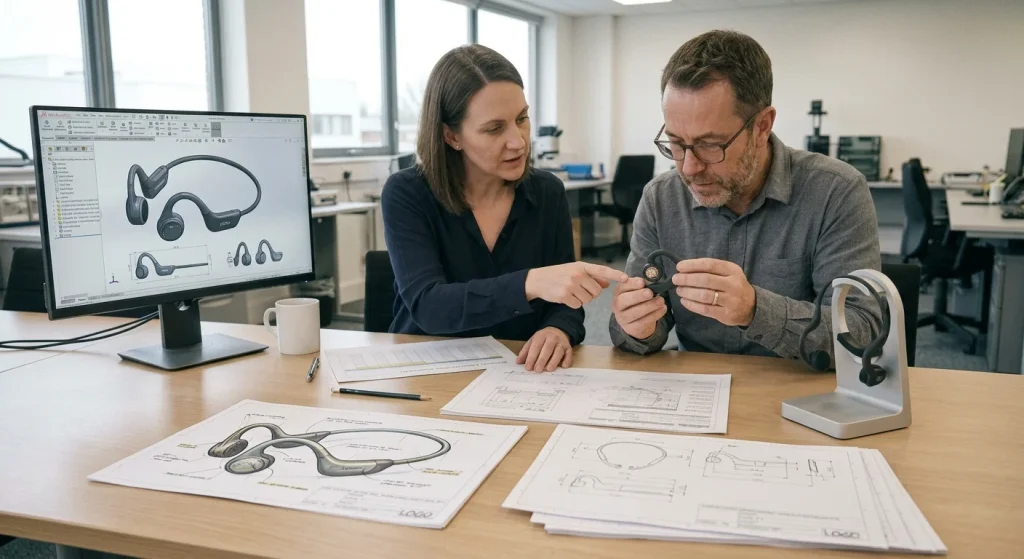
An industrial design usually defines how the headphone should look and how its main physical features should be arranged. It may include sketches, reference dimensions, surface details, material ideas, and other design requirements.
An ODM supplier must translate those design intentions into engineering information that can be reviewed and manufactured. This is where the headphone ODM industrial design sketch to 3D CAD process becomes important.
The engineering team may first review whether the proposed structure can accommodate required components, mechanical interfaces, battery space, buttons, charging connections, acoustic components, and other product requirements.
Not every industrial design can be transferred directly into production. Some surfaces, wall thicknesses, connection points, or internal spaces may need adjustment to accommodate real components and manufacturing constraints.
The goal at this stage is not to redesign the product simply for appearance. It is to convert the design concept into a physical structure that can be engineered, prototyped, reviewed, and eventually manufactured.
How Is the Design Converted into 3D CAD?
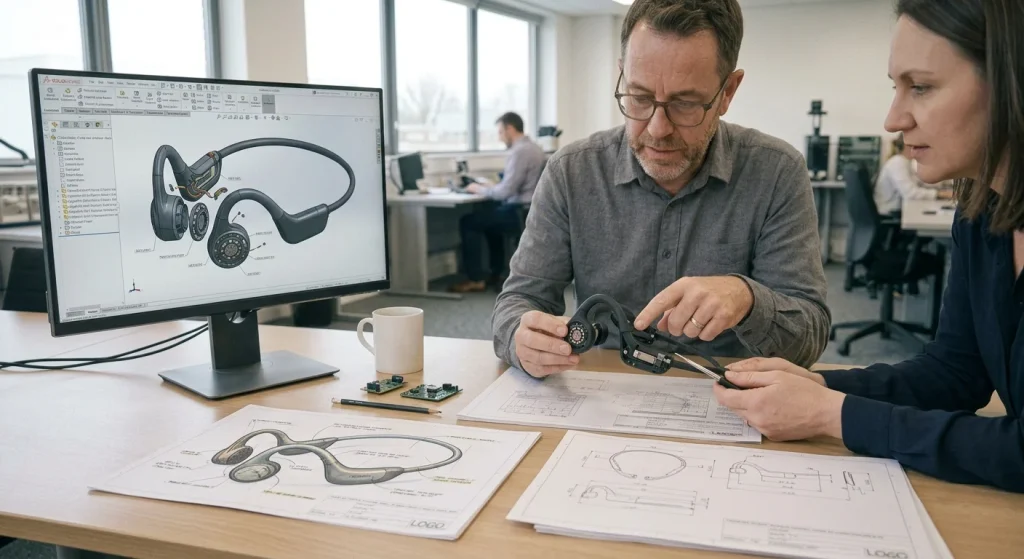
3D CAD provides the engineering geometry needed to move beyond a visual design concept.
The ODM engineering team can use the industrial design as a reference while building the product structure in CAD. This can define mechanical dimensions, component locations, interfaces, part relationships, and other information required for subsequent development.
For a headphone project, the CAD model may need to account for the relationship between the external housing and internal components. Battery placement, PCB space, charging interfaces, buttons, acoustic components, cables, and structural supports may all influence the final geometry.
The CAD model also provides a basis for identifying conflicts that may not be obvious in a two-dimensional sketch or industrial design rendering.
At this stage, engineering requirements can be documented alongside the geometry. Depending on the project, this may include material requirements, dimensional requirements, component interfaces, assembly considerations, and other specifications.
The result is more than a visual 3D representation. It becomes an engineering reference that can support prototype development and manufacturing preparation.
What Happens During Prototype Development?
Once the initial engineering design has been developed, a physical prototype can help determine whether the design works as expected in three dimensions.
A prototype may reveal issues that are difficult to identify from CAD alone. For example, physical evaluation can expose problems with component fit, part interfaces, housing alignment, assembly access, dimensions, or the overall physical form.
A headphone ODM rapid prototyping CNC mock up sample may be used when the project requires a physical representation of the proposed structure before production tooling is finalized. The exact prototyping method depends on the product structure, development stage, and project requirements.
Prototype review is also an opportunity to compare the physical product with the original industrial design.
If the prototype reveals an engineering problem, the CAD model can be revised before the design moves further toward tooling and production preparation. This creates an iterative relationship between 3D CAD and physical validation, rather than treating the first CAD version as automatically final.
The number of prototype iterations is project-dependent. The important point for B2B buyers is that prototype approval should be treated as part of the engineering decision process, not simply as a sample for visual inspection.
How Does DFM Prepare the Design for Manufacturing?
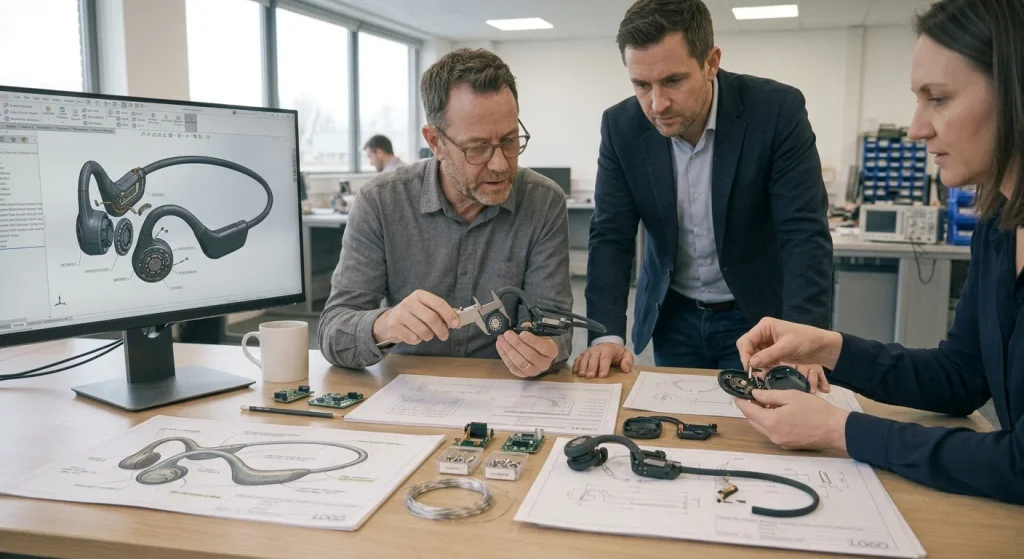
A design that looks correct and functions correctly as a prototype may still require changes before manufacturing.
DFM, or Design for Manufacturability, provides a review of whether the design can be produced using the intended manufacturing processes. A headphone ODM DFM design for manufacturability audit may consider factors such as part construction, assembly relationships, tooling feasibility, material selection, and production constraints.
The purpose is to identify manufacturing risks while design changes are still practical.
For example, an engineering team may identify a structure that is difficult to mold, an assembly interface that creates unnecessary complexity, or a component arrangement that makes production assembly difficult. The specific review points depend on the product and manufacturing method.
DFM should therefore be considered before final tooling approval rather than after production tooling has already been committed.
The DFM stage does not replace prototype evaluation. Instead, prototype feedback and manufacturing review can work together to refine the product before it reaches the production-ready stage.
What Makes a Headphone Design Production-Ready?
A production-ready headphone design is not simply an attractive industrial design or an approved prototype.
It should represent an engineering design that has been reviewed against the product requirements, physical structure, component interfaces, manufacturing considerations, and expected assembly conditions.
The transition can be viewed as:
Industrial Design → 3D CAD → Prototype → DFM → Production-Ready Design
At each stage, information becomes more specific.
The industrial design establishes the intended product concept. 3D CAD translates that concept into engineering geometry. Prototype development provides physical feedback, while DFM helps identify manufacturing concerns before tooling and production preparation.
Depending on the project, additional engineering revisions may still be required before final approval.
For B2B buyers, production-ready does not necessarily mean that every future manufacturing issue has been eliminated. It means the design has progressed sufficiently through engineering review and manufacturing preparation to support the next project stage.
What Should Buyers Review Before Engineering Approval?
B2B buyers should review more than the appearance of the final prototype.
First, confirm that the industrial design has been translated into production-oriented 3D CAD rather than remaining only as a visual concept.
Second, review whether the important mechanical dimensions, component interfaces, materials, and other engineering requirements have been defined according to the project scope.
Third, confirm that physical prototype feedback has been incorporated into the engineering design where necessary.
Finally, clarify whether a DFM review has been completed before tooling approval and whether any known engineering issues remain open.
This helps create a clearer boundary between design approval, engineering approval, and later manufacturing preparation.
Comparison Table
| Development Stage | Main Purpose | Typical Output | Buyer Checkpoint | Engineering Readiness |
|---|---|---|---|---|
| Industrial Design | Define product appearance and overall concept | Design sketches, renderings, concept specifications | Confirm appearance, proportions, and intended features | Concept stage |
| 3D CAD Development | Translate the concept into engineering geometry | 3D CAD model and related engineering information | Review dimensions, interfaces, component space, and structure | Engineering development |
| Prototype Development | Evaluate the physical design | Physical prototype or mock-up sample | Check fit, structure, appearance, and physical issues | Prototype validation |
| DFM Review | Identify manufacturing-related design risks | DFM findings and proposed design adjustments | Confirm key manufacturability issues are addressed | Pre-production engineering |
| Engineering Validation | Confirm that revised design requirements are addressed | Updated engineering design and approved prototype information | Review outstanding engineering issues | Near production-ready |
| Production Preparation | Prepare the approved design for manufacturing | Production-oriented engineering documentation and tooling inputs | Confirm design approval and manufacturing readiness | Production preparation |
The exact activities and outputs can vary depending on the project scope, product structure, manufacturing method, and ODM agreement.
Industry Insight
An industrial design and a production-ready headphone design serve different purposes. Industrial design establishes the intended product form, while engineering development converts that intention into dimensions, interfaces, structures, and manufacturing requirements.
In practice, 3D CAD acts as an important bridge between these two stages. Physical prototypes can then expose issues that are difficult to identify from drawings alone, while DFM review can identify manufacturing concerns before tooling is finalized.
For B2B buyers, this distinction matters because approving an attractive design does not necessarily mean that the product is ready for manufacturing. The more clearly each development stage and approval point is defined, the easier it becomes to understand what has actually been completed before production preparation begins.
Buyer Tips
- Ask whether the industrial design has been converted into production-oriented 3D CAD. A rendering alone does not provide the engineering information needed for manufacturing.
- Confirm which engineering requirements are finalized. This can include key dimensions, materials, component interfaces, and structural requirements.
- Review the physical prototype before tooling approval. Confirm that important design and fit issues have been addressed.
- Ask whether DFM has been completed before tooling. Manufacturing concerns are generally easier to address before production tooling is finalized.
- Clarify the remaining approval points. Make sure both sides understand which engineering issues are closed and which still require revision.
Common Mistakes
1. Treating an Industrial Design as a Production-Ready Product
An industrial design can communicate the intended appearance very effectively while leaving important engineering questions unresolved.
The risk is that tooling or other manufacturing commitments may begin before the physical structure has been adequately engineered.
How to avoid it: Confirm that the design has progressed into 3D CAD, engineering specifications, prototype review, and appropriate manufacturing preparation.
2. Approving Tooling Before Engineering Requirements Are Stable
Tooling decisions can become difficult to change after the design has moved into production preparation.
If important dimensions, interfaces, or structural requirements are still changing, later revisions may affect previously approved tooling.
How to avoid it: Establish clear engineering approval points and complete the relevant prototype and DFM reviews before final tooling decisions.
3. Assuming “Turnkey” Means All Responsibilities Are Automatically Defined
A turnkey development arrangement may integrate multiple project activities, but the word itself does not define every technical responsibility or approval point.
How to avoid it: Confirm the actual deliverables, engineering responsibilities, approval stages, and remaining development tasks in the project scope.
Key Takeaway
Turning an industrial design into a production-ready headphone requires more than creating a 3D model. The design needs to be translated into engineering geometry, reviewed through physical prototypes, assessed for manufacturing feasibility, and refined before production preparation. For B2B buyers, the key checkpoints are the transition from industrial design to 3D CAD, prototype validation, DFM review, and final engineering approval.
Related Questions
- What Is a Headphone ODM Turnkey Product Development Workflow?
- What Is Included in a Headphone ODM NRE Cost?
- What Engineering Capabilities Should a Headphone ODM Supplier Provide?
- How Do Headphone ODM Suppliers Test Products Before Mass Production?
- How Does IP Co-Development Work with a Headphone ODM Supplier?
Discuss Your Headphone Product Development Requirements
If a headphone project starts with an industrial design or product concept, the next step is to establish how that concept will be translated into engineering requirements, 3D CAD, prototypes, DFM review, and production preparation. A project discussion can focus on the existing design materials, required product changes, prototype requirements, and engineering approval points before tooling decisions are made.