
Quick Answer
Minimum Order Quantities (MOQ) for bone conduction headphones wholesale orders range from 100 units for standard factory stock to 1,000–3,000 units for full custom OEM projects. Selecting a verified OEM headphones manufacturer allows procurement managers to negotiate tiered MOQ structures based on custom colorways, custom packaging printing, firmware modifications, and proprietary injection mold investments. Understanding these baseline thresholds helps brands optimize cash flow while maintaining competitive unit pricing across international sales channels.
Detailed Explanation
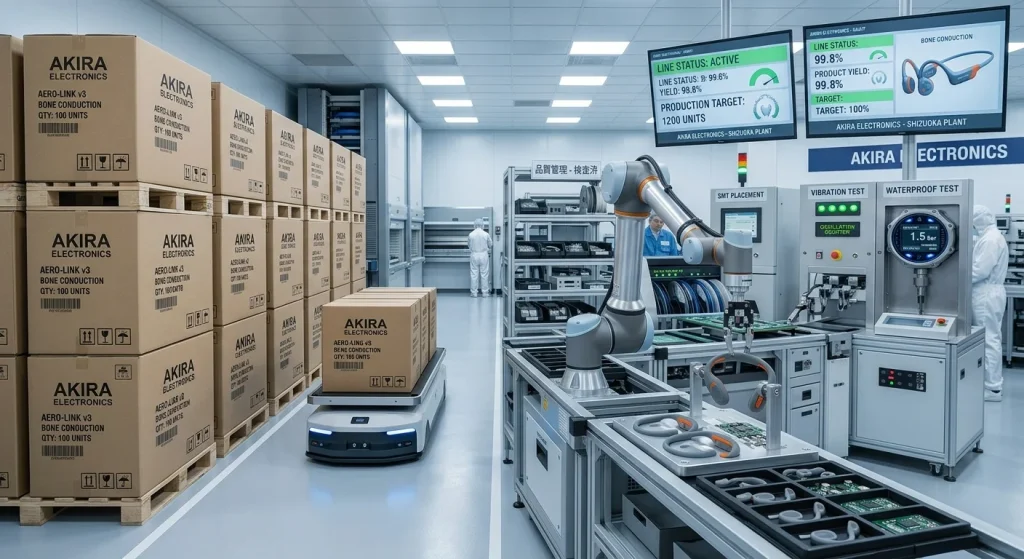
Minimum Order Quantity requirements in open-ear audio manufacturing are dictated by raw material purchase minimums, automated production setup costs, and specialized component assembly runs. Unlike standard air-conduction earbuds, bone conduction devices require specialized liquid silicone overmolding, titanium memory wire framing, and hermetic transducer sealing. Factories enforce MOQs to amortize setup costs across SMT circuit assembly lines and automated water-testing stations.
At the lowest threshold, ready-to-ship ODM platforms typically require an MOQ of 100 to 500 units. For brands seeking light private labeling—such as laser-engraving a logo on existing silicone frames or printing custom retail packaging—the MOQ usually increases to 1,000 units. During initial vendor negotiations, reviewing a comprehensive china bone conduction headphones wholesale guide helps procurement teams understand how component procurement dictates minimum volume tiers.
Full custom OEM orders involving exclusive structural molds, custom PCB layout, and tailored acoustic chambers demand the highest MOQs, generally starting at 2,000 to 3,000 units. This higher volume compensates the factory for Non-Recurring Engineering (NRE) setup time and custom plastic injection mold calibration. Working directly with a custom headphone OEM factory ensures transparent cost structures, allowing buyers to balance upfront tooling expenses against per-unit production margins.
Establishing clear communication with a private label audio headphone producer helps brand owners navigate component supplier MOQs, such as custom Bluetooth chipsets or specialized IPX8 waterproof acoustic transducers. Choosing a reliable OEM bluetooth headset manufacturing partner guarantees consistent quality control across both initial low-MOQ trial orders and high-volume mass production runs.
Furthermore, procurement managers can lower risk by negotiating modular MOQ structures. Experienced direct factories often permit split shipments—producing the total order volume in a single manufacturing run while holding unprinted housing components for subsequent logo application. Working with an OEM headphones manufacturer that offers flexible order staging helps growing audio brands scale inventory without overextending operational capital.
Comparison Table
| Customization Tier | Typical Minimum Order Quantity (MOQ) | Key Customization Options Included | Lead Time Baseline |
| Factory Standard Stock | 100 – 500 units | Neutral factory packaging, standard colorways, stock firmware | 1 – 2 weeks |
| Private Label Customization | 1,000 units | Custom logo printing, Pantone silicone color match, retail box packaging | 3 – 4 weeks |
| Modular ODM Modifications | 1,000 – 2,000 units | Upgraded Bluetooth 5.4 chipset, expanded MP3 storage, custom voice prompts | 4 – 6 weeks |
| Full Custom OEM Tooling | 2,000 – 3,000+ units | Exclusive housing molds, custom acoustic chambering, dedicated PCB layouts | 12 – 16 weeks |
Industry Insight
The open-ear audio supply chain is adapting to support emerging e-commerce audio brands through flexible “tiered MOQ” strategies. Historically, direct factories enforced rigid 3,000-unit minimums due to component supplier restrictions on raw silicone and Bluetooth microcontrollers. Today, advanced manufacturers leverage modular assembly frameworks, maintaining unbranded core sub-assemblies in stock. This enables brands to secure entry-level MOQs of 1,000 units with full retail packaging customization while providing a clear price drop schedule as volume scales toward 5,000 and 10,000 units.
Buyer Tips
- Negotiate a “mixed color MOQ” where total volume counts toward the minimum threshold across 2–3 Pantone colorways.
- Request a detailed Non-Recurring Engineering (NRE) breakdown to determine if paying upfront tooling fees can lower your production MOQ.
- Verify if battery suppliers require separate MSDS/UN38.3 transport certification MOQs for custom battery sizes.
- Include a strict AQL 1.0/2.5 quality inspection clause in your master purchase agreement regardless of order size.
- Partner with a direct OEM headphones manufacturer to avoid trading company markups on low-volume trial orders.
Common Mistakes
- Assuming low MOQs yield the same unit cost as full container loads, resulting in compressed retail profit margins.
- Failing to confirm packaging supplier MOQs, which often require 2,000–3,000 units even if the headphones themselves have a 1,000-unit limit.
- Skipping pre-production golden sample sign-offs on low-MOQ orders to rush delivery schedules.
Key Takeaway
Understanding MOQ thresholds allows procurement teams to align inventory management with commercial brand strategy. Whether placing a 500-unit trial order on an existing ODM platform or investing in a 3,000-unit custom OEM production run, partnering with a qualified OEM headphones manufacturer provides clear pricing transparency, predictable lead times, and reliable product execution.
Related Questions
- How do custom packaging requirements affect minimum order quantities?
- Can buyers split a high-volume MOQ across multiple shipment schedules?
- What are the standard NRE fees for custom bone conduction plastic injection tooling?
- How does battery transit certification impact minimum production quantities?
- What is the cost difference per unit between a 1,000-unit and 5,000-unit wholesale order?
Recommended Images
- Featured image: Clean, high-tech B2B industrial photography showing bulk packaging cartons stacked neatly beside an automated bone conduction headset assembly line.
- Factory production image: Technician operating a high-speed SMT circuit placement machine producing Bluetooth 5.4 PCBA modules inside a cleanroom.
- Testing process image: Quality control inspector conducting IPX8 pressure tank water testing on bulk production samples.
- Comparison chart or workflow diagram: Infographic diagram illustrating unit price drops across tiered MOQ milestones (100, 1,000, 3,000, and 10,000 units).
Image ALT Text Suggestions
- OEM bone conduction headphones manufacturer bulk packaging line
- Bone conduction headphones waterproof testing during mass production
- IPX8 swimming headphones factory automated assembly line
Suggested Internal Links
- /bone-conduction-headphones/
- /oem-bone-conduction-headphones/
- /odm-services/
- /swimming-headphones/
- /blog/
- /contact/
What Is the MOQ for Bone Conduction Headphones Wholesale Orders?
The MOQ ranges from 100-500 units for stock ODM designs, 1,000 units for private label branding and custom packaging, and 2,000-3,000 units for full custom OEM tooling projects.
Why do full OEM custom projects require higher MOQs?
Full OEM orders require higher MOQs to amortize upfront tooling setup costs, raw material supplier minimums, and custom plastic injection molding runs.
Can brands customize packaging at lower MOQ levels?
Standard custom packaging typically starts at 1,000 units. Buyers can order lower unit quantities of headphones if they pay a flat fee to cover the remaining unprinted packaging inventory.