
Quick Answer
Developing and mass-producing OEM bone conduction headphones typically takes 16 to 24 weeks for full custom tooling, or 4 to 8 weeks for modified platform orders. Procurement teams evaluating bone conduction headphones wholesale China programs must factor in industrial design, mold fabrication, prototype validation, international regulatory compliance, and trial assembly runs. Managing these milestone timelines ensures predictable product launches while preventing costly engineering delays across global retail distribution networks.
Detailed Explanation
The development timeline for original equipment manufacturing (OEM) open-ear headsets depends on technical complexity, enclosure customization, and component sourcing schedules. Unlike conventional air-conduction earphones, bone conduction hardware requires precise mechanical housing tolerances to guarantee effective bone-vibration transmission while maintaining internal liquid protection.
Phase one begins with industrial design (ID) and mechanical engineering (MD) refinement, which consumes 2 to 4 weeks. During this stage, engineers optimize ergonomic headband curvature and temporal contact pad placement. Simultaneously, technicians layout internal circuit board schematics, preparing for bluetooth 5.4 acoustic module assembly to ensure stable wireless connectivity and low power consumption.
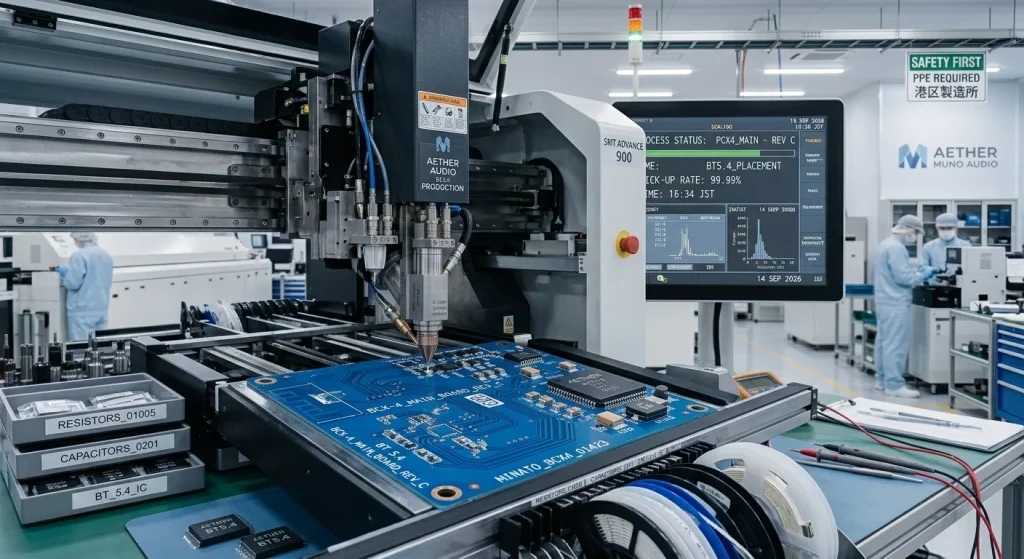
Phase two focuses on plastic injection mold fabrication and acoustic transducer calibration, taking 6 to 8 weeks. Creating precise steel molds for liquid silicone rubber (LSR) and titanium alloy memory wire frames requires extensive CNC milling and EDM processing. Once preliminary T1 samples exit the molds, engineers conduct acoustic frequency response testing and acoustic leakage evaluations to verify performance metrics against client benchmarks.
Phase three involves compliance certification, trial production runs, and mass assembly, requiring 4 to 6 weeks. Before starting full-scale production, prototypes must pass CE, FCC, Telec, and RoHS testing. Conducting a detailed china bone conduction headphones factory audit allows procurement managers to verify line balance, automated dispensing calibration, and output capacity before releasing initial purchase orders.
Working closely with an established china bone conduction headphones factory helps streamline these milestone approvals without compromising quality. Partnering with an experienced custom bone conduction headphones supplier protects your launch schedule against unexpected mold modifications or component lead-time bottlenecks. Rigid bone conduction headphones quality control implemented by a certified open ear audio equipment manufacturer ensures high assembly yield rates during final mass production.
For brands launching specialized sports audio lines, verifying high-integrity sealing techniques is essential to produce IPX8 waterproof bone conduction headphones capable of enduring continuous water immersion. Companies building a bone conduction headphones private label portfolio benefit from early component locking and clear engineering freeze dates. Aligning schedules with a dependable open ear headphones bulk supplier secures stable raw material pricing and prevents unexpected manufacturing delays.
Comparison Table
| Development Phase | Full Custom OEM Project | Modified ODM Platform | Critical Milestone Deliverables |
| Industrial & Engineering Design | 2 – 4 Weeks | 1 – 2 Weeks | 3D CAD models, PCB schematics, CMF specifications |
| Tooling & Mold Fabrication | 6 – 8 Weeks | 0 – 1 Week (Existing Molds) | Steel injection molds, T1 housing samples, acoustic jigs |
| Prototyping & Reliability Testing | 3 – 4 Weeks | 1 – 2 Weeks | Golden samples, IPX8 water testing, drop/flex testing |
| Regulatory Certifications | 3 – 4 Weeks | 2 – 3 Weeks (Leveraged Docs) | FCC, CE, RoHS, Telec, UN38.3 battery transport testing |
| Pilot Run & Mass Production | 3 – 4 Weeks | 2 – 3 Weeks | First article inspection, automated assembly, AQL audit |
| Total Estimated Time-to-Market | 17 – 24 Weeks | 6 – 11 Weeks | Mass production shipment release to freight forwarder |
Industry Insight
Supply chain bottlenecks in open-ear headphone production stem from long lead times for specialized components, such as custom bone conduction transducers and micro-density silicone overmolding. Leading direct manufacturers mitigate these timeline risks by maintaining pre-tested modular platform architectures. By stocking pre-certified Bluetooth 5.4 mainboards and standardized waterproof battery enclosures, factories can shorten total OEM engineering cycles by up to 30%. Procurement buyers who leverage these modular platforms achieve custom industrial design differentiation while maintaining rapid time-to-market schedules.
Buyer Tips
- Institute a formal “Engineering Freeze” date after sample approval to prevent mid-project design changes that stall mold production.
- Request a detailed Gantt chart from your supplier outlining critical path milestones for tooling, certification, and pilot assembly.
- Confirm that battery supplier UN38.3 and MSDS transport documentation is finalized early to prevent air/ocean freight delays.
- Require a 500-unit pilot production run to test assembly yield rates before authorizing full mass production.
- Work directly with direct manufacturing plants to streamline engineering communications and eliminate intermediary delays.
Common Mistakes
- Underestimating regulatory approval timelines, causing finished goods to sit in warehouses awaiting compliance certificate issuance.
- Finalizing retail packaging artwork late in the process, which halts final assembly lines during master carton packing stages.
- Skipping environmental heat and humidity chamber testing during prototype stages, leading to high field return rates post-launch.
Key Takeaway
Developing OEM bone conduction headsets requires a realistic 4 to 6 month timeline to move from initial CAD drawings to final shipping containers. Planning around mold fabrication, acoustic tuning, and compliance testing prevents delayed launch dates. Aligning your procurement schedule with a capable supplier ensures consistent production flow for bone conduction headphones wholesale China projects.
Related Questions
- What factors cause the longest delays in custom headphone mold fabrication?
- How can buyers shorten prototype validation times for waterproof sports headsets?
- What compliance certificates are mandatory before shipping audio electronics to the EU and US?
- How does pilot production help identify structural defects before mass assembly?
- Can component lead times be reduced by using standardized chipset modules?
Recommended Images
- Featured image: A clean, professional timeline graphic showing the phase-by-phase development stages of bone conduction headphone manufacturing.
- Factory production image: High-precision automated SMT placement machine assembling Bluetooth 5.4 mainboards inside a cleanroom production facility.
- Testing process image: Reliability engineer placing bone conduction headset prototypes inside an environmental heat and humidity test chamber.
- Comparison chart or workflow diagram: Infographic diagram illustrating the 16-to-24-week OEM development schedule vs. the accelerated ODM process.
Image ALT Text Suggestions
- OEM bone conduction headphones manufacturer engineering production timeline
- Bone conduction headphones waterproof testing during pilot production phase
- IPX8 swimming headphones factory assembly line testing and quality control
Suggested Internal Links
- /bone-conduction-headphones/
- /oem-bone-conduction-headphones/
- /odm-services/
- /swimming-headphones/
- /blog/
- /contact/
How long does it take to develop and mass produce OEM bone conduction headphones?
Full custom OEM bone conduction headphone projects typically take 16 to 24 weeks from initial CAD design to mass production shipment. Projects modifying existing platforms take 4 to 8 weeks.
Which phase of OEM development takes the longest time?
Steel injection mold fabrication and acoustic transducer tooling take the longest, typically requiring 6 to 8 weeks to complete and validate.
How can procurement teams prevent delays in custom headphone production?
Teams can prevent delays by enforcing an engineering freeze after prototype approval, securing battery transit certifications early, and choosing modular hardware platforms.