
Quick Answer
Before shipment, a reliable bone conduction headphone supplier China tests acoustic performance using artificial head simulators, mechanical vibration meters, and audio spectrum analyzers inside anechoic chambers. Testing evaluates frequency response, transducer vibration efficiency, Total Harmonic Distortion (THD), and acoustic sound leakage. Establishing automated inline acoustic testing ensures consistent sound delivery, eliminates left-right channel imbalance, and verifies product compliance before dispatching bulk orders to international markets.
Detailed Explanation
Acoustic testing for bone conduction hardware requires an entirely different methodology than conventional air-conduction earbud evaluations. Standard headphones project sound waves through air to vibrate the eardrum, allowing measurement via standard free-field microphones. In contrast, open-ear bone conduction headsets transfer mechanical vibrations directly to the temporal bone. Consequently, factory acoustic verification must evaluate both mechanical resonance force and airborne acoustic leakage.
The pre-shipment acoustic testing workflow begins inside an isolated anechoic chamber to eliminate ambient factory noise. Technicians place the finished headset onto an artificial head simulator equipped with specialized force sensors and mechanical couplers that mimic human skull impedance. Testing instruments drive frequency sweeps across the 20 Hz – 20,000 Hz spectrum, measuring the transducer’s mechanical output force to ensure balanced bass, clear midrange vocals, and stable high-frequency delivery.
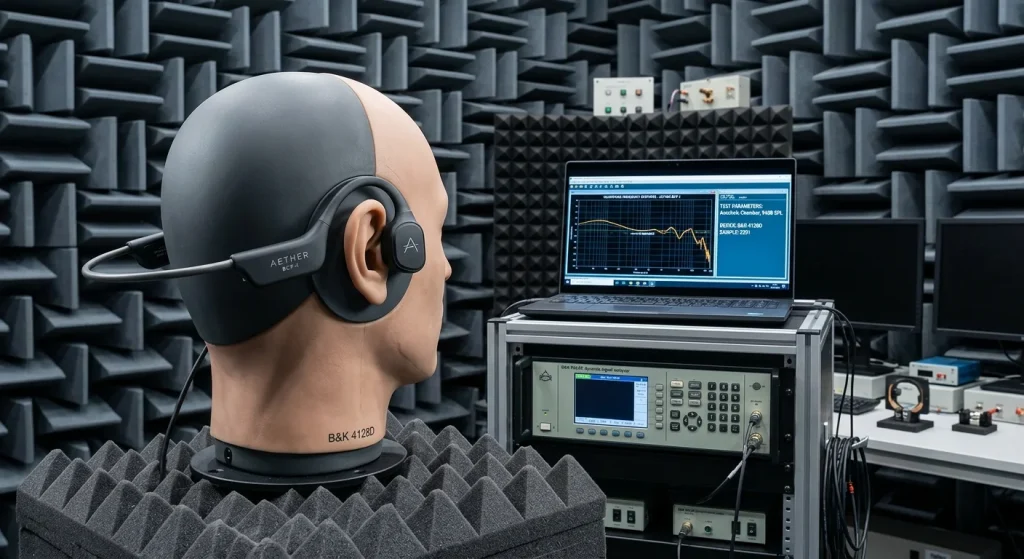
Following frequency response mapping, engineers test Total Harmonic Distortion (THD) and left-right driver balance. Because bone conduction transducers rely on magnetic coils moving within precise physical cavities, minor assembly misalignments cause severe mechanical distortion or channel volume drops. Automated audio analyzers flag units exceeding 3% THD thresholds, removing defective components before final packaging.
For outdoor and aquatic sports models, such as IPX8 waterproof bone conduction headphones, acoustic testing occurs both before and after environmental stress testing. Units undergo pressurized water tank immersion and vibration endurance checks to confirm that liquid sealing does not alter internal transducer cavity acoustics or muffle sound transmission.
Furthermore, factories measure airborne acoustic sound leakage using external measurement microphones positioned at fixed distances (typically 30 cm and 50 cm) from the artificial head. Modern casing structures feature anti-phase sound leakage suppression technology, which emits reverse sound waves to neutralize air leakage.
Reviewing these testing workflows during a china bone conduction headphones factory audit allows procurement managers to verify factory testing precision. Partnering with a competent china bone conduction headphones factory guarantees that advanced features, such as bluetooth 5.4 acoustic module assembly integration, deliver high wireless signal fidelity alongside optimal mechanical vibration.
Working with an established custom bone conduction headphones supplier for bone conduction headphones private label projects ensures that every batch meets global compliance standards. Rigorous bone conduction headphones quality control protocols executed by an open ear audio equipment manufacturer reduce field warranty returns, protecting brand reputation across competitive retail channels. Sourcing from a verified open ear headphones bulk supplier ensures batch-to-batch acoustic consistency for long-term commercial success.
Comparison Table
| Acoustic Test Parameter | Primary Equipment Used | Acceptance Standard / Metric | Key Quality Objective |
| Vibration Frequency Response | Artificial head coupler, spectrum analyzer | Curve match within ±2.5 dB tolerance | Ensures balanced bass, vocal clarity, and frequency distribution |
| Channel Balance (L/R) | Dual-channel force transducer sensor | Deviation < 1.0 dB between channels | Prevents audio imbalance between left and right transducers |
| Total Harmonic Distortion (THD) | Automated audio distortion meter | THD < 3.0% across 100 Hz – 10 kHz | Eliminates mechanical buzzing, casing rattle, and driver distortion |
| Acoustic Sound Leakage | Free-field microphone in anechoic box | Leakage SPL < 35 dB at 50 cm distance | Verifies privacy protection and anti-phase leakage suppression |
| Post-Immersion Audio Audit | Hydrostatic tank, artificial head coupler | Acoustic output variation < 5% post-water test | Guarantees IPX8 waterproof sealing does not alter sound quality |
Industry Insight
The open-ear audio manufacturing sector is rapidly adopting artificial intelligence and optical vibration sensing to improve pre-shipment acoustic checks. Traditional testing relies on physical contact couplers, which can suffer from slight positioning alignment errors during high-speed manual operations. Modern manufacturing plants are integrating Laser Doppler Vibrometers (LDV) directly into automated SMT and inline testing stations. LDV technology measures transducer surface vibration velocity non-destructively using laser beams, enabling dynamic acoustic calibration in under two seconds per unit without physical contact wear.
Buyer Tips
- Require suppliers to provide pre-shipment acoustic testing reports (including frequency curve overlays and THD charts) for every production batch.
- Verify that the factory conducts acoustic leakage testing in an accredited anechoic chamber rather than an unshielded open workspace.
- Specify maximum acceptable channel volume deviation (e.g., maximum 1 dB difference between left and right sides) in purchasing contracts.
- Confirm that post-waterproofing acoustic checks are included in standard quality control protocols for swimming headphones.
- Request confirmation that internal Bluetooth chipsets pass official compliance standards prior to mass production.
Common Mistakes
- Assuming standard earbud testing equipment (like standard artificial ears) can accurately measure bone conduction mechanical output.
- Neglecting acoustic leakage testing, resulting in products that leak private phone calls or audio to nearby individuals in quiet settings.
- Failing to re-test acoustic performance after environmental reliability tests (such as high-humidity exposure or drop testing).
Key Takeaway
Pre-shipment acoustic testing is essential for delivering high-performance open-ear audio hardware to international markets. From artificial head vibration mapping to anechoic sound leakage checks, rigorous factory testing ensures structural integrity and acoustic balance. Partnering with an audited bone conduction headphone supplier China guarantees that your private-label inventory meets strict international quality standards, minimizing warranty claims and strengthening retail brand authority.
Related Questions
- What is the difference between measuring air-conduction audio and bone-conduction mechanical vibration?
- How do factories suppress airborne sound leakage in open-ear headphone enclosures?
- Why is an anechoic chamber necessary for testing bone conduction acoustic performance?
- What causes left-right channel volume imbalance in mass-produced bone conduction devices?
- How does IPX8 waterproof sealing impact transducer acoustic frequency response?
Recommended Images
- Featured image: A cleanroom laboratory setup showing an artificial head simulator equipped with bone conduction headphones inside an anechoic acoustic test chamber.
- Factory production image: High-precision SMT surface mount machinery assembling Bluetooth circuit boards for open-ear audio devices.
- Testing process image: QC engineer analyzing real-time frequency response curves and THD metrics on a digital audio spectrum analyzer screen.
- Comparison chart or workflow diagram: Workflow diagram illustrating the five key acoustic testing steps from incoming transducer screening to final pre-shipment AQL audit.
Image ALT Text Suggestions
- OEM bone conduction headphones manufacturer acoustic testing laboratory
- Bone conduction headphones waterproof testing and acoustic frequency calibration
- IPX8 swimming headphones factory pre-shipment quality control line
Suggested Internal Links
- /bone-conduction-headphones/
- /oem-bone-conduction-headphones/
- /odm-services/
- /swimming-headphones/
- /blog/
- /contact/
How does a bone conduction headphones factory test acoustic performance before shipment?
Factories test acoustic performance using artificial head simulators, mechanical vibration sensors, and audio analyzers in anechoic chambers to measure frequency response, channel balance, THD, and acoustic leakage.
Why are standard headphone testing couplers unsuitable for bone conduction devices?
Standard couplers measure air pressure waves sent to an eardrum, whereas bone conduction devices require force sensors to measure mechanical vibrations transmitted to human bone structure.
How do factories test acoustic sound leakage in open-ear headphones?
Technicians place the headphones inside an anechoic chamber and measure airborne sound pressure levels at fixed distances using calibrated microphones to ensure reverse-phase leakage suppression works.