
Quick Answer
Before shipment, IPX8 waterproof bone conduction headphones undergo multi-stage pressure chamber testing, continuous submersion trials, dynamic button actuation tests under water, and post-immersion acoustic inspections. Working with an audited bone conduction headphones bulk supplier ensures that every mass-produced unit meets IEC 60529 submersion standards. This comprehensive verification prevents water ingress, protects internal Bluetooth microcircuits, and maintains sound transducer performance under underwater pressure.
Detailed Explanation
Ensuring true IPX8 compliance requires far more than basic splash testing. Because underwater swimming conditions subject audio equipment to continuous hydro-static pressure, a qualified china bone conduction headphones factory establishes a rigorous multi-phase quality assurance protocol prior to final packaging and export dispatch.
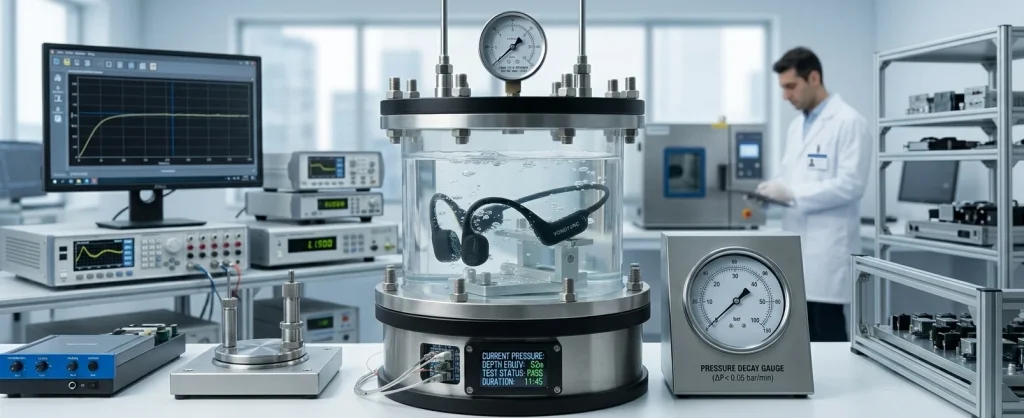
The verification process starts at the component stage before final housing assembly. Ultrasonic welding lines and silicone overmolding seals are inspected for microscopic gaps. Once assembled, units enter automated air-pressure decay testing chambers. These pressurized pneumatic devices inject dry air into the internal cavity of the headphones to detect tiny pressure drops, identifying structural sealing defects before the units ever touch water.
Following pneumatic screening, physical submersion testing takes place in specialized hydrostatic pressure tanks. In accordance with IEC 60529 standards, IPX8 certification demands continuous submersion in water depths exceeding 1.5 meters for extended periods—typically 30 minutes to 2 hours depending on target brand specifications. During these pressurized tank trials, automated mechanical arms actuate physical control buttons while submerged to verify that dynamic rubber gaskets prevent moisture seepage during active swimming motion.
After underwater exposure, the units undergo mandatory post-test evaluations. Every headphone must pass acoustic frequency response testing to verify that transducer output remains clear and uninhibited by moisture. Additionally, magnetic charging ports are checked for electrical continuity and salt-spray oxidation resistance. Sourcing through a trustworthy china bone conduction headphones factory ensures that these strict testing metrics are consistently logged across every bulk order batch.
Finally, a dedicated custom bone conduction headphones supplier conducts environmental aging tests. Random batch samples undergo thermal shock cycles—alternating rapidly between cold water and ambient storage—to ensure that structural adhesives and silicone seals do not expand, contract, or degrade over time.
Comparison Table
| Testing Stage | Test Method | Primary Objective | Failure Criteria |
| Pre-Assembly Inspection | Air-pressure decay testing | Detect structural seal gaps before water contact | Pressure drop > 0.05 kPa/sec |
| Hydrostatic Submersion | Pressurized water chamber (2m depth) | Simulate continuous underwater swimming conditions | Water ingress inside casing |
| Dynamic Operation Test | Underwater physical button actuation | Verify rubber gasket seal under active pressure | Moisture seepage near switches |
| Post-Immersion Acoustic | Frequency response spectrum sweep | Ensure transducer sound output remains unaffected | Audio distortion or loss of volume |
Industry Insight
In the cross-border sports audio market, returning defective aquatic gear due to water leakage is one of the highest financial risks for brand owners. Modern manufacturing lines are shifting from manual spot-checking to 100% automated pressure-decay screening integrated directly into the assembly line. Experienced B2B buyers recognize that rigorous factory testing protocols directly correlate with lower customer return rates, better marketplace reviews, and long-term customer loyalty in the competitive swimming headphones sector.
Buyer Tips
- Always request third-party IPX8 test reports certified by ISO 17025 accredited testing laboratories (such as SGS or TÜV Rheinland).
- Verify whether the factory performs 100% air-pressure decay testing or only relies on statistical batch sampling.
- Specify exact submersion depth and duration parameters in your initial purchasing contract agreements.
- Require video documentation of automated underwater button-actuation tests prior to approving final shipment balance payments.
Common Mistakes
- Assuming an IPX7 certification is sufficient for active swimming, whereas only IPX8 guarantees continuous underwater performance.
- Accepting generic factory certificates without verifying model-specific testing report serial numbers.
- Skipping post-immersion acoustic testing, leading to shipments of waterproof headphones that survive water exposure but suffer from degraded audio output.
Key Takeaway
Verifying IPX8 waterproof performance requires strict, multi-layer testing including pneumatic pressure decay, deep-water tank submersion, and post-immersion acoustic audits. Partnering with a supplier that enforces rigorous bone conduction headphones quality control protects your brand reputation, prevents costly customer returns, and guarantees that every shipment meets international aquatic safety standards.
Related Questions
- What is the difference between IPX7 and IPX8 waterproof standards in sports audio?
- How does salt-water submersion affect bone conduction headphone charging ports?
- What equipment is required to perform air-pressure decay testing on waterproof headphones?
- Can swimming headphones be customized with private label logos without compromising IPX8 sealing?
- What are the most common structural causes of water leakage in bone conduction headphones?
Recommended Images
- Featured image: A modern quality control laboratory showing pressurized water testing tanks and bone conduction headphones on a technical workstation.
- Factory production image: Automated assembly line in a cleanroom environment featuring ultrasonic welding and silicone sealing processes for sports headphones.
- Testing process image: Close-up of a bone conduction headphone submerged inside a transparent pressurized testing chamber with digital measurement displays.
- Comparison chart or workflow diagram: A step-by-step flowchart illustration showing the complete IPX8 testing workflow from air-pressure decay screening to final acoustic verification.
Image ALT Text Suggestions
- OEM bone conduction headphones manufacturer conducting IPX8 waterproof pressure tests
- Bone conduction headphones waterproof testing in pressurized laboratory water tank
- IPX8 swimming headphones factory automated testing line and quality control station
Suggested Internal Links
- /bone-conduction-headphones/
- /oem-bone-conduction-headphones/
- /odm-services/
- /swimming-headphones/
- /blog/
- /contact/
How are IPX8 waterproof bone conduction headphones tested before shipment?
Before shipment, IPX8 waterproof bone conduction headphones undergo pneumatic pressure decay tests, pressurized water tank submersion exceeding 1.5 meters depth, underwater button actuation trials, and post-immersion acoustic verification.
What is the difference between IPX7 and IPX8 waterproof ratings?
IPX7 certifies protection against temporary immersion up to 1 meter for 30 minutes, while IPX8 certifies continuous underwater submersion beyond 1 meter under specific pressure conditions defined by the manufacturer.
Why is air-pressure decay testing conducted before water submersion?
Air-pressure decay testing uses dry air to detect microscopic structural gaps without wetting the components, allowing non-destructive screening before full water immersion tests.