
Quick Answer
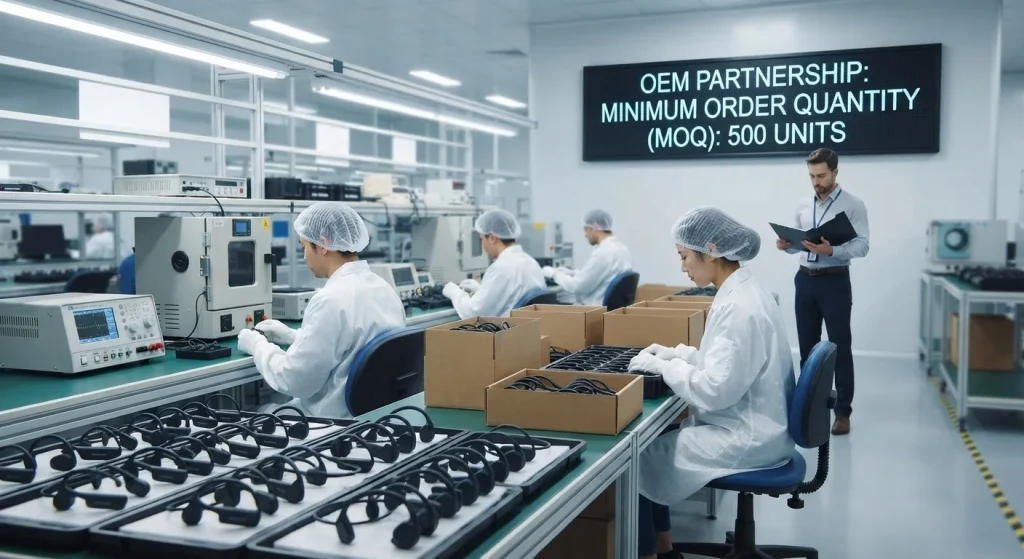
Partnering with a reliable bone conduction headphones supplier for retailers is the first step when launching an aquatic audio brand. Typically, the minimum order quantity (MOQ) for private label swimming headphones ranges from 300 to 1,000 units. Basic branding like logo silk-screening usually starts around 300 units, while customized packaging, colorways, or hardware changes require higher thresholds. Understanding these volume brackets helps procurement managers balance upfront capital requirements with production efficiency.
Detailed Answer
Navigating minimum order quantities (MOQs) is a crucial operational phase for brands expanding into aquatic audio electronics. Manufacturing consumer-grade waterproof gear involves fixed engineering setup costs, including custom injection molds, acoustic tuning, and automated assembly calibration. Because of these foundational expenses, every experienced bone conduction headphones factory enforces standard volume tiers to maintain operational viability.
When ordering standard bone conduction headphones private label inventory, the entry threshold is usually the most accessible. Many a trusted china bone conduction headphones factory will set initial MOQs between 300 and 500 units for basic logo laser-etching or silk-screening on existing tooling. This lower threshold minimizes financial exposure for Amazon sellers and emerging brands testing market response.
However, as brands shift toward advanced customization, volume requirements increase proportionally. For example, if you partner with a specialized custom bone conduction headphones supplier to develop tailored retail boxes, user manuals, and branded accessories, suppliers typically require 500 to 1,000 units per run. This higher count accounts for custom printing plate setup costs and cardboard minimum purchase orders from sub-tier vendors.
When specifying unique adjustments—such as custom Pantone colorways for silicone overmolding or altered internal MP3 memory capacities—a certified waterproof bone conduction headphones supplier will generally mandate 1,000 to 2,000 units. Color changes require purging production lines and mixing custom silicone batches, resulting in substantial machine downtime.
Furthermore, rigorous bone conduction headphones quality control protocols become far more cost-effective when executed across larger production batches. Acoustic response tests, button tactile checks, and automated IPX8 pressure chamber verifications require dedicated technician time. Procuring through a qualified custom bone conduction headphones channel or tapping into bulk swimming bone conduction headphones wholesale distribution allows brands to achieve a balanced compromise between unit cost economies and inventory turnover speed.
Comparison Table
| Customization Level | Typical MOQ | Primary Cost Driver |
| Logo Laser Etching | 300–500 units | Surface printing plate setup |
| Custom Retail Packaging | 500–1000 units | Packaging material minimum orders |
| Pantone Color Matching | 1000–2000 units | Silicone batch mixing & machine purging |
| Full ODM Customization | 2000+ units | New mold tooling & circuit redesign |
Industry Insight
The global demand for specialized aquatic training gear has accelerated rapidly, forcing supply chains to balance flexibility with production realities. Experienced industry analysts note that manufacturer MOQs are not arbitrary barriers, but rather mathematical equations driven by raw material minimums and assembly line changeover times. By leveraging established platforms from a professional custom bone conduction headphones supplier, emerging brands can bypass expensive R&D cycles. Strategic inventory planning ensures that companies scale operations profitably without creating dead stock or cash flow bottlenecks during seasonal retail peaks.
Buyer Tips
- Clarify whether the minimum order quantity applies to the total order aggregate or strictly per individual color variant.
- Establish tiered price scaling agreements so that unit costs decrease as repeat order volumes grow over time.
- Request comprehensive physical pre-production samples to verify acoustic performance and waterproof sealing before bulk manufacturing begins.
- Review all third-party compliance documentation, including IPX8 reports and battery transport summaries, prior to signing production contracts.
Common Mistakes
- Committing to excessive initial volumes prematurely without validating actual consumer demand in target e-commerce markets.
- Neglecting to factor in landed costs, including international freight logistics, insurance, and import customs tariffs.
- Failing to define explicit defect acceptance thresholds and replacement guarantees within the initial purchase agreement.
Recommended Internal Links
Related Questions
- Can minimum order quantities be split across multiple color options?
- How do custom packaging options affect manufacturing lead times?
- What is the difference between white-label and private label aquatic audio procurement?
- How do factories handle defect rates in initial trial production runs?
Summary
Securing optimal production terms for OEM bone conduction headphones requires a clear understanding of industry MOQ structures. By evaluating customization complexity alongside factory capabilities, a procurement manager or brand owner can select the ideal manufacturer for their project. Implementing a structured approach to private label sourcing ensures long-term profitability, reliable product compliance, and smooth scaling across international retail distribution networks.