
Quick Answer
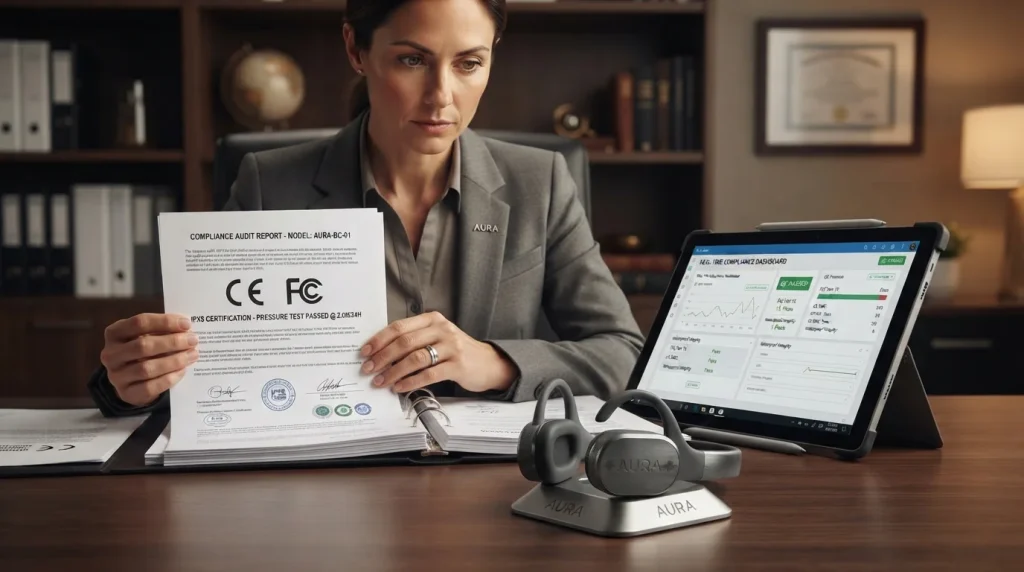
When sourcing from a reliable swimming headphones bulk supplier, verifying mandatory product and facility certifications is critical for legal import and retail distribution. Essential compliance documents include CE, FCC, and RoHS for electronic safety, along with IPX8 waterproof test reports. Furthermore, a qualified waterproof bone conduction headphones supplier or a certified bone conduction headphones factory must provide ISO 9001 quality management documentation and battery-specific transport reports like UN38.3 to ensure smooth customs clearance.
Detailed Answer
Importing and distributing electronic audio equipment across North America and European markets requires strict adherence to international regulatory frameworks. Partnering with an experienced china bone conduction headphones factory means verifying that both the facility and the physical products hold verified compliance credentials.
Electronic Safety and Electromagnetic Compatibility
Products shipped internationally must comply with basic electromagnetic emission and safety directives. The CE mark is mandatory for the European market, verifying that devices meet health, safety, and environmental protection standards. Similarly, the FCC certification (Federal Communications Commission) is indispensable for products sold in the United States, regulating radio frequency interference from integrated Bluetooth modules. Additionally, the RoHS directive (Restriction of Hazardous Substances) and REACH compliance ensure that manufacturing inputs—such as solders, circuit boards, and silicone components—do not contain restricted toxic elements like lead, cadmium, or phthalates.
Waterproofing and Ingress Protection
Because these devices are frequently marketed for aquatic sports, verifying water resistance is paramount. A reputable swimming headphones OEM manufacturer must provide official laboratory test reports certifying an IPX8 waterproof rating. This testing confirms that devices can withstand continuous immersion beyond one meter under pressure without internal moisture leakage, protecting the internal transducers and memory modules.
Quality Management and Factory Audits
Beyond product-level certificates, operational compliance safeguards procurement investments. A trusted bone conduction headphones factory should maintain an ISO 9001 quality management system certification, ensuring consistent production oversight, incoming material inspection, and final assembly verification. For custom bone conduction headphones projects, supply chain managers also evaluate ISO 14001 for environmental management and BSCI or SMETA audits for social responsibility, which are often prerequisites for major retail chains.
Battery Safety and Transportation Compliance
Rechargeable lithium-ion polymer batteries powering these wireless audio systems are classified as hazardous materials during air and ocean freight. Manufacturers must provide UN38.3 test summaries, MSDS (Material Safety Data Sheet), and IEC 62133 cell safety reports to clear customs and secure booking with logistics carriers.
Comparison Table
| Certification Type | Scope & Application | Mandatory Region | Key Compliance Focus |
| CE / FCC | Electromagnetic compatibility & safety | Europe / USA | RF frequency emission, electrical safety |
| RoHS / REACH | Environmental hazardous substance control | Global / EU | Non-toxic materials in plastics and circuits |
| IPX8 Test Report | Deep-water immersion waterproof standard | Global | High-pressure waterproof sealing durability |
| ISO 9001 | Factory quality management system | Manufacturing Plant | Standardized production and defect control |
| UN38.3 / MSDS | Lithium-ion battery transport safety | Global Logistics | Safe shipping via air and ocean freight |
Industry Insight
Regulatory enforcement at international ports has intensified significantly. Customs authorities across the US and Europe routinely demand physical copies of test reports matching the exact model number, hardware revision, and manufacturer details. Procuring custom bone conduction headphones without verified documentation risks border detentions, costly inventory impoundments, and severe legal liabilities for brand owners. Ensuring strict bone conduction headphones quality control documentation upfront protects supply chain continuity and builds immediate consumer trust in competitive retail environments.
Buyer Tips
- Request third-party laboratory testing certificates (such as SGS or TÜV) rather than accepting self-declared manufacturer compliance letters.
- Cross-check the company name on test reports with the actual manufacturing entity or authorized export agent handling the transaction.
- Verify battery transport compliance documents (UN38.3) before booking cargo space to prevent shipment delays at origin ports.
- Ensure IPX8 test reports specify exact immersion depth and duration limits matching product marketing claims.
Common Mistakes
- Accepting expired or generic laboratory reports that belong to different product models or outdated component versions.
- Overlooking local market labeling requirements, such as missing CE, FCC, or recycling compliance symbols on product housing and retail packaging.
- Neglecting chemical compliance (ROHS/REACH), which can result in immediate retail banishments if random random customs spot-checks fail.
Recommended Internal Links
Related Questions
- What is the difference between IPX7 and IPX8 certifications for aquatic audio devices?
- How can importers verify the authenticity of CE and FCC laboratory test reports?
- What documentation is required to ship lithium battery-powered audio gear internationally?
- Why is ISO 9001 certification essential when evaluating contract manufacturers?
Summary
Securing proper regulatory and quality documentation is foundational when launching OEM bone conduction headphones into international markets. Verifying compliance credentials—ranging from CE, FCC, and RoHS to IPX8 waterproof test reports—mitigates legal risks and avoids costly customs delays. Working with a verified manufacturer ensures that every production batch meets rigorous standards. Whether ordering trial inventory with a baseline MOQ or scaling private label distribution, thorough compliance vetting safeguards your brand reputation and ensures seamless retail entry.