
Quick Answer
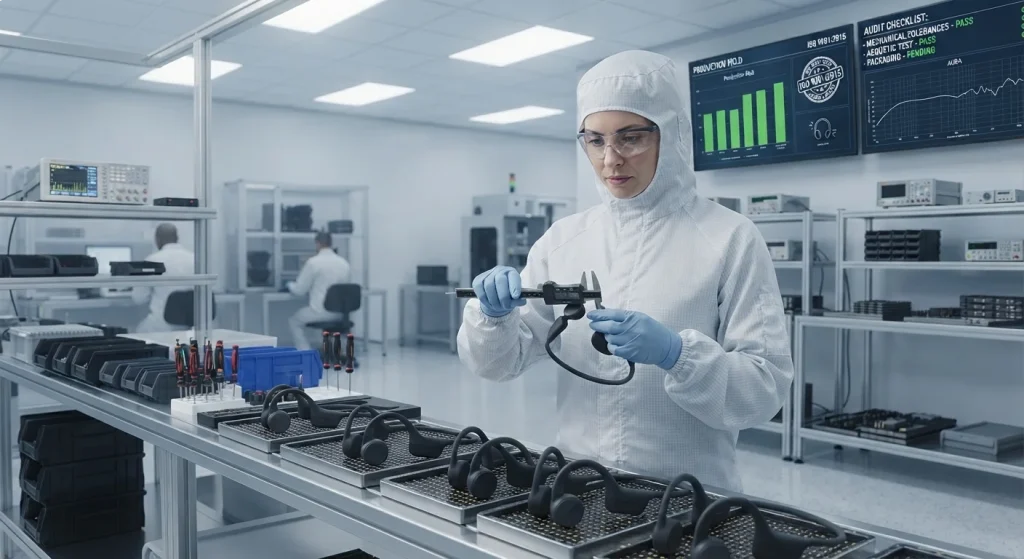
To find a reliable private label bone conduction headphones manufacturer, brands must thoroughly evaluate supplier R&D capabilities, quality assurance protocols, and industry certifications. Partnering with an experienced custom headphones manufacturer ensures that open-ear audio products meet strict acoustic and safety benchmarks. Procurement managers should review factory audit reports, examine pre-production samples, and verify compliance with global electrical and material standards before locking in bulk purchase agreements.
Detailed Answer
Sourcing high-performance open-ear audio requires a systematic approach to identifying capable production partners in the global electronics supply chain. For emerging brands and established Amazon sellers, vetting a qualified bone conduction headphones factory begins with assessing their technical infrastructure and core competencies. Unlike standard consumer audio devices, bone conduction technology relies on precise transducer calibration, structural damping, and proprietary magnetic resonance design to transmit sound through the cheekbones effectively. Therefore, prospective buyers must look beyond simple assembly workshops and seek dedicated manufacturing facilities with proven acoustic engineering expertise.
A critical aspect of partner selection involves verifying supply chain transparency and component quality control systems. A professional bone conduction headphones OEM supplier will provide clear documentation regarding raw material sourcing, battery safety testing, and waterproof rating validations, such as IP68 certifications required for aquatic sports models. Buyers should request comprehensive factory audit reports—including ISO 9001 compliance, social accountability audits, and environmental standards—to ensure ethical and stable production environments.
Furthermore, evaluating communication efficiency and flexibility during the sample development phase is vital. A competent china bone conduction headphones factory should demonstrate deep technical understanding, offering constructive feedback on acoustic housing designs, custom firmware modifications, and packaging optimizations. They must also maintain strict intellectual property protections to safeguard proprietary branding elements and custom acoustic tuning profiles from unauthorized replication during bone conduction headphones private label development.
Finally, establishing transparent communication regarding minimum order quantities, production lead times, and defect-rate thresholds protects brands from unexpected supply chain disruptions. Whether sourcing standard variants or specialized lines from a trusted waterproof bone conduction headphones supplier, buyers who implement rigorous multi-stage quality inspections—from incoming raw materials to final pre-shipment checks—consistently secure reliable products that minimize customer return rates and reinforce long-term brand equity in competitive international markets.
Comparison Table
| Evaluation Criterion | Low-Risk Supplier | High-Risk Supplier |
| R&D & Acoustic Testing | In-house acoustic labs & tuning | Outsourced or non-existent |
| Quality Control Protocols | Multi-stage QC (IQC, IPQC, OQC) | Final random check only |
| Regulatory Compliance | Full CE, RoHS, FCC, Bluetooth SIG | Unverified or missing certificates |
| Communication & Transparency | Rapid technical feedback & audit access | Vague responses & opaque sourcing |
Industry Insight
The consumer electronics landscape has shifted dramatically, with open-ear sports audio becoming a high-growth sector across North America and Europe. As more brands enter this space, manufacturing excellence has evolved from basic assembly to sophisticated acoustic engineering and automated quality validation. Industry leaders increasingly value supply chain resilience, preferring partners who invest heavily in R&D and advanced testing equipment. For brand owners and importers, understanding these manufacturing dynamics is essential for mitigating risk and securing a competitive edge in a crowded digital marketplace.
Buyer Tips
- Request and independently verify all third-party laboratory test reports for acoustic distortion, battery safety, and waterproof sealing.
- Order functional pre-production samples to rigorously test sound leakage control, microphone clarity, and structural durability under real-world usage conditions.
- Inspect the factory’s quality management certifications, such as ISO 9001, to ensure standardized and repeatable production processes.
- Clarify intellectual property and design ownership agreements clearly in writing before sharing proprietary product specifications or custom tooling blueprints.
Common Mistakes
- Choosing a manufacturing partner based exclusively on the cheapest initial quote without evaluating their internal quality control infrastructure.
- Neglecting to perform rigorous environmental and acoustic sample testing prior to authorizing mass production runs.
- Failing to establish explicit contract terms regarding defect rates, penalty clauses, and delivery timelines.
Recommended Internal Links
Related Questions
- What key factors determine the unit cost when sourcing from an overseas audio manufacturer?
- How do factory quality control protocols prevent high return rates for consumer electronics?
- What is the standard procedure for protecting intellectual property during OEM custom manufacturing?
- How long does the sample development and mass production cycle typically take for private label audio devices?
Summary
Successfully entering the open-ear sports audio market depends heavily on selecting the right production partner. When developing custom OEM bone conduction headphones, partnering with a trusted custom headphones manufacturer ensures that brands can balance product quality, regulatory compliance, and cost efficiency. Negotiating a reasonable MOQ ensures financial flexibility while allowing growing businesses to test market demand effectively. Ultimately, collaborating with an experienced private label partner that prioritizes transparent communication and strict quality control enables global importers to establish a resilient supply chain and deliver reliable, high-performance audio products.