
Quick Answer
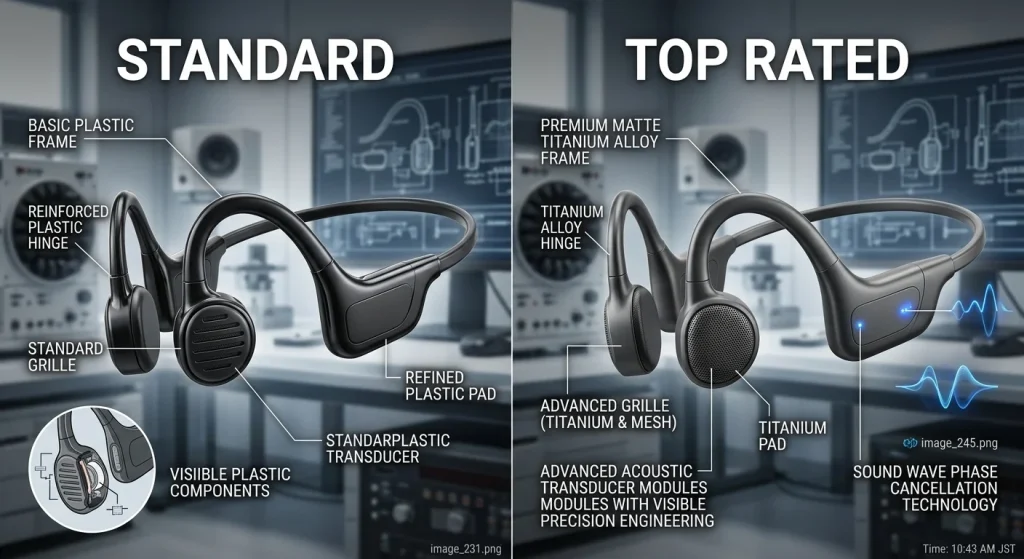
When evaluating options in the market, top rated bone conduction headphones are distinguished from standard models by advanced acoustic transducer calibration, superior structural damping, and lower sound leakage. While standard variants often suffer from vibration distortion and audio leakage in public settings, premium-tier designs utilize state-of-the-art phase-cancellation engineering to deliver the best sound bone conduction headphones can achieve, providing clear audio without sacrificing open-ear environmental awareness.
Detailed Answer
To understand the performance gap between market leaders and budget alternatives, procurement professionals often look closely at how do bone conduction headphones work under demanding acoustic conditions. Standard consumer models typically rely on basic magnetic drivers that cause excessive frame vibration and uncontrolled sound dispersion. In contrast, top-tier engineering focuses on precision-machined titanium frames and closed-loop transducer modules that focus mechanical vibrations directly toward the cheekbones, significantly minimizing outward noise dispersion.
Another critical differentiator relates to public privacy and sound leakage control. Importers frequently test whether can others hear bone conduction headphones during high-volume playback. While entry-level models leak noticeable sound in quiet environments due to poor acoustic isolation, premium engineering incorporates reverse-phase sound cancellation slots that neutralize stray acoustic waves before they escape into the surrounding air. This technical refinement is a primary benchmark for high-end procurement.
Furthermore, user safety and long-term durability separate elite electronics from generic counterparts. Buyers frequently question whether are bone conduction headphones safe for prolonged daily wear. Superior models use biocompatible, hypoallergenic silicone coatings and precise clamping force distribution to prevent skin fatigue and localized pressure points. Advanced manufacturing processes also implement strict waterproofing standards, such as IP68 ratings for swimming variants, ensuring structural integrity and reliable electrical insulation across various usage environments.
Comparison Table
| Feature Category | Standard Models | Top Rated Models |
| Transducer Quality | Basic magnetic drivers | High-efficiency neodymium transducers |
| Sound Leakage Control | Minimal or none | Advanced phase-cancellation systems |
| Frame Material | Standard plastic / low-grade alloy | Memory titanium alloy |
| Waterproof Rating | IP54 / IPX5 | IP68 (Swimming & diving ready) |
Industry Insight
The open-ear sports audio sector has evolved rapidly, driven by rising consumer demand for safety-conscious wearable electronics. Manufacturing excellence has shifted from basic assembly to sophisticated acoustic tuning and micro-injection molding. For private label brands and distributors, sourcing products that integrate advanced leakage reduction and premium comfort is essential for maintaining brand reputation. As global competition intensifies, factories that invest in proprietary R&D and automated acoustic calibration will continue to define the benchmark for high-performance audio hardware.
Buyer Tips
- Examine third-party acoustic test reports to verify frequency response curves and sound pressure level distortion limits.
- Evaluate sample units in diverse environments to test high-volume sound leakage and vibration intensity on skin contact.
- Ensure suppliers hold valid international compliance certificates, including CE, RoHS, and biocompatibility standards.
- Verify international regulatory compliance, such as CE Marking and RoHS standards, for all skin-contact components.
Common Mistakes
- Focusing solely on unit cost while ignoring transducer calibration quality, which frequently results in high return rates and poor user reviews.
- Failing to verify sound leakage control mechanisms, leading to privacy issues that alienate end-users in public spaces.
- Neglecting rigorous sample testing for skin-contact materials, risking regulatory non-compliance in target export markets.
Recommended Internal Links
Related Questions
- What manufacturing standards determine the durability of waterproof bone conduction headphones?
- How do OEM factories customize sound profiles for private label audio brands?
- What is the typical minimum order quantity for custom-branded open-ear sports headphones?
Summary
Sourcing high-performance open-ear audio requires evaluating acoustic precision and manufacturing reliability. When building a portfolio around top rated bone conduction headphones, partnering with an experienced OEM manufacturer allows private label brands to secure customized solutions without excessive financial strain. Negotiating a manageable MOQ ensures cost efficiency while maintaining rigorous safety standards, enabling international distributors to achieve long-term success in the competitive global consumer electronics marketplace.