
Quick Answer
Audio products MOQ (Minimum Order Quantity) is determined by raw material batch sizes, custom tooling setup costs, and assembly line scheduling. A professional bone conduction headphones manufacturer typically sets production thresholds to balance component procurement efficiency with factory labor allocation. For custom projects like OEM bone conduction headphones or ODM bone conduction headphones, these minimum limits ensure that factory overhead and calibration expenses remain economically viable for both parties.
Detailed Answer
The Minimum Order Quantity (MOQ) is one of the most critical metrics in contract manufacturing. For brand managers, importers, and Amazon sellers navigating the consumer electronics sector, understanding the underlying cost and operational drivers of MOQ helps in financial planning and supplier negotiation. Several core factors dictate these volume thresholds.
Upstream Component Batch Sizes
Audio products rely on complex supply chains. Upstream suppliers of specialized components—such as Bluetooth microchips, specialized batteries, and acoustic drivers—have their own factory-level production minimums. A bone conduction headphones manufacturer cannot purchase just 50 acoustic transducers because raw wafer fabrication and custom driver production runs are set in thousands. Consequently, the finished goods MOQ is heavily anchored to these foundational component thresholds.
Custom Tooling and Mold Amortization
When developing private label bone conduction headphones or unique acoustic architectures, custom plastic injection molds and structural housing tools are required. Opening a metal mold involves thousands of dollars in machining and fine-tuning. Factories establish MOQs to spread these upfront tooling investment costs across a sufficient number of units. If the production run is too small, the high tooling cost per piece makes the retail price uncompetitive.
Assembly Line Setup and Calibration
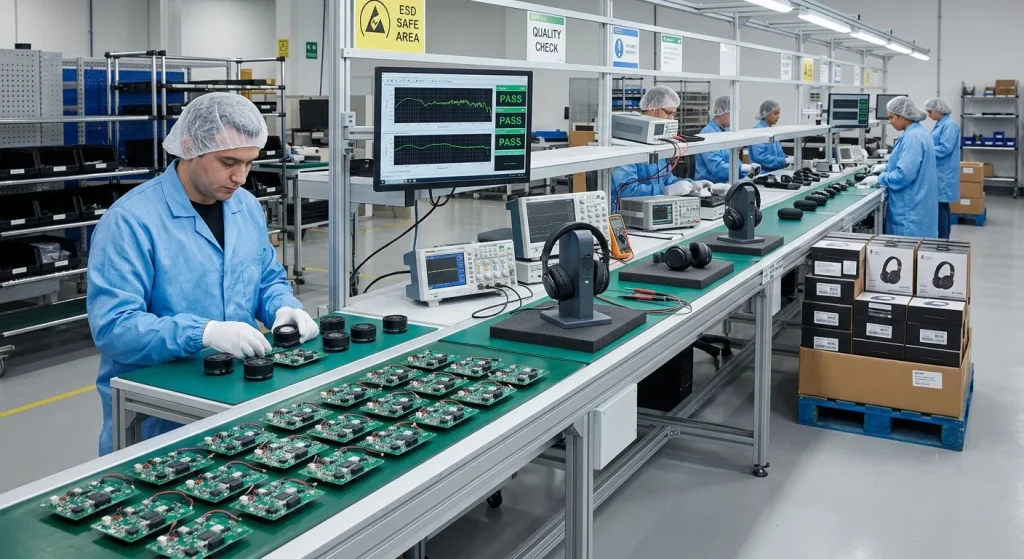
Modern electronics manufacturing requires rigorous calibration, especially for specialized devices like those built by a swimming headphones manufacturer requiring strict waterproof sealing and acoustic testing. Configuring and calibrating SMT placement machines and acoustic testing rigs consumes time and labor. Factories require a minimum run length to justify the downtime and setup hours required to transition a line from one product specification to another.
Packaging and Customization Complexity
Packaging runs, printing plates for user manuals, and customized color boxes also operate on strict industrial minimums. Printers and packaging material vendors require bulk orders to offset setup plates. When sourcing standard or ODM bone conduction headphones, even minor modifications, such as laser-engraved branding or specific color Pantone matching, require specific batch thresholds to maintain economic efficiency during assembly.
Comparison Table
| Customization Level | Typical MOQ Range | Primary Cost Driver |
| Standard Stock Model | 300–500 units | Basic packaging and assembly scheduling |
| Logo Branding Only | 500–1,000 units | Silk-screening and custom master cartons |
| Custom Packaging | 1,000–2,000 units | Custom printing plates and color box runs |
| Full Custom ODM Design | 3,000–5,000+ units | New tooling, mold opening, and R&D allocation |
Industry Insight
In the global audio manufacturing landscape, MOQ is often negotiable, but lower volume always carries trade-offs. Some buyers attempt to pressure factories into accepting minimal batch runs, such as 100 or 200 units. However, doing so usually results in “surplus pricing,” where the factory inflates the unit cost to cover idle line time and component surcharges. Experienced supply chain partners look for a balance where the MOQ aligns with market validation goals without eroding profit margins due to high overhead penalties.
Buyer Tips
- Align MOQ with Sales Forecasts: Match your order quantities with realistic inventory turnover rates to avoid holding excessive stock.
- Negotiate Tiered Pricing: Request price breaks at higher volume milestones (e.g., 1,000, 3,000, and 5,000 units) to optimize budgeting.
- Inquire About Shared Components: Ask if the factory uses common parts across multiple models, which can sometimes lower material batch constraints.
- Clarify Packaging MOQs: Separate the device MOQ from the packaging MOQ, as custom boxes often require higher minimums than the hardware itself.
Common Mistakes
- Chasing Unrealistic Low MOQs: Forcing a factory into extremely small batches, resulting in inflated unit costs and potential quality control compromises.
- Ignoring Component Lead Times: Failing to realize that low-MOQ orders may be delayed while waiting for the factory to accumulate enough small orders to trigger a material run.
- Overlooking Shipping Economics: Ordering quantities that do not optimize container space, leading to disproportionately high logistics costs per unit.
Recommended Internal Links
- Bone Conduction Headphones
- OEM Service
- Minimum Order Quantity (MOQ)
- Swimming Headphones
- Contact Page
Related Questions
- Can I negotiate a lower MOQ for my first trial order?
- How do custom molds affect project lead times and startup costs?
- What is the difference in MOQ between standard stock and custom audio designs?
- How do packaging minimums impact overall order quantities?
Summary
Navigating Minimum Order Quantities requires a strategic approach that balances capital investment with inventory management. Whether you are launching a startup line of OEM bone conduction headphones or expanding an established catalogue, understanding these underlying supply chain constraints is vital. Partnering with an experienced manufacturer ensures transparency regarding batch thresholds, whether you are developing standard models or customized private label bone conduction headphones for your target market.