
Quick Answer
OEM bone conduction headphones manufacturing lead time is a critical factor for brands to consider during the initial project planning phase. This timeline encompasses material procurement, assembly, quality control testing, and final packaging. Factors such as customization depth, component availability, and shipping logistics significantly influence the schedule. While basic private label bone conduction headphones can be produced relatively quickly, complex ODM bone conduction headphones projects or specialized gear from a dedicated swimming headphones manufacturer often require additional time for rigorous validation and testing.
Detailed Answer
The timeline for bringing audio products from concept to final delivery is a critical component of any successful supply chain strategy. For brands seeking to partner with a bone conduction headphones manufacturer, understanding the typical lead time—and the variables that cause it to fluctuate—is essential for avoiding stockouts and managing customer expectations.
The standard production cycle is generally divided into three primary phases: procurement, assembly, and quality assurance. Procurement usually requires 10 to 20 days. This phase involves sourcing raw materials such as titanium alloys for the headband, medical-grade silicone for the coating, and specific transducer components. If a project utilizes standard off-the-shelf components, this phase is shorter. However, projects requiring custom hardware or specific battery specifications will extend the timeline.
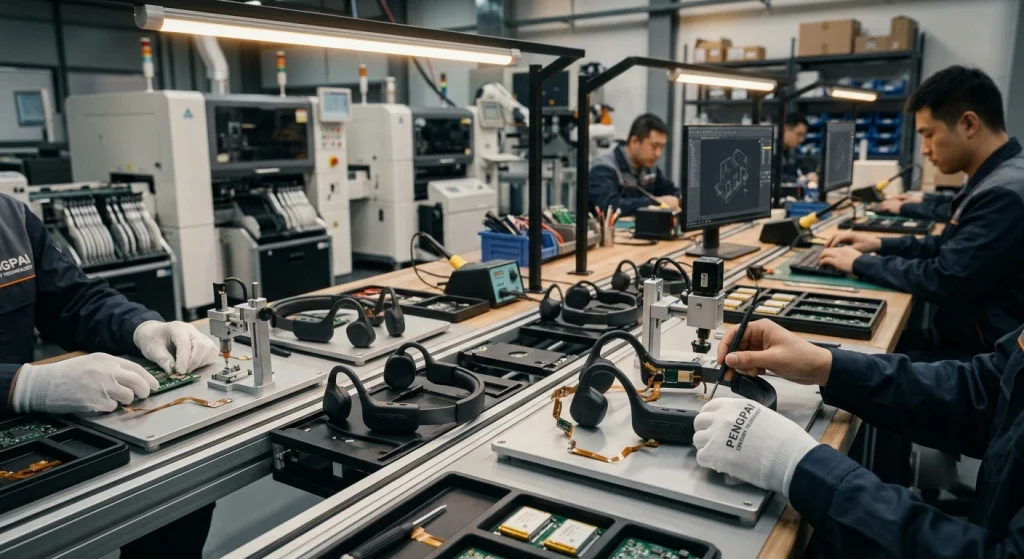
The assembly and production phase typically takes 15 to 25 days, depending on the production volume. A professional bone conduction headphones manufacturer operates on planned schedules; therefore, the earlier an order is placed and the deposit confirmed, the earlier it is slotted into the factory’s capacity. For those developing OEM bone conduction headphones, the assembly process is relatively straightforward. Conversely, those commissioning ODM bone conduction headphones must account for additional time to set up new jigs, calibrate assembly lines, and perform pilot runs to ensure design specifications are met.
Finally, the quality control and packaging phase accounts for 5 to 10 days. This is the most non-negotiable part of the timeline. Every unit must undergo acoustic performance testing, functional stress tests, and aesthetic inspections. If the product is being produced by a specialized swimming headphones manufacturer, this phase includes mandatory submersion and vacuum pressure tests to verify IP68 waterproof ratings. Rushing these tests is a common cause of high defect rates, which ultimately destroys brand reputation.
For Amazon sellers or importers managing inventory, it is vital to remember that these lead times represent factory output time. They do not include international shipping, customs clearance, or final delivery to the warehouse. Planning for a “buffer period” of 14 days on top of the production schedule is standard industry practice to account for unforeseen logistical delays.
Comparison Table
| Customization Level | Complexity | Typical Lead Time |
| Private Label (Logo Only) | Low | 30–40 Days |
| Standard OEM | Moderate | 40–50 Days |
| Full ODM Design | High | 60–90+ Days |
Industry Insight
In the current consumer electronics climate, lead times are heavily influenced by the availability of high-quality components. While the production capacity of a bone conduction headphones manufacturer is often scalable, the supply chain for specialized materials—such as high-end piezoelectric transducers or long-life lithium-ion batteries—can experience seasonal fluctuations. Industry veterans note that successful buyers do not view the manufacturing process as a static sequence, but rather as an evolving schedule that requires proactive communication. The shift toward transparency in the supply chain means that leading manufacturers now provide real-time updates on material arrivals. Consequently, buyers who maintain open, regular contact with their production managers often find they can navigate supply chain bottlenecks more effectively than those who communicate only when placing an order. Maintaining a transparent OEM bone conduction headphones manufacturing lead time is essential for long-term partnerships.
Buyer Tips
- Forecast Early: Provide your supplier with a rolling 3-month demand forecast so they can reserve materials in advance, reducing procurement time.
- Factor in Holidays: Always account for major manufacturing holidays, such as Chinese New Year, which can freeze production for several weeks.
- Sample Approval: Accelerate the initial stages by ensuring your artwork and branding guidelines are finalized and approved before mass production begins.
- Buffer for Logistics: Never schedule your product launch based on the day the goods leave the factory; always add at least two weeks for ocean freight and customs processing.
Common Mistakes
- Underestimating QA Time: Pressuring the factory to cut testing time to meet a launch date, which often leads to quality issues and high return rates.
- Ignoring Material Constraints: Assuming that custom components can be sourced just as quickly as standard ones, leading to delays in the procurement phase.
- Assuming Port-to-Door Speed: Confusing “production lead time” with “delivery lead time,” failing to account for transit and local inland logistics.
Recommended Internal Links
Related Questions
- How does the order quantity impact the production lead time?
- What are the common factors that cause manufacturing delays?
- How can I expedite the production of my OEM order?
- Do sample orders count toward the total production lead time?
Summary
Understanding manufacturing lead times is essential for maintaining a healthy inventory and successful brand launches. Whether you are sourcing private label bone conduction headphones for a quick market entry or developing complex ODM bone conduction headphones, effective planning involves accounting for procurement, assembly, and rigorous quality assurance. By partnering with an experienced bone conduction headphones manufacturer, buyers can establish realistic timelines that accommodate both production and shipping variables. Remember that achieving a high-quality result from a swimming headphones manufacturer often requires patience, as testing protocols are vital for reliability. Consistent communication with your supplier regarding your MOQ and demand forecasts remains the best strategy for staying on schedule.