
Quick Answer
No, standard Bluetooth headphones cannot work effectively underwater. Bluetooth signals operate on the 2.4 GHz frequency band, which is severely attenuated by water molecules, leading to immediate connectivity loss upon submersion. For aquatic sports, users require specialized swimming headphones with integrated MP3 storage. Professional manufacturers advise that while some devices have high IP68 ratings, the hardware limitation of radio frequency transmission in water makes Bluetooth connectivity unreliable for swimming applications.
Detailed Answer
The inability of Bluetooth headphones to function underwater is rooted in basic physics. Because they rely on radio frequency transmission designed for air-based propagation, the high conductivity of water causes the signal to be absorbed almost instantly.
Even with a high-quality antenna, the signal depth is typically limited to a few centimeters. This makes standard audio devices effectively useless once the user’s head is fully submerged.
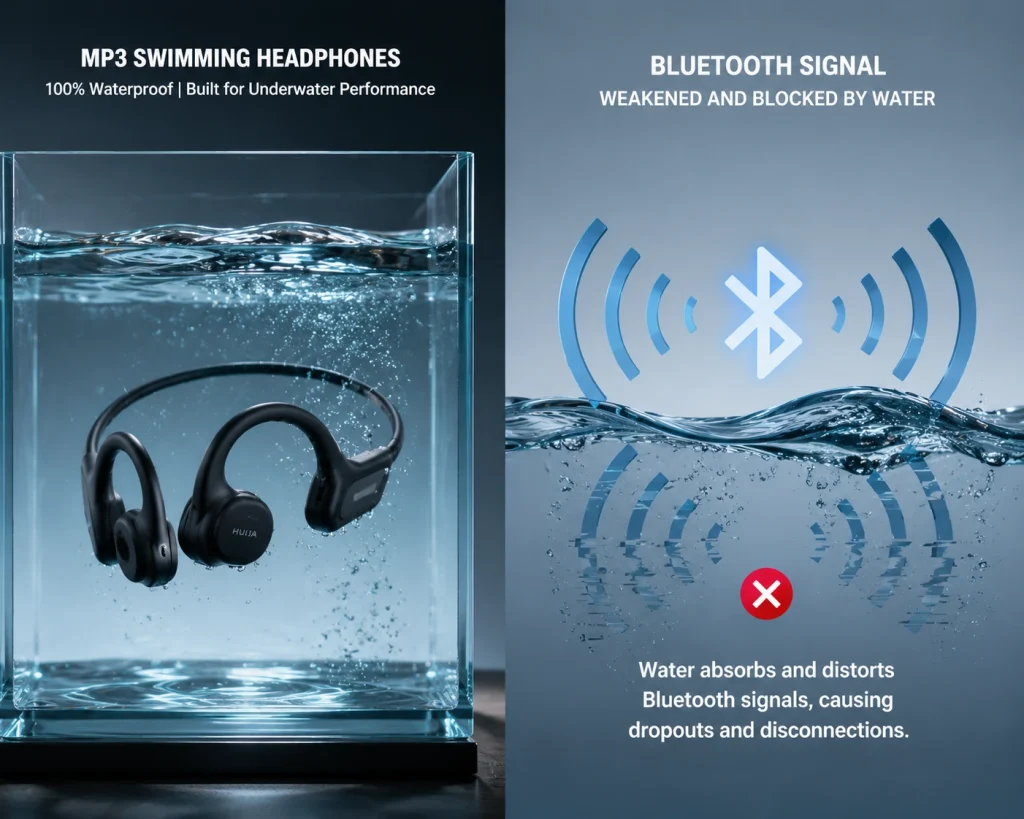
From a manufacturing perspective, this physical barrier is a critical factor when designing audio products for the sports industry. A professional swimming headphones manufacturer must prioritize integrated internal memory to ensure uninterrupted audio playback.
Aquatic-grade devices require specialized sealing techniques to ensure that charging ports and internal components remain protected under pressure.
Comparison Table
| Feature | Standard Bluetooth Headphones | Dedicated Swimming Headphones |
| Connectivity | Bluetooth (Air) | Integrated MP3 (Local Storage) |
| Water Performance | Fails upon submersion | Reliable playback underwater |
| Best Usage | Gym, Running, Daily Commute | Swimming, Surfing, Diving |
| Storage | None (Streaming Only) | 8GB–32GB Internal Memory |
Industry Insight
The industry shift toward dual-mode devices is a strategic response to the physical limitations of RF signals in water.
A reputable bone conduction headphones manufacturer now focuses on the seamless transition between streaming (for out-of-water use) and onboard storage (for swimming). As market demand for ODM bone conduction headphones continues to climb, factories that provide robust, easy-to-use data transfer interfaces—such as magnetic charging cables that also serve as data links—are gaining significant market share.
Sourcing quality OEM bone conduction headphones that feature this dual-mode capability is essential for any brand aiming to compete in the high-performance aquatic sports segment.
Buyer Tips
- Verify Dual-Mode Specs: Ensure the unit supports both Bluetooth streaming and onboard MP3 playback.
- Assess Sealing Quality: Request testing reports on the magnetic charging contacts, as these are common failure points.
- Check Memory Capacity: Standardize at least 8GB for optimal user experience in private label bone conduction headphones.
- Test Signal Latency: Evaluate how quickly the device switches modes to ensure a premium user experience.
Common Mistakes
- Misbranding: Marketing Bluetooth-only “waterproof” headphones as swimming-ready, leading to negative consumer reviews.
- Ignoring Material Durability: Overlooking the degradation of internal seals caused by pool chemicals over time.
- Neglecting Data Transfer: Failing to ensure the provided cable supports efficient data transfer for the MP3 function.
Recommended Internal Links
Related Questions
- What is the difference between IP67 and IP68 waterproof ratings?
- How does bone conduction technology work underwater?
- Why do swimming headphones need internal storage?
- Can I customize the storage capacity of my OEM headphones?
Summary
Bluetooth technology is not a viable solution for underwater audio due to signal absorption. When users rely on standard Bluetooth headphones, they experience immediate connectivity loss, making integrated storage a mandatory feature for aquatic devices.
For brands seeking to enter the aquatic audio market, sourcing the right OEM bone conduction headphones that include integrated storage is paramount.
Whether you are working with a bone conduction headphones manufacturer on a new design or managing a private label bone conduction headphones project, understanding these technical limitations is key. Always discuss MOQ requirements and technical specifications early to ensure your ODM bone conduction headphones meet professional standards.