
Quick Answer
To find a reliable supplier in China, evaluate factory technical certifications, inspect acoustic testing facilities, and verify liquid silicone assembly lines. Partnering with a vetted bone conduction headphones bulk order supplier ensures your orders meet strict waterproof standards, acoustic performance benchmarks, and international compliance regulations. B2B buyers must audit manufacturing facilities, review past production batch records, and negotiate structured contract terms to mitigate supply chain risks during international procurement operations.
Detailed Explanation
Sourcing open-ear audio products requires a disciplined supplier selection framework due to the technical complexity of bone vibration transducers and waterproof enclosures. Unlike standard air-conduction earphones, bone conduction headsets require precise mechanical clamping pressure, ultrasonic housing welding, and hermetic sealing. Distinguishing genuine manufacturing plants from trading intermediaries is critical to securing consistent batch quality and stable component pricing.
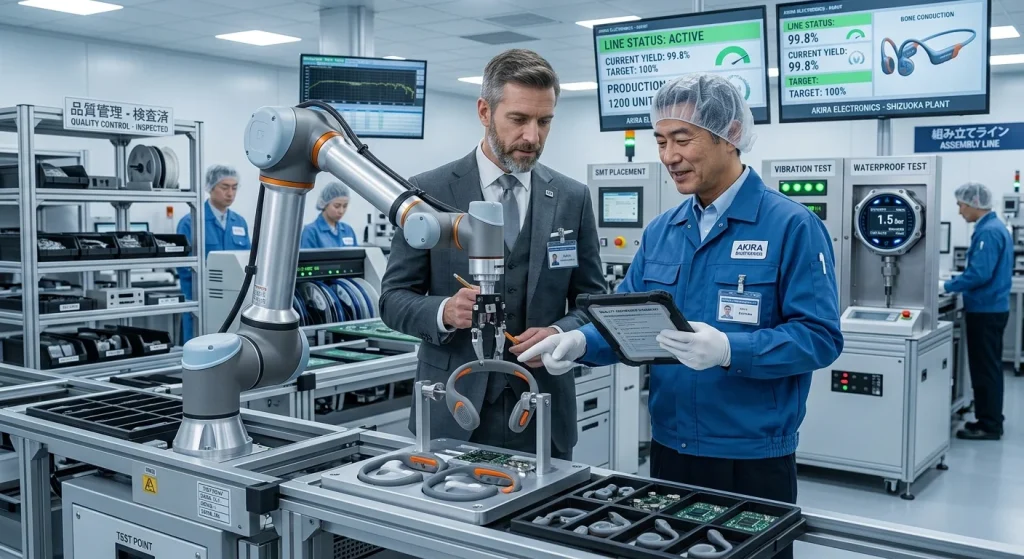
The qualification process begins with verifying physical manufacturing infrastructure. Authentic factories operate automated SMT circuit assembly lines, cleanroom silicone overmolding stations, and dedicated acoustic testing chambers equipped with artificial head simulators. Evaluating these facilities through a structured china bone conduction headphones factory guide helps procurement teams verify production capacity, engineering support, and assembly automation.
Technical quality assurance serves as the next evaluation pillar. A qualified supplier must demonstrate rigorous testing protocols, including IPX8 pressure tank water immersion, multi-axis drop tests, and battery burn-in cycles. Furthermore, buyers should scrutinize component traceability for essential modules such as Bluetooth chipsets, lithium-ion protection circuits, and titanium memory wire bands to ensure long-term product durability.
Evaluating commercial transparency is equally vital when establishing long-term manufacturing agreements. Contracting with a reliable bulk order bone conduction headset vendor provides transparent bill-of-materials (BOM) cost breakdowns, clear minimum order quantity tiers, and explicit engineering change notice (ECN) procedures. Working alongside a proven high volume bone conduction earphone supplier protects your brand against unannounced component substitution and unexpected schedule slippages.
Ultimately, choosing a dedicated bone conduction headphones bulk procurement partner ensures seamless technical alignment between western brand expectations and eastern production execution. Established suppliers provide comprehensive testing documentation, maintain ISO9001 and BSCI compliance, and support structured post-sale replacement guarantees for commercial peace of mind.
Comparison Table
| Evaluation Criterion | Direct Manufacturing Plant | Trading Company / Intermediary |
| Engineering Capability | In-house R&D, tooling engineers, custom firmware development | Outsourced engineering, limited to cosmetic customization |
| Facility Control | Direct access to SMT lines, cleanrooms, and testing chambers | Third-party facility access, limited operational visibility |
| Cost Structure | Direct factory pricing without middleman margins | Added commission markups (15% – 30% price premium) |
| Quality Oversight | Real-time line inspections and automated AQL testing | Reliance on factory self-reporting or external inspectors |
| Issue Resolution | Immediate engineering fixes and direct mold modifications | Slower communication relays between client and true factory |
Industry Insight
The open-ear audio manufacturing landscape in China is undergoing rapid technological consolidation. As consumer demand for sports and swimming audio expands, tier-one manufacturers are investing heavily in automated liquid silicone rubber (LSR) injection and robotic adhesive dispensing lines. Modern B2B procurement strategies are shifting away from general audio vendors toward specialized open-ear facilities that maintain dedicated acoustic research labs. Sourcing from specialized plants reduces initial defect rates while ensuring compliance with evolving international standards such as Bluetooth 5.4, RED directives, and REACH chemical safety norms.
Buyer Tips
- Request live video walk-throughs or perform third-party factory audits (ISO9001/BSCI) prior to depositing tooling funds.
- Require golden sample sign-offs where physical prototypes are sealed and signed by both parties as quality baselines.
- Implement structured AQL (Acceptable Quality Limit) standards—typically Level II Normal with 0 Major / 1.5 Minor defect tolerances.
- Mandate 100% IPX8 pressure tank testing records for aquatic sports models before authorizing final balance payments.
- Establish milestones tied to production deliverables: 30% deposit, 40% after line assembly inspection, and 30% upon final AQL pass.
Common Mistakes
- Relying solely on B2B marketplace supplier badges without independently verifying physical factory ownership and production lines.
- Selecting suppliers based exclusively on the lowest unit price, leading to compromised waterproof seals or recycled battery cells.
- Failing to define explicit defective return policies (RMA terms) and spare parts allocations in the master supply agreement.
Key Takeaway
Finding a dependable bone conduction audio manufacturer in China requires systematic auditing of technical facilities, quality management systems, and commercial terms. Verifying in-house tooling, acoustic lab capabilities, and IPX8 waterproofing processes ensures high production yields. Aligning with an experienced bone conduction headphones bulk order supplier builds a resilient, high-yield supply chain for your brand’s global growth.
Related Questions
- What certifications should I check when vetting a Chinese audio manufacturer?
- What is the standard AQL defect tolerance rate for bulk earphone shipments?
- How can buyers verify if a supplier is a direct factory or a trading company?
- What payment terms are customary for high-volume custom headphone production?
- How are warranty returns (RMA) handled in international B2B audio manufacturing?
Recommended Images
- Featured image: Professional B2B inspection team auditing an automated bone conduction headset assembly line inside an electronics facility.
- Factory production image: High-precision automated robotic arm applying silicone waterproof sealants to headphone frames.
- Testing process image: Acoustic engineer using an artificial head simulator inside an anechoic chamber to measure frequency response.
- Comparison chart or workflow diagram: Infographic flowchart outlining the 5-step supplier evaluation framework from initial screening to AQL audit.
Image ALT Text Suggestions
- OEM bone conduction headphones manufacturer factory assembly line audit
- Bone conduction headphones waterproof testing in pressure water tank
- IPX8 swimming headphones factory automated silicone dispensing process
Suggested Internal Links
- /bone-conduction-headphones/
- /oem-bone-conduction-headphones/
- /odm-services/
- /swimming-headphones/
- /blog/
- /contact/
How to Find a Reliable Bone Conduction Headphones Supplier in China?
Finding a reliable supplier involves auditing physical manufacturing plants, verifying acoustic testing labs, confirming IPX8 waterproof capabilities, and reviewing third-party ISO/BSCI certifications.
How can buyers differentiate direct factories from trading companies?
Direct factories own physical SMT lines, mold fabrication shops, and in-house engineering teams, whereas trading companies outsource production and cannot grant direct operational control.
What quality inspection standards should be applied to bulk headphone orders?
B2B buyers should implement AQL Level II Normal inspection standards with 0 critical defects, 1.0 major defects, and 2.5 minor defect limits.