
Quick Answer
The production process of bone conduction headphones integrates surface-mount technology (SMT) electronics assembly, titanium alloy frame molding, acoustic transducer calibration, ultrasonic casing sealing, and strict quality verification. Partnering with a qualified bone conduction headphone OEM factory China ensures that critical steps—such as multi-stage waterproofing and frequency response tuning—adhere to international standards. Understanding this structured workflow helps procurement managers evaluate production lead times, verify structural integrity, and optimize supply chain quality.
Detailed Explanation
Manufacturing bone conduction headsets requires specialized assembly techniques that differ fundamentally from conventional air-conduction earbud manufacturing. Instead of driving acoustic waves through air canals via standard speaker diaphragms, bone conduction devices rely on precision electromagnetic transducers that transmit mechanical vibrations through the temporal bones. Consequently, every manufacturing step demands precise mechanical tolerances, controlled environmental conditions, and rigorous electronic testing.
The production journey begins with electronic component assembly using automated Surface Mount Technology (SMT). High-speed pick-and-place machines position micro-passives, power management integrated circuits (PMICs), and advanced wireless chipsets onto rigid-flex printed circuit boards. During this phase, technicians execute bluetooth 5.4 acoustic module assembly to ensure low-power communication, minimal signal latency, and reliable audio streaming. Concurrently, high-tensile titanium memory alloy wires are overmolded with skin-safe silicone to form ergonomic, durable neckband structures.
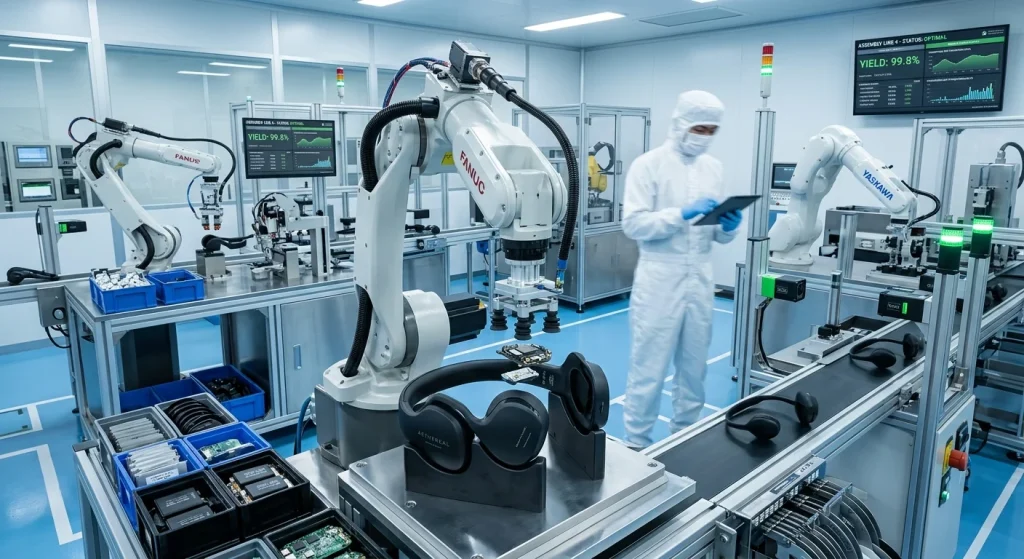
The second phase centers on acoustic transducer integration and enclosure assembly. Transducers are carefully placed within sealed acoustic cavities engineered to maximize mechanical vibration transfer while curbing external acoustic leakage. For high-performance sports models, such as IPX8 waterproof bone conduction headphones, plastic casings are joined using ultrasonic welding or double-injection molding. This hermetic sealing prevents liquid ingress during prolonged underwater immersion.
Following housing closure, units undergo systematic verification. A reputable china bone conduction headphones factory applies comprehensive bone conduction headphones quality control protocols across the line. Automated audio analyzers evaluate frequency curves, vibration amplitude, and harmonic distortion, while pressurized fluid tanks verify sealing integrity.
Procurement teams evaluating prospective production partners should inspect these workflows during a china bone conduction headphones factory audit to confirm consistent yields. Working alongside an experienced custom bone conduction headphones supplier for bone conduction headphones private label projects ensures high product reliability across competitive international retail channels.
Furthermore, an established open ear audio equipment manufacturer maintains strict component traceability. From incoming battery cell stress testing to final master carton drop testing, systematic quality checkpoints protect brands against field failure risks. Sourcing from a reliable open ear headphones bulk supplier guarantees consistent acoustic performance across large volume shipments.
Comparison Table
| Production Stage | Primary Operations & Equipment | Critical Quality Checks | Average Timeline |
| Electronics Assembly | SMT component placement, reflow soldering, chipset flashing | Solder paste inspection (SPI), Automated Optical Inspection (AOI) | 2–3 Days |
| Acoustic & Frame Assembly | Transducer positioning, titanium frame silicone overmolding | Vibration intensity verification, acoustic leakage checks | 3–5 Days |
| Enclosure Sealing | Dispensing waterproof adhesives, ultrasonic housing welding | Vacuum leak testing, enclosure tolerance validation | 2–3 Days |
| Quality Control & Testing | Battery aging cycles, pressure tank immersion, drop tests | Audio analyzer frequency sweeps, IPX8 rating verification | 3–4 Days |
| Packaging & Fulfillment | Custom box assembly, accessory packing, master carton sealing | Barcode scan verification, cosmetic appearance audit | 2–3 Days |
Industry Insight
The open-ear audio manufacturing sector is increasingly implementing automated assembly systems to eliminate variance in acoustic performance. Because bone conduction technology relies on physical resonance, minor discrepancies in transducer positioning or adhesive application volume can cause noticeable left-right audio imbalances. Leading manufacturing facilities now utilize automated glue dispensers, robotic ultrasonic welding stations, and computer-vision alignment platforms. This automation maintains factory yields above 98%, enabling suppliers to meet growing global demand while maintaining strict acoustic standards.
Buyer Tips
- Inspect the factory’s SMT line capabilities to confirm the use of Automated Optical Inspection (AOI) on all circuit boards.
- Verify that IPX8 waterproof testing is conducted on 100% of finished units rather than relying on random sample testing.
- Ensure the supplier uses high-grade memory titanium alloy for neckbands to prevent structural fatigue or deformation over time.
- Request comprehensive audio frequency response reports from suppliers to evaluate acoustic leakage suppression controls.
- Require full compliance documentation, including CE, FCC, RoHS, and REACH certifications, prior to authorizing mass production.
Common Mistakes
- Evaluating production facilities purely on final assembly capacity while overlooking in-house SMT and acoustic tooling controls.
- Skipping pressure-chamber water immersion validation for swimming headsets, resulting in high field failure rates.
- Failing to standardize Pantone silicone colors early in development, leading to shade variations between plastic parts and silicone bands.
Key Takeaway
Understanding the multi-stage manufacturing process of open-ear audio hardware enables B2B buyers to select competent supply chain partners. From precise SMT electronics assembly to automated ultrasonic sealing, every step impacts long-term durability and audio clarity. Partnering with a certified bone conduction headphone OEM factory China ensures strict quality control, reliable IPX8 sealing, and scalable production for private-label audio brands worldwide.
Related Questions
- What is the difference between air-conduction and bone-conduction headphone manufacturing?
- How do factories test and verify IPX8 waterproofing on swimming headsets?
- What is the typical lead time for mass production at a bone conduction headphone factory?
- How do acoustic engineers suppress sound leakage in bone conduction housing designs?
- What certifications are required when importing bone conduction headphones into North America and Europe?
Recommended Images
- Featured image: A clean, professional overview of an automated electronics assembly line showing workers in anti-static attire assembling bone conduction headphones.
- Factory production image: High-precision SMT placement machinery mounting chipsets and micro-components onto headphone circuit boards.
- Testing process image: Quality assurance technician placing sealed bone conduction headphones into a high-pressure water tank for IPX8 validation.
- Comparison chart or workflow diagram: Structured infographic outlining the step-by-step manufacturing workflow from raw material inspection to final packaging.
Image ALT Text Suggestions
- OEM bone conduction headphones manufacturer assembly line and production workflow
- Bone conduction headphones waterproof testing in a factory pressure tank
- IPX8 swimming headphones factory quality control and SMT assembly
Suggested Internal Links
- /bone-conduction-headphones/
- /oem-bone-conduction-headphones/
- /odm-services/
- /swimming-headphones/
- /blog/
- /contact/
What is the complete production process of bone conduction headphones?
The manufacturing process includes SMT circuit board assembly, titanium memory frame overmolding, transducer acoustic chamber positioning, ultrasonic housing sealing, IPX8 waterproofing validation, and automated quality testing.
How is waterproofing achieved during bone conduction headphone manufacturing?
Waterproofing is achieved using double-injection molded enclosures, precision silicone seal dispensing, and ultrasonic welding. Completed units undergo pressurized water immersion testing to confirm IPX8 compliance.
Why is quality control critical for bone conduction audio devices?
Because bone conduction relies on mechanical vibration transmission, rigorous quality control ensures balanced transducer output, structural sealing integrity, and minimal acoustic sound leakage.