
Quick Answer
The typical minimum order quantity (MOQ) for custom bone conduction headphones ranges from 500 to 3,000 units per order, depending primarily on the scope of customization. Basic logo branding and custom packaging often start at 500 to 1,000 units. However, deeper engineering modifications—such as custom tooling, unique silicone color matching, or specialized board layouts—require 2,000 to 3,000 units. Partnering with an experienced custom bone conduction headphones manufacturer helps brands align order volumes with supply chain financial constraints.
Detailed Explanation
Minimum order quantities in specialized audio manufacturing reflect hard operational constraints rather than arbitrary factory policies. Bone conduction hardware requires complex component sourcing, including titanium memory alloy bands, specialized bone conduction transducers, lithium-polymer batteries, and precision-molded silicone enclosures. Understanding how factories calculate MOQs enables B2B buyers to negotiate terms effectively while mitigating inventory exposure.
The primary factor driving high MOQs is upstream supplier requirements. A standard china bone conduction headphones factory must order sub-components—such as Bluetooth System-on-Chip (SoC) solutions, mainboards, and battery cells—in bulk batches from tier-two vendors. Masterbatch color matching for custom silicone casings, for instance, typically requires a minimum chemical dye run equivalent to 1,000 or 2,000 finished units.
Customization depth directly dictates the tier of MOQ required:
- Private Label Branding (MOQ 500 – 1,000 units): This entry-level customization involves applying custom silkscreen or laser-engraved logos onto an existing factory enclosure, alongside custom-printed retail packaging and user manuals.
- Color & Surface Modifications (MOQ 1,000 – 2,000 units): Customizing the silicone shell color or applying soft-touch rubberized coatings requires dedicated production line calibration and higher raw material commitments.
- Full Hardware / Tooling Customization (MOQ 3,000+ units): Developing a proprietary casing mold, re-engineering the printed circuit board assembly (PCBA), or altering the acoustic cavity structural design requires substantial upfront engineering resources and high tooling amortization thresholds.
For specialized products like IPX8 waterproof bone conduction headphones, assembly lines require rigorous non-destructive pneumatic pressure decay testing to comply with IEC 60529 standards. Setting up specialized testing jigs and optical alignment tools creates fixed operational overhead, making small production runs under 500 units economically inefficient for the factory.
Working with a reliable custom bone conduction headphones supplier provides access to component standardization strategies that reduce initial order hurdles. Implementing strict bone conduction headphones quality control across standardized core platforms allows manufacturers to offer flexible packaging customization without requiring full hardware re-tooling.
Selecting a supplier experienced in bone conduction headphones private label programs ensures your brand achieves optimal unit pricing without overcommitting capital during initial product validation phases.
Comparison Table
| Customization Level | Average MOQ | Cost Impact | Typical Lead Time | Key Deliverables |
| Logo & Packaging Only | 500 – 1,000 units | Low upfront cost | 25 – 35 days | Custom logo print, branded box, user manual |
| Custom Casing Color | 1,000 – 2,000 units | Moderate material fee | 35 – 45 days | Pantone-matched silicone, custom accessories |
| Proprietary Hardware / Tooling | 3,000+ units | High NRE / tooling fee | 60 – 90 days | Exclusive casing mold, custom PCBA layout |
Industry Insight
In the sports audio manufacturing ecosystem, the trend is shifting toward modular hardware design to help B2B buyers enter the market faster. Leading factories now pre-certify core motherboard architectures—complete with Bluetooth 5.3/5.4 chipsets, battery safety protection, and transducer drivers—while keeping unbranded enclosures in buffer inventory. This strategy allows brands to execute initial market testing runs at lower MOQs, scaling up to multi-thousand unit orders once market demand is validated.
Buyer Tips
- Negotiate tiered MOQs by offering to pay a small setup surcharge on smaller initial trial orders (e.g., 500 units).
- Standardize core internal components across multiple SKU colors to meet the factory’s overall material threshold.
- Ask the factory if they hold unbranded neutral stock (white-label units) ready for rapid logo printing.
- Align custom packaging production with local print suppliers who accept lower MOQs than the main hardware plant.
Common Mistakes
- Demanding low MOQs on fully custom tooling without offering to cover Non-Recurring Engineering (NRE) costs.
- Failing to account for component supplier MOQs, such as custom Bluetooth firmware flashes or specialized battery configurations.
- Over-customizing outer packaging design, which causes packaging MOQs (often 2,000+ units) to bottleneck the hardware production run.
Key Takeaway
While baseline MOQs for custom bone conduction devices range from 500 to 3,000 units, order thresholds are negotiable based on customization depth. Partnering with a professional custom bone conduction headphones manufacturer enables buyers to balance low upfront inventory risk with scalable unit production economics.
Related Questions
- What is the typical lead time for a custom bone conduction headphone order?
- What are Non-Recurring Engineering (NRE) fees in OEM audio manufacturing?
- How can buyers lower initial packaging MOQs when starting a private label brand?
- What is the difference between OEM and ODM bone conduction manufacturing?
- How do factories handle component sourcing for small batch trial orders?
Recommended Images
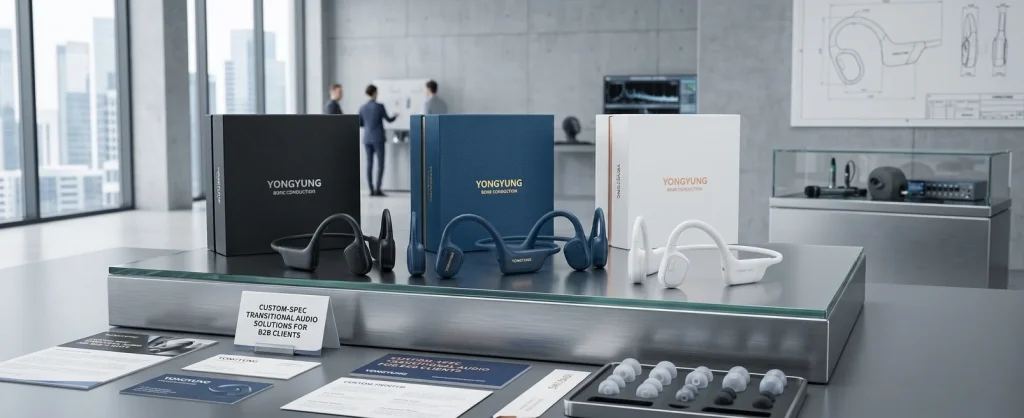
- Featured image: A commercial product showcase displaying custom bone conduction headphones in multiple Pantone colors alongside branded retail packaging.
- Factory production image: High-volume automated SMT line assembling PCBA boards for wireless bone conduction headphones.
- Testing process image: QC engineer performing pneumatic pressure decay testing on IPX8 waterproof headphone enclosures.
- Comparison chart or workflow diagram: A diagram illustrating the breakdown of MOQs across logo printing, casing color matching, and full custom tooling.
Image ALT Text Suggestions
- OEM bone conduction headphones manufacturer custom production line
- Bone conduction headphones waterproof testing in cleanroom lab
- IPX8 swimming headphones factory bulk manufacturing process
Suggested Internal Links
- /bone-conduction-headphones/
- /oem-bone-conduction-headphones/
- /odm-services/
- /swimming-headphones/
- /blog/
- /contact/
What is the typical MOQ for custom bone conduction headphones?
The typical MOQ for custom bone conduction headphones ranges from 500 to 3,000 units depending on customization levels, such as logo printing, custom casing colors, or proprietary tooling.
Why do custom bone conduction headphones require higher MOQs for custom colors?
Custom casing colors require raw silicone masterbatch dye mixing, which involves a minimum raw material batch volume from upstream suppliers.
Can I order 500 units for a private label bone conduction headphone project?
Yes, 500 units is usually feasible if customization is limited to laser engraving or silkscreening logos onto existing stock models with custom packaging.