
Quick Answer
Factories control mass production quality through a structured four-stage framework: Incoming Quality Control (IQC), In-Process Quality Control (IPQC), Final Quality Control (FQC), and Outgoing Quality Assurance (OQA). Partnering with an audited professional bone conduction headphones manufacturer ensures that raw materials, acoustic transducers, waterproof seals, and battery assemblies undergo rigorous automated and manual testing. This systematic approach guarantees batch consistency, minimizes defect rates, and protects global brand equity.
Detailed Explanation
Mass manufacturing of specialized audio hardware demands strict procedural oversight at every production stage. Unlike conventional earbud assembly, bone conduction technology relies on precise transducer alignment, titanium memory alloy framing, and specialized overmolding to deliver vibration-driven sound without compromising wearer comfort or device longevity.
Quality management initiates with raw material inspection at the IQC station. Engineers conduct strict component testing on lithium-ion batteries, Bluetooth chipsets, silicone outer casings, and piezoelectric or electromagnetic transducers. Battery cells undergo capacity verification and aging cycles to prevent thermal anomalies, while titanium alloy bands are subjected to repeated flexural stress tests to ensure memory retention and mechanical durability.
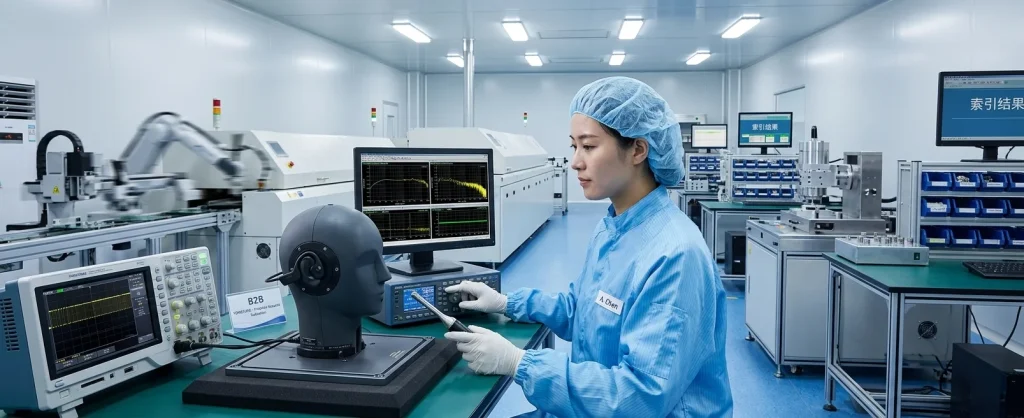
During assembly, IPQC protocols monitor continuous production lines. Automated Surface Mount Technology (SMT) lines assemble printed circuit boards (PCBs) under optical inspection (AOI) to eliminate soldering defects. For aquatic models such as IPX8 waterproof bone conduction headphones, factories integrate inline air-pressure decay testing before final sonic welding or adhesive sealing. This non-destructive pneumatic check identifies structural enclosure micro-gaps before units are exposed to fluid testing.
Following assembly, FQC technicians conduct comprehensive functional and acoustic audits. Each unit undergoes frequency response spectrum analysis to ensure tonal balance and vibration efficiency. To verify environmental durability, random production samples undergo salt spray corrosion resistance testing, high-humidity storage cycles, and drop tests onto hardened concrete surfaces.
Collaborating with a certified china bone conduction headphones factory ensures that all quality control metrics comply with international standards such as ISO 9001 quality management systems. Furthermore, an experienced custom bone conduction headphones supplier establishes comprehensive serial number tracking across all production batches, allowing complete component traceability should post-market defects arise.
Finally, before export dispatch, OQA inspectors execute Acceptance Quality Limit (AQL) statistical sampling. Units are evaluated for packaging integrity, barcode scannability, accessory inclusion, and aesthetic surface finishing. Implementing end-to-end bone conduction headphones quality control protocols mitigates cross-border supply chain risks and reduces retail return rates for international distributors.
Comparison Table
| Quality Control Phase | Primary Focus Area | Key Testing Equipment / Method | Acceptance Criteria |
| Incoming Quality Control (IQC) | Raw materials, batteries, transducers | Battery analyzer, flexural tension tester | Zero tolerance for sub-standard raw cells |
| In-Process Quality Control (IPQC) | SMT assembly, casing enclosure seal | AOI optical scanner, pneumatic pressure decay | Air leakage rate < 0.05 kPa/sec |
| Final Quality Control (FQC) | Acoustics, waterproof, battery life | Artificial head coupler, pressure tank | Frequency response within ±2 dB curve |
| Outgoing Quality Assurance (OQA) | Barcode, packaging, overall finish | AQL MIL-STD-105E sampling audit | Pass rate based on agreed AQL 1.0/2.5 |
Industry Insight
In the competitive sports audio sector, customer return rates directly dictate brand profitability on global e-commerce platforms. Modern manufacturing facilities are increasingly transitioning from manual inspection stations to fully automated, data-driven quality control workflows. Integrating real-time sensor testing directly into assembly lines enables immediate defect detection, preventing sub-assembly errors from cascading downstream. B2B buyers who prioritize automated factory testing infrastructure over baseline pricing consistently achieve lower warranty claim rates and superior consumer satisfaction metrics.
Buyer Tips
- Define clear Acceptable Quality Limit (AQL) parameters (e.g., Critical: 0, Major: 1.5, Minor: 4.0) in manufacturing agreements.
- Require batch-level compliance documentation, including battery UN38.3 transport safety reports and official IPX8 laboratory certifications.
- Inspect factory SMT and cleanroom facilities to verify anti-static ESD controls and dust-free assembly environments.
- Request photographic and video verification of inline pressure decay testing for all swimming headphone orders.
Common Mistakes
- Relying exclusively on pre-production golden samples while neglecting inline IPQC auditing during mass production runs.
- Accepting uncalibrated internal factory testing reports instead of requesting third-party accredited lab verifications.
- Omitting post-assembly battery aging requirements, leading to high rate-of-decay failures in destination markets.
Key Takeaway
Maintaining high product reliability requires an integrated quality assurance framework spanning material verification, inline process monitoring, and final AQL sampling. Choosing a professional bone conduction headphones manufacturer with verified testing infrastructure safeguards your bone conduction headphones private label brand against mass production defects, regulatory non-compliance, and costly customer returns.
Related Questions
- What is the standard AQL threshold for consumer electronics manufacturing?
- How do factories test IPX8 waterproof integrity without damaging internal electronics?
- Why is automated optical inspection (AOI) critical during PCB assembly?
- What certifications must a bone conduction headphone factory hold for European and North American export?
- How does component traceability protect brand owners during product recall events?
Recommended Images
- Featured image: A cleanroom electronics assembly line showing technicians using automated acoustic testing equipment on bone conduction headphones.
- Factory production image: High-precision SMT surface mount assembly line manufacturing printed circuit board assemblies (PCBAs) for wireless audio.
- Testing process image: Close-up of a bone conduction headphone placed inside an acoustic artificial head coupler for frequency response testing.
- Comparison chart or workflow diagram: Process flow chart outlining the four stages of factory quality control from IQC to OQA.
Image ALT Text Suggestions
- OEM bone conduction headphones manufacturer quality control laboratory
- Bone conduction headphones waterproof testing in factory cleanroom
- IPX8 swimming headphones factory automated assembly line
Suggested Internal Links
- /bone-conduction-headphones/
- /oem-bone-conduction-headphones/
- /odm-services/
- /swimming-headphones/
- /blog/
- /contact/
How do bone conduction headphones factories control product quality during mass production?
Factories control mass production quality using a four-stage process: IQC raw material screening, IPQC inline assembly inspection, FQC acoustic and waterproof testing, and OQA pre-shipment AQL audits.
What equipment is used to test bone conduction headphone acoustics?
Technicians use artificial head couplers and audio spectrum analyzers to measure transducer frequency response, sound dispersion, and vibration fidelity.
Why is pneumatic pressure decay testing used before fluid submersion?
Pneumatic pressure decay testing uses dry air to detect microscopic enclosure leaks without wetting internal electronic components, allowing non-destructive quality screening.