
Quick Answer
Amazon sellers should verify quality before a bulk order by evaluating samples, checking technical specifications, reviewing test reports, auditing the production process, and conducting pre-shipment inspections. A qualified bone conduction headphones manufacturer China should provide consistent samples, clear quality standards, production records, and relevant compliance documentation. For waterproof models, battery performance, acoustic output, structural durability, and water-resistance testing should also be verified before approving mass production.
Detailed Answer
For Amazon sellers, product quality should be verified before the purchase order reaches mass production. A good-looking sample does not necessarily guarantee that 1,000 or 10,000 units will have the same performance.
The first step is to create a clear product specification sheet. It should define the headphone structure, Bluetooth version, battery capacity, charging method, playback time, frequency response, materials, waterproof rating, accessories, packaging, and acceptable cosmetic defects. These specifications become the reference standard for both sampling and production.
1. Test production samples
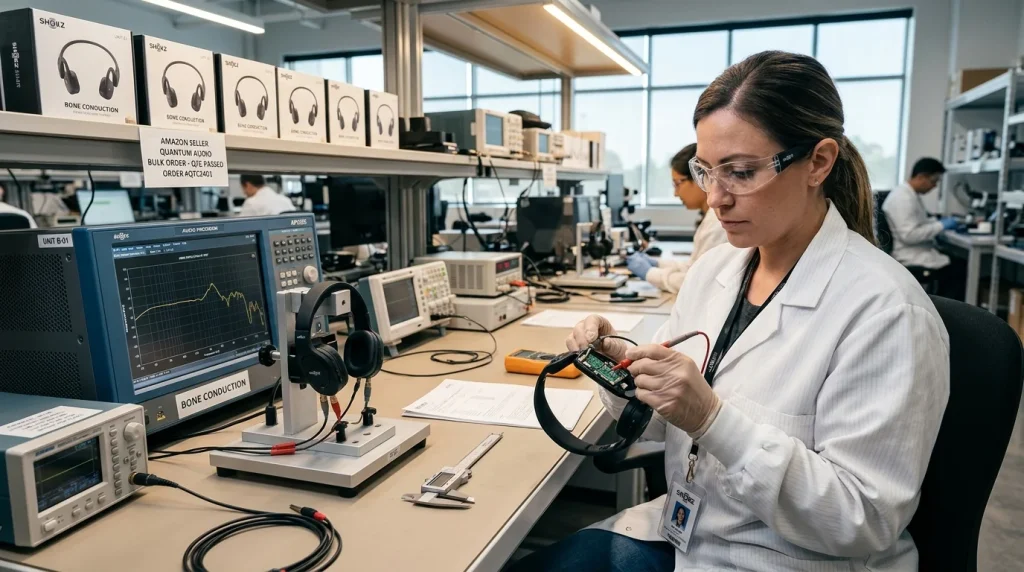
Request several samples rather than evaluating only one unit. Test them under normal and repeated use.
For bone conduction headphones, pay particular attention to:
- Audio consistency between left and right transducers
- Maximum and normal listening volume
- Bluetooth connection stability
- Microphone performance
- Battery charging and discharge behavior
- Button response
- Structural strength of the ear hooks and frame
- Comfort and pressure around the contact points
- Charging-port sealing and overall assembly
If the product will be marketed as IPX8 waterproof bone conduction headphones, waterproof performance should be verified using an appropriate laboratory or factory test procedure rather than relying only on a printed rating.
2. Check the supplier’s production capability
Amazon sellers should distinguish between a trading company and a genuine manufacturing operation. When evaluating a china bone conduction headphones factory, examine its production equipment, assembly lines, testing stations, quality-control procedures, and experience with similar products.
The supplier should be able to explain how incoming components, in-process assemblies, and finished headphones are inspected.
A useful indicator is whether the factory can provide measurable inspection criteria rather than simply stating that products are “high quality.”For a broader guide to selecting a reliable supplier for Amazon, see “Find a Reliable Headphones Supplier for Amazon Sellers.”
3. Review compliance and test documentation
Depending on the destination market and product configuration, buyers may need documentation covering areas such as EMC, radio performance, battery safety, RoHS, and applicable waterproof testing.
Documents should correspond to the actual product model and hardware configuration being purchased. A certificate for a visually similar product is not necessarily sufficient.
4. Establish a quality-control process before production
Effective bone conduction headphones quality control should cover three stages:
Incoming inspection: Check chips, batteries, transducers, PCB assemblies, silicone components, and other critical materials.
In-process inspection: Monitor soldering, assembly, waterproof sealing, button installation, charging functions, and acoustic performance.
Final inspection: Test finished units for functionality, appearance, charging, Bluetooth connection, audio output, packaging, and other agreed specifications.
For Amazon orders, buyers should also define an acceptable defect level and inspection method before mass production starts.
5. Conduct a pre-shipment inspection
A third-party inspection company or buyer-appointed QC inspector can randomly inspect finished goods before the balance payment and shipment.
The inspection can verify:
- Quantity
- Product appearance
- Functional performance
- Accessories
- Packaging
- Labels and barcodes
- Carton markings
- Randomized sample performance
This provides an additional checkpoint between factory production and Amazon inventory.
Comparison Table
| Verification Method | What It Checks | Recommended Timing |
|---|---|---|
| Sample Testing | Audio, Bluetooth, battery, comfort, structure | Before order |
| Specification Review | Product configuration and measurable standards | Before sampling |
| Factory Audit | Equipment, production, QC capability | Before bulk order |
| Laboratory Testing | Safety, EMC, waterproofing and related requirements | Before mass production |
| Production QC | Component and assembly consistency | During production |
| Pre-Shipment Inspection | Finished-product quality and packaging | Before shipment |
Industry Insight
Quality verification is particularly important for private-label Amazon products because the seller is responsible for maintaining consistent product performance after the listing goes live.
A custom bone conduction headphones supplier may support different levels of customization, but customization also creates additional quality-control variables. Changes to the battery, PCB, enclosure, silicone material, firmware, packaging, or acoustic components can affect the final product.
For bone conduction headphones private label projects, the approved sample should therefore become the production reference sample. Any material or component change should require buyer approval before implementation.
The most reliable procurement process is not based on one inspection. It uses several checkpoints from component sourcing through finished-goods inspection.
Buyer Tips
- Request multiple samples and test them under the same conditions.
- Create a written specification sheet before confirming the purchase order.
- Ask for test reports that match the exact product model and configuration.
- Confirm how critical components and finished units are inspected.
- Use pre-shipment inspection for larger orders instead of relying only on factory assurances.
Common Mistakes
- Approving production after testing only one sample
A single sample cannot demonstrate production consistency. - Accepting certificates without checking product identity
Test reports should correspond to the actual model, components, and configuration being purchased. - Changing specifications after mass production begins
Late changes to batteries, chips, materials, or packaging can introduce unexpected quality problems.
Recommended Internal Links
Related Questions
- What quality tests should Amazon sellers perform on bone conduction headphones?
- How can buyers evaluate a bone conduction headphones manufacturer in China?
- What documents should an Amazon seller request from a headphone supplier?
- How should buyers inspect bone conduction headphones before shipment?
- What quality-control standards should be included in an OEM headphone purchase order?
Frequently Asked Questions
How can Amazon sellers verify the quality of bone conduction headphones before placing a bulk order?
Amazon sellers can verify quality by testing multiple samples, defining product specifications, reviewing relevant test reports, evaluating the factory’s production and quality-control capabilities, and conducting a pre-shipment inspection before the bulk order is released.
What should Amazon sellers test on bone conduction headphones?
Sellers should evaluate audio consistency, Bluetooth connection stability, battery performance, charging, microphone function, button response, structural durability, comfort, and waterproof performance when applicable.
How can buyers evaluate a bone conduction headphones factory in China?
Buyers can evaluate a factory by reviewing its production equipment, assembly processes, testing stations, quality-control procedures, experience with similar products, and ability to provide relevant production and testing documentation.
Why is pre-shipment inspection important for Amazon headphone orders?
Pre-shipment inspection provides a final quality checkpoint before products are shipped. It can verify quantity, appearance, functionality, accessories, packaging, labels, and other agreed specifications.
What quality-control process is recommended for private-label bone conduction headphones?
A practical process includes incoming component inspection, in-process assembly checks, finished-product functional testing, sample-based final inspection, and pre-shipment inspection against an approved production sample and written specifications.
Summary
Before placing a bulk order, Amazon sellers should treat quality verification as a structured procurement process rather than a simple sample approval. OEM bone conduction headphones should be evaluated against written specifications covering acoustic performance, battery behavior, durability, connectivity, materials, and applicable waterproof requirements. MOQ should be discussed together with the supplier’s ability to maintain consistent production quality at that volume. A capable manufacturer should support sampling, documentation, production QC, and pre-shipment inspection. For private label projects, keeping an approved reference sample and controlling specification changes can further reduce quality risks before products enter Amazon inventory.