
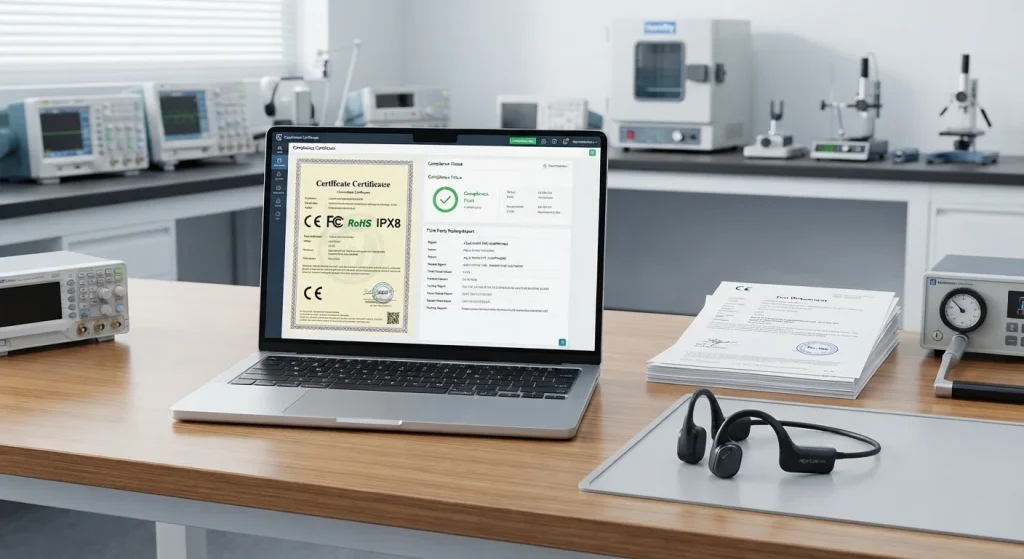
Quick Answer
When evaluating a qualified bone conduction headphones manufacturer for Amazon or other global e-commerce markets, buyers should not simply ask for a list of “certificates.” The required documentation depends on the destination market, wireless functions, battery configuration, and product claims.
For Bluetooth headphones, an Amazon-ready supplier should be able to provide applicable FCC compliance documentation for the U.S. market and appropriate EU conformity documentation for European sales. Depending on the product and market, buyers may also need RoHS compliance evidence, REACH-related documentation, battery safety and transport documents such as UN 38.3 test summaries and SDS, and product-specific waterproof test reports for models marketed with IPX8 or swimming claims.
The most important point is to verify that the documentation matches the exact product model, hardware configuration, battery, and private-label version being purchased.
What Documents Should an Amazon Headphones Supplier Provide?
One of the most common mistakes when sourcing electronics is treating every compliance document as a “certificate.” In practice, a supplier may provide different types of evidence, including declarations, laboratory test reports, regulatory authorizations, and battery transportation documents.
For an Amazon seller, the following documents are commonly relevant when evaluating a china bone conduction headphones factory:
| Document / Compliance Evidence | Typical Scope | Main Purpose |
|---|---|---|
| EU Declaration of Conformity | European Union | Declares conformity with applicable EU legislation |
| FCC Authorization / Compliance Documentation | United States | Demonstrates applicable RF compliance for Bluetooth products |
| RoHS Compliance Documentation | EU / applicable markets | Demonstrates compliance with restricted substance requirements |
| REACH Documentation | EU | Supports applicable chemical substance obligations |
| UN 38.3 Test Summary | Global battery transportation | Demonstrates lithium battery transport testing |
| SDS / MSDS | Logistics and safety | Provides battery/material safety information |
| IEC 62133 Test Report | Rechargeable battery safety | Provides evidence of battery safety testing where applicable |
| IPX8 Test Report | Waterproof / swimming products | Supports specific waterproof performance claims |
The exact document set should always be determined according to the destination market and product configuration rather than assuming that every headphone model requires every document.
CE Compliance: What Should Buyers Actually Request?
For headphones sold in the European Economic Area, CE compliance is an important part of the regulatory process.
However, buyers should understand that CE is not simply a certificate issued by an EU government agency. The manufacturer is responsible for identifying the applicable EU legislation, carrying out the required conformity assessment, preparing technical documentation, issuing the EU Declaration of Conformity, and affixing the CE marking when applicable.
For Bluetooth headphones, the applicable EU requirements can include legislation covering radio equipment and electromagnetic compatibility, depending on the product configuration.
Therefore, instead of asking a supplier only:
“Do you have CE certification?”
a more useful request is:
“Please provide the EU Declaration of Conformity and the applicable supporting test reports for this exact model.”
Buyers should check that the documents identify the correct:
- Product model
- Manufacturer
- Product description
- Applicable EU legislation
- Relevant standards
- Testing or conformity assessment information
- Date and responsible signatory
A supplier-issued document that simply displays a CE logo is not sufficient evidence by itself.
FCC Compliance for Bluetooth Headphones
For Bluetooth headphones sold on Amazon.com, FCC compliance is particularly important because Bluetooth products are considered radio frequency devices.
Amazon states that RF devices offered for sale on Amazon must comply with applicable FCC requirements. For relevant listings, sellers may need to provide FCC authorization evidence, such as an FCC certification number or Responsible Party information, through Amazon’s FCC Radio Frequency Emission Compliance attribute.
This means an Amazon buyer should not simply ask:
“Does the supplier have FCC?”
Instead, ask for the applicable FCC compliance documentation and verify that it corresponds to the actual product.
For Bluetooth bone conduction headphones, buyers should pay particular attention to:
- FCC ID or applicable authorization information
- Product model
- Bluetooth module
- RF-related hardware
- Responsible Party information where applicable
- Testing documentation
- Whether the tested configuration matches the final product
This is especially important when a factory has multiple versions of the same headphone platform.
A supplier may have a valid FCC report for one hardware configuration while supplying another configuration under a similar model name.
RoHS and REACH: Do They Mean the Same Thing?
No.
RoHS and REACH should not be treated as interchangeable certificates.
RoHS restricts specified hazardous substances in electrical and electronic equipment, including substances such as lead, cadmium, mercury and certain flame retardants and plasticisers, subject to applicable concentration limits and exemptions.
REACH is a broader EU chemicals framework covering areas such as the registration, evaluation, authorization and restriction of chemical substances.
For an Amazon seller sourcing private-label electronics, the supplier should therefore be able to explain what documentation is available for:
- Restricted substances
- Materials and components
- Plastics
- Batteries
- Cables and electronic assemblies
- Applicable REACH substance obligations
Do not assume that a single “RoHS certificate” automatically proves complete REACH compliance.
The documentation should be reviewed according to the product, components, market, and applicable regulatory requirements.
Do IPX8 Headphones Need a Waterproof Test Report?
Not every pair of headphones requires an IPX8 test report.
The need for waterproof testing becomes particularly important when a product is marketed with a specific IP rating or claims such as:
- IPX7
- IPX8
- Waterproof
- Swimming headphones
- Underwater audio
- Suitable for swimming
For IPX8 waterproof bone conduction headphones, buyers should request a product-specific waterproof test report that supports the claimed level of protection.
The report should identify the tested product and, where possible, include:
- Exact model number
- Test standard or method
- Test conditions
- Immersion conditions
- Test date
- Laboratory information
- Test result
- Product identification
Using a laboratory accredited to ISO/IEC 17025 can provide additional confidence in the laboratory’s competence, but buyers should not confuse laboratory accreditation with the IPX8 rating itself.
In other words:
IPX8 is a product performance claim supported by testing; ISO/IEC 17025 relates to the competence of the testing laboratory.
This distinction is particularly important when sourcing swimming headphones or other waterproof sports audio products.
What Battery Documents Should a Headphones Supplier Provide?
Most modern Bluetooth headphones use rechargeable lithium-ion batteries, so battery documentation should be reviewed separately from general electronic product compliance.
UN 38.3 Test Summary
UN 38.3 relates specifically to lithium battery transportation testing.
For an Amazon seller importing headphones internationally, the supplier should be able to provide the applicable UN 38.3 test summary before shipment planning.
The battery information should match the actual battery used in the headphones.
SDS / MSDS
An SDS provides safety information about a material or product and may be requested during logistics, customs, or dangerous-goods handling processes.
However, an SDS should not be treated as a replacement for UN 38.3 transportation testing.
IEC 62133
IEC 62133 relates to the safety of portable sealed secondary cells and batteries containing alkaline or other non-acid electrolytes.
Where applicable, an IEC 62133 test report can provide additional evidence concerning rechargeable battery safety.
Therefore, these documents should be treated as serving different purposes:
| Document | Main Purpose |
|---|---|
| UN 38.3 Test Summary | Lithium battery transportation compliance |
| SDS / MSDS | Safety and hazard information |
| IEC 62133 Test Report | Rechargeable battery safety evidence |
This distinction helps buyers avoid asking for “one battery certificate” when several different documents may serve different compliance purposes.
Certificate vs. Test Report vs. Declaration: What Is the Difference?
This distinction is one of the most important things an Amazon buyer should understand.
Declaration
A declaration, such as an EU Declaration of Conformity, is a formal statement of conformity made by the responsible manufacturer or economic operator under the applicable regulatory framework.
Test Report
A test report records the results of testing performed against a specified standard or test method.
Examples include:
- EMC test report
- Radio test report
- RoHS test report
- IPX8 test report
- IEC 62133 battery test report
Regulatory Authorization
Certain markets and product types require regulatory authorization or specific compliance information.
For U.S. Bluetooth/RF products sold on Amazon, FCC authorization information may be required under Amazon’s RF device listing requirements.
Transport Documentation
Documents such as a UN 38.3 test summary address lithium battery transportation requirements rather than general headphone product compliance.
Understanding these differences makes supplier verification much more reliable.
How Should Amazon Sellers Verify a Supplier’s Compliance Documents?
A document is only useful if it actually applies to the product being purchased.
Before placing a bulk order with a custom bone conduction headphones supplier, buyers should compare the compliance documentation against the physical product and purchase specifications.
1. Match the Exact Model Number
The model number on the test report should correspond to the actual product.
Do not automatically accept a report for a similar-looking model.
2. Check the Hardware Configuration
For Bluetooth headphones, verify whether the tested product uses the same:
- Bluetooth chipset or module
- PCB
- antenna
- battery
- charging circuit
- amplifier
- major electronic components
Hardware changes can affect the relevance of previous compliance testing.
3. Check the Battery Specification
Compare:
- Battery manufacturer
- Battery model
- Nominal voltage
- Capacity
- Cell type
- UN 38.3 documentation
The battery referenced in the documents should match the battery installed in production units.
4. Check Private-Label Information
If the product will be sold under your own brand, confirm how the private-label configuration relates to the original tested model.
A logo change may not have the same compliance implications as a hardware modification.
5. Check the Testing Laboratory
Verify:
- Laboratory name
- Laboratory address
- Accreditation information where relevant
- Report number
- Issue date
- Scope of testing
For important compliance claims, buyers can independently verify laboratory information rather than relying entirely on supplier screenshots.
6. Check Whether the Documentation Is Current
Compliance documentation should be reviewed whenever there are changes to:
- Product design
- Components
- Battery
- Wireless module
- Applicable regulations
- Harmonised standards
Amazon Headphones Supplier Compliance Checklist
Before approving a supplier, Amazon sellers and procurement teams can use the following checklist:
- ☐ Exact product model identified
- ☐ EU Declaration of Conformity available where applicable
- ☐ Applicable FCC compliance documentation available for U.S. Bluetooth/RF products
- ☐ RoHS compliance evidence available where applicable
- ☐ REACH-related documentation reviewed where applicable
- ☐ UN 38.3 test summary available for lithium battery transportation
- ☐ SDS / MSDS available as required for logistics
- ☐ IEC 62133 documentation reviewed where applicable
- ☐ IPX8 test report available if the product makes IPX8 or swimming claims
- ☐ Battery model matches production samples
- ☐ Bluetooth module matches the tested configuration
- ☐ Model number matches the compliance documentation
- ☐ Private-label configuration has been reviewed
- ☐ Laboratory information can be independently verified
- ☐ Documents are current and traceable
This checklist can help buyers identify documentation gaps before committing to a large MOQ.
Buyer Tips for Sourcing from a Bone Conduction Headphones Manufacturer
When evaluating a bone conduction headphones manufacturer, buyers should focus on traceability rather than simply counting certificates. For brands developing customized products, understanding the manufacturer’s OEM capabilities is equally important because compliance documentation needs to remain aligned with the final product configuration.
Ask for product-specific documentation
A factory may have dozens of compliance reports covering different products. The important question is whether the documentation applies to the exact model you intend to purchase.
Verify the underlying report
Do not rely only on a certificate image supplied through email or messaging software. Review the report number, laboratory information, model number and testing scope.
Review documents before production
Compliance verification should happen before the purchase order or mass production stage, not after the products have already been manufactured.
Control changes after approval
If the supplier changes the Bluetooth module, battery, PCB or other significant components, ask whether the existing compliance documentation remains applicable.
Keep your own compliance records
Amazon sellers should retain copies of relevant supplier documentation, product specifications, invoices, test reports and product identification records for future compliance reviews.
Common Mistakes When Choosing an Amazon Headphones Supplier
1. Treating Every Document as a Certification
A test report, declaration, authorization and transport document have different purposes.
2. Accepting a Generic Report
A report for a similar model does not automatically prove compliance of the exact product being purchased.
3. Checking Only the Logo
A CE logo, FCC logo or laboratory logo does not provide enough information to establish product-specific compliance.
4. Ignoring Hardware Changes
Changing the Bluetooth module, battery or PCB can affect the relevance of existing compliance documentation.
5. Treating IPX8 as a Universal Requirement
IPX8 documentation is particularly relevant when a product makes an IPX8, waterproof or swimming-related claim. It should not be presented as a universal requirement for every headphone.
6. Combining All Battery Documents Into One Category
UN 38.3, SDS and IEC 62133 serve different purposes. Buyers should verify each document according to its intended use.
7. Waiting Until Shipment to Review Compliance
Discovering documentation problems after production or before shipment can create avoidable delays and additional costs.
Frequently Asked Questions
What certifications should an Amazon headphones supplier provide?
The exact documentation depends on the destination market and product configuration. For Bluetooth headphones, buyers commonly request applicable FCC compliance documentation for the U.S., EU conformity documentation for European sales, RoHS evidence, battery transport documentation such as a UN 38.3 test summary, and product-specific waterproof testing when IPX8 or swimming claims are made.
Does a Bluetooth headphone need FCC compliance documentation for Amazon?
Bluetooth headphones are RF devices, and Amazon requires applicable FCC compliance information for RF device listings on Amazon.com. Depending on the applicable FCC authorization pathway, sellers may need to provide an FCC certification number or Responsible Party information through Amazon’s compliance system.
Is CE certification required for headphones sold in Europe?
CE marking applies when the product is covered by applicable EU harmonisation legislation that requires it. For relevant electronic and radio products, the manufacturer must complete the applicable conformity assessment process and prepare the EU Declaration of Conformity before affixing the CE marking.
Why are UN 38.3 test summaries important for Bluetooth headphones?
Bluetooth headphones commonly contain lithium batteries. UN 38.3 testing addresses the transportation safety requirements for lithium cells and batteries, and the applicable test summary should be available for the battery type being transported.
Does an IPX8 headphone need a waterproof test report?
If a product is marketed with an IPX8 or swimming-related waterproof claim, buyers should request product-specific testing evidence that supports the claimed protection level. The report should identify the tested product and test conditions.
How can buyers verify electronic compliance certificates?
Buyers should check the model number, manufacturer, hardware configuration, battery information, report number, testing laboratory, issue date and testing scope. Where appropriate, laboratory accreditation and report information should also be independently verified.
Final Takeaway
Choosing an Amazon headphones supplier requires more than asking whether a factory has CE, FCC or RoHS certificates.
A professional supplier should be able to provide product-specific compliance documentation appropriate to the destination market and product configuration. Depending on the product, this may include an EU Declaration of Conformity, applicable FCC compliance documentation, RoHS and REACH-related evidence, UN 38.3 battery transportation documentation, SDS, battery safety reports, and waterproof test reports for IPX8 or swimming products.
For buyers sourcing OEM bone conduction headphones or launching a private label audio product, the most important step is to verify that every document matches the actual product, hardware configuration, battery and branding being purchased. If you are evaluating an OEM or private-label headphone project and need to review product specifications, compliance documentation, or customization requirements, you can contact our team to discuss your project.
This approach can help reduce compliance risks, documentation gaps, customs delays and marketplace-related issues before a large MOQ investment is committed.